Research Highlights
Pennsylvania State University
Strong Exciton Regulation of Raman Scattering
The 2DCC-MIP team has developed an efficient first-principles way to calculate excitonic resonant Raman intensities, thereby explaining the puzzling near-absence of resonant Raman response around the A and B excitons (band-edge excitations with very strong optical absorption) and the pronounced strength of the resonant Raman response from the C exciton (which arises from parallel valence and conduction bands). These insights can now be carried to other semiconducting systems.
Pennsylvania State University
Local Optical Control Of Ferromagnetism And Chemical Potential In A Topological Insulator
Ferromagnetic topological insulators (TIs) have promise for applications in spintronics, metrology, and quantum computing. However, TI materials are fragile and often incompatible with nanofabrication techniques. We have developed a technique that enables persistent, micron-scale optical control of both magnetization and chemical potential in Cr-(Bi,Sb)2Te3 grown by MBE on SrTiO3.
Pennsylvania State University
Graphene and Beyond Workshop: 2016-2019 Summary
The 2DCC completed its 4th year of sponsorship of the Graphene and Beyond Workshop. To date, >650 individuals from academia, government and industry across all career levels have attended. The 2DCC has broadened participation by sponsoring travel and registration for dozens of users and potential users particular from MSIs and PUIs. The workshop enhances community synergy toward a strong future in 2D crystal science and technology.
Pennsylvania State University
Epitaxial growth of large area WSe2 monolayers by gas source chemical vapor deposition
Monolayer 2D transition metal dichalcogenides (TMDs) have been a focus of increasing interest due to their unique properties but the development of device technologies has been hampered by difficulties in synthesizing large area monolayer and few layer films. We developed a multi-step process involving nucleation, ripening and preferential lateral growth to achieve epitaxial WSe2 monolayers on sapphire by gas source chemical vapor deposition.
Pennsylvania State University
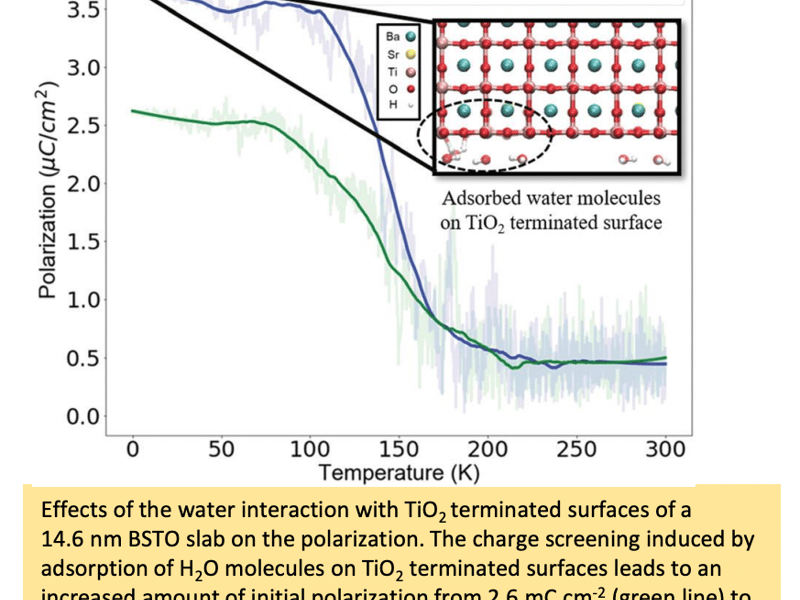
Understanding the physical chemistry properties of BaxSr1-xTiO3 using ReaxFF based Molecular Dynamics Simulations
In order to expand the ReaxFF capability for support material simulations, the 2DCC group has extended a previously developed ReaxFF parameter set for BaTiO3 to SrTiO3 (STO) – a highly relevant support material for 2D-chalcogenide growth.
Cornell University
“Band-Structure Engineering” of Quantum Materials to Create a new Superconductor
J.P. Ruf, H. Paik, N.J. Schreiber, H. P. Nair, L. Miao, J.K. Kawasaki, J.N. Nelson, B.D. Faeth, Y. Lee, B.H. Goodge, B. Pamuk, C.J. Fennie, L.F. Kourkoutis, D.G. Schlom, K.M. Shen
One Materials-by-design commonly starts with first principles theory to identify materials with desired properties. The significant energetic contribution of electron-electron interactions, however, makes it difficult for theory to accurately predict quantum materials. Experimental tools like ARPES that measure electronic band structure directly used in combination with synthesis tools like MBE make it possible to enter the materials-by-design loop from a different on-ramp and navigate quantum materials to achieve desired properties.
Pennsylvania State University
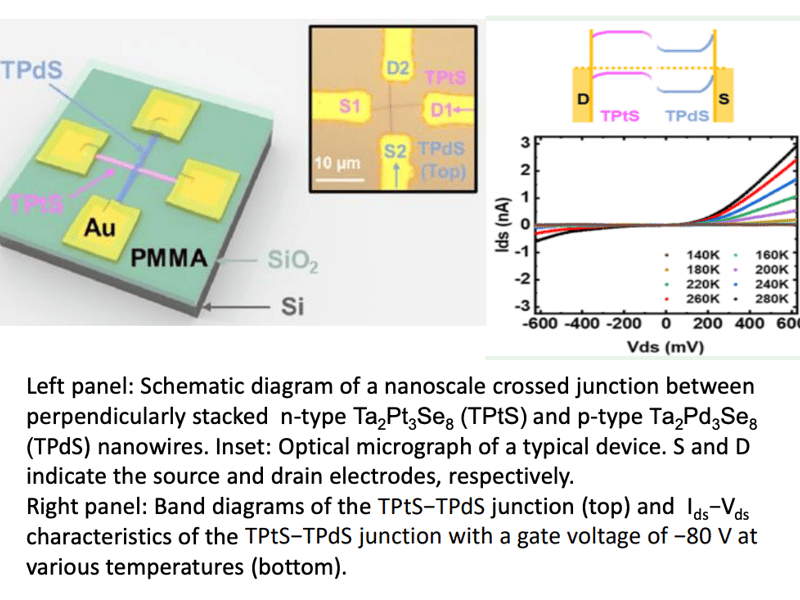
Tunneling Effects in Crossed Ta2Pt3Se8−Ta2Pd3Se8 Nanowire Junctions: Implications for Anisotropic Photodetectors
This study not only offers a way to build nanoscale junctions but also provides fundamental understandings of the electronic and optoelectronic properties of vdW nanowires and their heterojunctions.
Pennsylvania State University
New Theory Tools for Modeling Growth of TMD Materials
The first ReaxFF force field developed for 2D-WSe2 provides the community with a highly efficient means that describe material growth, phase transitions, defect formation and migration and thus can provide valuable atomistic insights into experimental efforts on growth, phase, and defect engineering as a function of the local chemical environment. This potential can elucidate further the morphological evolution of monolayers in different environments in terms of loading conditions and defect concentrations/distributions. Interactions between vacancies and ripples in a 2D layers (“ripplocations”) suggest that vacancies could stabilize buckled structures by modulating the strain energy and possibly open a venue for sweeping out undesirable defects such as vacancies from 2D WSe2.
Pennsylvania State University
Coupling Distinct Defect Species In 2D Crystals
Doping modulates the electronic, chemical, and mechanical properties of materials. For a two-dimensional tungsten disulfide, although an isolated molybdenum substitution only perturbs the host lattice negligibly, it couples strongly to common lattice defects such as sulfur vacancies, as verified by state-of-the-art electron microscopy and atomistic modeling techniques.
Pennsylvania State University
Origami Without Fingers
Origami with regular paper can produce a limitless number of fascinating, beautiful and useful shapes, but we lack “fingers” at the nanoscale to guide the folding. Researchers in the Two-Dimensional Crystal Consortium at Penn State have conceived and simulated a novel way to “program” a folding pattern by patterning the nanoscale sheet with complementary regions of n-type and p-type doping.
Showing 221 to 230 of 237