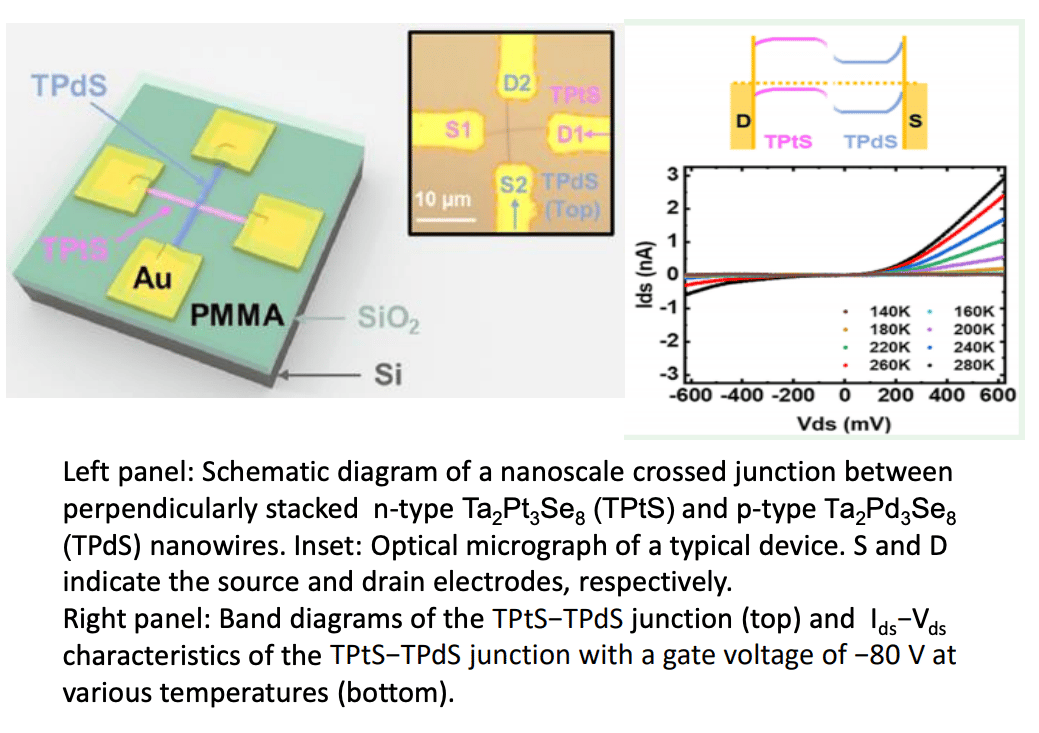
Transition metal dichalcogenides (TMDCs) with van der Waals gaps (vdW) have been a subject under extensive studies, since 2D thin layers of these materials exhibit a plethora of technologically useful properties, e.g. large direct band gap and high photoresponsibility. Quasione-dimensional (1D) transition metal vdW materials are also predicted to not only inherit some features of 2D TMDCs, such as strong light - matter coupling and thickness-dependent band gaps, but also possess unique thermal, electrical, and optical properties due to their distinctive chain structures. However, quasi-1D vdW materials are less experimentally explored. Yaqiong Xu’s group at Vanderbilt University recently demonstrated nanoscale crossed p-n junctions formed by two quasi-1D vdW materials, i.e.
p-type Ta2Pd3Se8 (TPdS) and n-type Ta2Pt3Se8 (TPtS). Such p-n junctions exhibit asymmetric nonlinear output behaviors, inelastic tunneling effects, and isotropic photocurrent signals. This study not only offers a way to build nanoscale junctions but also provides fundamental understandings of the electronic and optoelectronic properties of vdW nanowires and their heterojunctions.
p-type Ta2Pd3Se8 (TPdS) and n-type Ta2Pt3Se8 (TPtS). Such p-n junctions exhibit asymmetric nonlinear output behaviors, inelastic tunneling effects, and isotropic photocurrent signals. This study not only offers a way to build nanoscale junctions but also provides fundamental understandings of the electronic and optoelectronic properties of vdW nanowires and their heterojunctions.
 Download

2D Crystal Consortium - Materials Innovation Platform (2DCC-MIP)
The 2DCC-MIP combines a vibrant in-house research effort focused on transformative advances in the synthesis and characterization of 2D chalcogenide layered materials with a robust external user program that provides access to expertise and state-of-the-art facilities. The 2DCC-MIP platform enables cutting edge research and discovery, across in-house research and the user program, on the synthesis and characterization of 2D chalcogenide materials by a national user community guided by four science drivers: Physics of 2D Systems, Epitaxy of 2D Chalcogenides, Next-generation 2D Electronics, and Advanced Characterization and Modeling.