Research Highlights
Pennsylvania State University
Ferromagnetism in van der Waals compound MnSb1.8Bi0.2Te4
MnBi2Te4 has recently been established as the first intrinsic antiferromagnetic (AFM) topological insulator. Although quantum anomalous Hall effect (QAHE) has been observed in MnBi2Te4, it is only realized with odd numbers of septuple layers due to the AFM interlayer coupling. Therefore, it is crucial to stabilize ferromagnetic (FM) phase in MnBi2Te4. We have discovered a new FM phase with the Curie temperature of 26 K in the MnSb1.8Bi0.2Te4 sample through tuning growth conditions, in contrast to the AFM order seen in the Mn(Bi1-xSbx)2Te4 family.
Pennsylvania State University
Unveiling Intervalley Scattering In 2D Crystals
Double resonance in two-dimensional MoS2 reveals the dynamics of excitons – robust elementary excitations of a 2D crystal – between two sets of low-energy states known as valleys. The accurate assignment of vibrational signatures elucidates the essential physics limiting the performance of a novel class of “valleytronic” devices exploiting the selectivity of valleys to incident light carrying different polarizations.
Pennsylvania State University
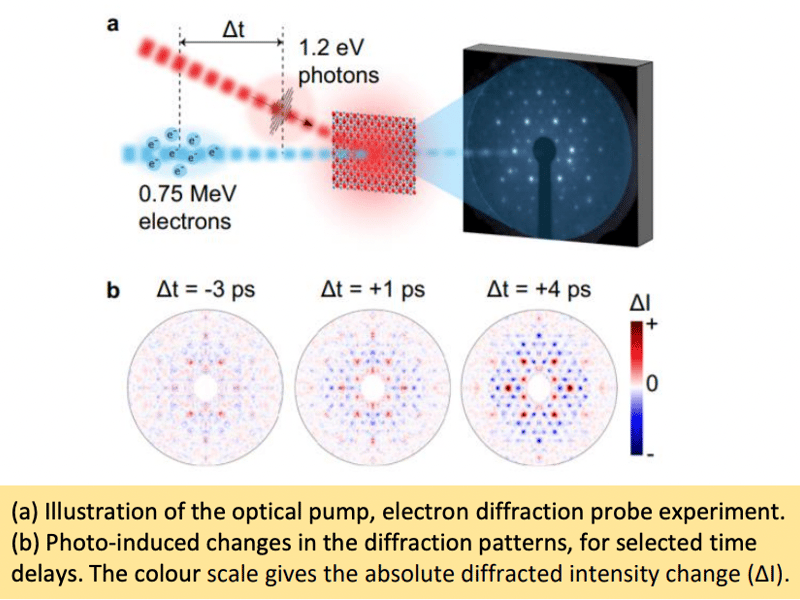
Ultrafast optical melting of trimer superstructure in layered 1T′-TaTe2
The Kaindl group at Lawrence Berkeley National Lab recently reported the ultrafast investigation of 1T’-TaTe2, demonstrating a rapid picosecond melting of its trimer cluster lattice superstructure in the low temperature phase.
Pennsylvania State University
Room-temperature spin-orbit torque switching induced by a topological insulator
While previous studies show a large discrepancy of the charge-spin conversion efficiency in topological insulators (TI), the 2DCC research group reports spin-orbit torque switching in a TI-ferrimagnet heterostructure with perpendicular magnetic anisotropy at room temperature.
Pennsylvania State University
Graphene and Beyond Workshop - 2017 Edition
The Graphene and Beyond Workshop, in its 5th year (2nd year of joint sponsorship with 2DCC), is a collaboration between the Center for 2D and Layered Materials (2DLM) and the 2DCC-MIP at Penn State. The workshop aims to enhance synergy in the community and build toward a strong future in 2D crystal science and technology.
Pennsylvania State University
Observation of Axion Physics in Condensed Matter
The strongly spin-momentum coupled electronic states on the surfaces of topological insulators (TIs) exist because of time-reversal symmetry. The theoretical description of these states is fundamentally analogous to a picture used to describe particles known as ‘axions’ theoretically postulated to exist in Nature but never observed. Demonstrating and understanding this conceptual analogy is important for gaining new insights into how our universe works.
Pennsylvania State University
Sticking coefficients of selenium and tellurium
The sticking coefficients of thermally evaporated chalcogen elements selenium and tellurium were experimentally determined as a function of temperature. Their direct and quantitative determination provides important insights to comprehend and realistically model the growth kinetics of chalcogenide-based film growth.
Pennsylvania State University
Epitaxial Growth of Large Area WSe2 Monolayers By Gas Source Chemical Vapor Deposition
Monolayer 2D transition metal dichalcogenides (TMDs) have been a focus of increasing interest due to their unique properties but the development of device technologies has been hampered by difficulties in synthesizing large area monolayer and few layer films. We developed a multi-step process involving nucleation, ripening and preferential lateral growth to achieve epitaxial WSe2 monolayers on sapphire by gas source chemical vapor deposition.
Cornell University
1st Forum on NSF-DMR Materials Innovation Platforms
Materials Innovation Platforms (MIPs): are user facilities dedicated to accelerating materials discovery by providing a community of practitioners with access to cutting edge tools in theory, synthesis, and characterization and the ability to share knowledge effortlessly. MIPs are funded by the National Science Foundation (NSF) and are freely available to users from universities and national laboratories in the United States—from scientists just beginning their careers to seasoned experts—from all institutions.:
Pennsylvania State University
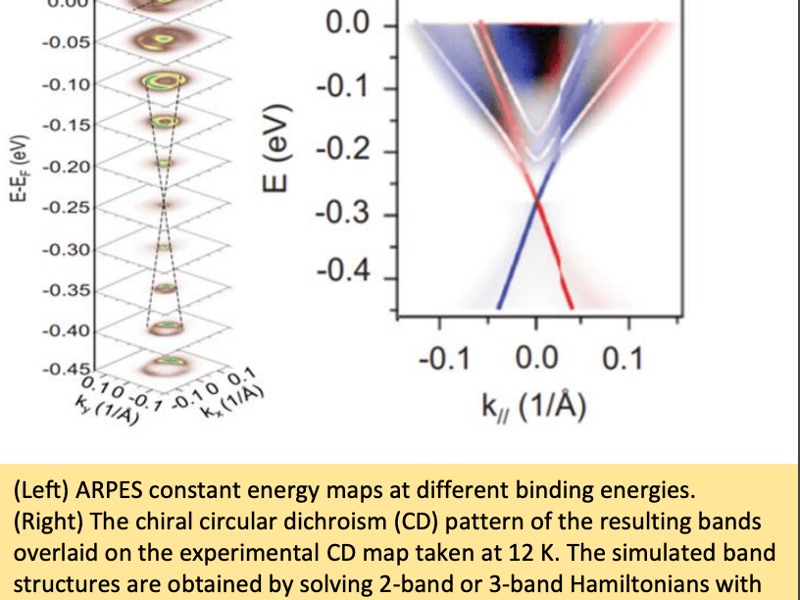
Origins of electronic bands in the antiferromagnetic topological insulator MnBi2Te4
Through an in-depth investigation by ARPES experiment and the numerical calculations, an upper bound of 3 meV for the gap size of the topological surface state (TSS) is estimated. Furthermore, we also reveal band chiralities for both the TSS and quasi-2D bands, which can be well reproduced in a band hybridization model based on the circular dichroism measurements.
Showing 211 to 220 of 237