Research Highlights
Aug 1, 2026
Cornell University
Collaboration - Growth of Nickelate Superconductor Alliance
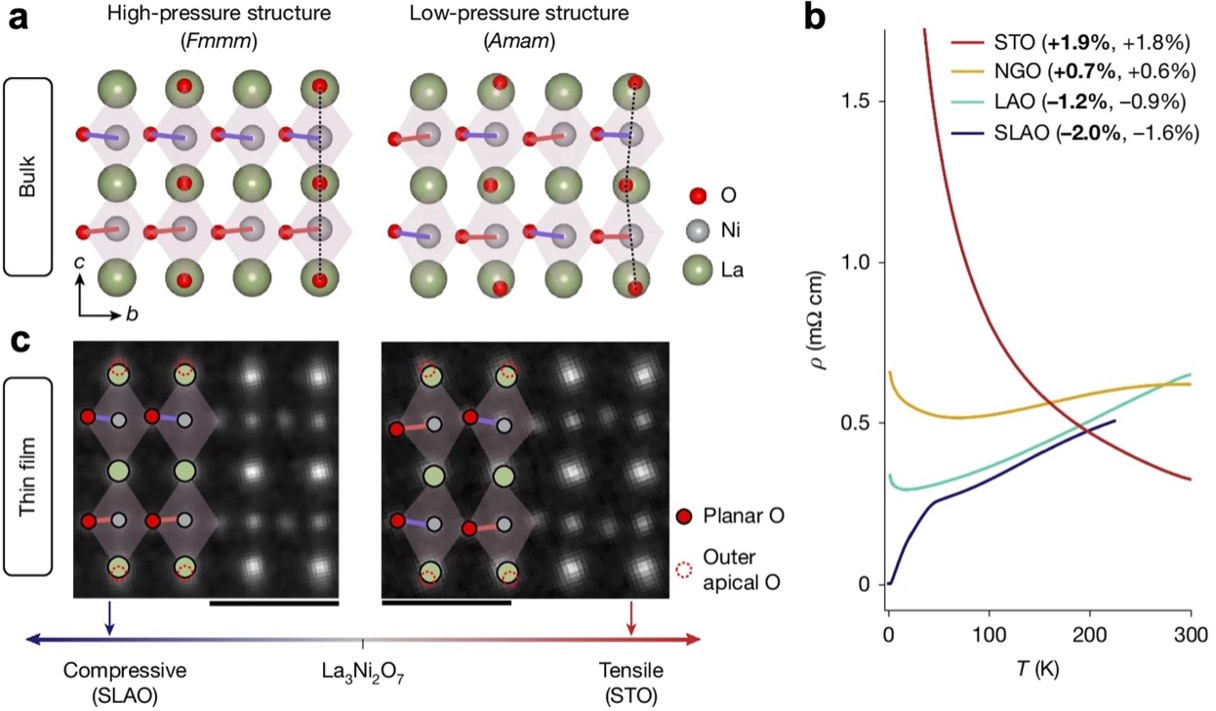
PARADIM Highlight #121 reports a collaborative study of La3Ni2O7 thin films under epitaxial strain, showing in-plane compression induces superconductivity. Using multislice electron ptychography, XRD, and STEM, researchers link Ni–O bond-angle distortions and symmetry lifting to cuprate-like Fermiology, hinting at new paths and improved superconducting transitions.
May 1, 2026
Cornell University
Unconventional polaronic ground state in superconducting LiTi2O4
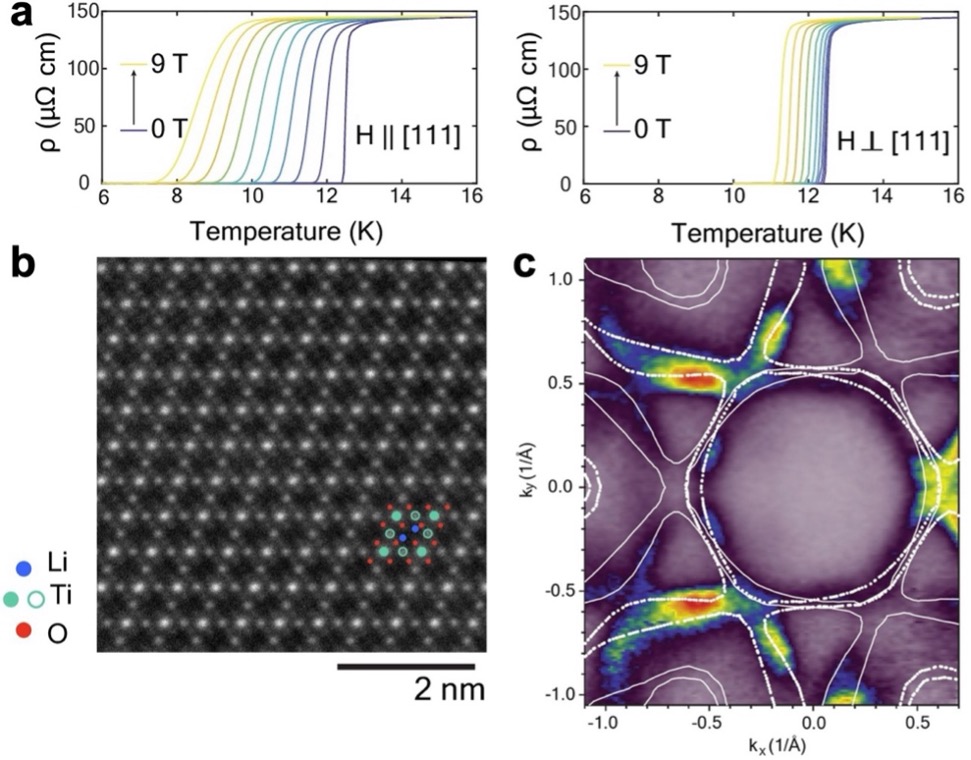
PARADIM Highlight #119 reports LiTi2O4 superconductivity revealing an unconventional polaronic ground state from multimodal studies (ARPES, RIXS, probes, DFT). Strong electron-electron and electron-phonon coupling coexist, challenging conventional BCS. Demonstrates correlated phenomena in half-valence spinels and showcases PARADIM’s MBE+ARPES platform.
Feb 1, 2026
Cornell University
Electron Microscopy Pioneer Inducted into National Academy of Engineering
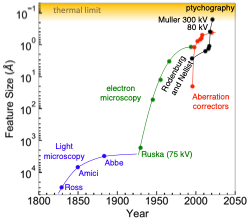
David A. Muller’s work combines a highly sensitive, high-dynamic-range electron-microscope pixel-array detector (EMPAD) with ptychography and multislice algorithms, achieving the world’s highest resolution microscope. PARADIM contributed throughout, with detectors and training; the 0.2 Å images approach atomic-vibration limits. Muller was elected to the National Academy of Engineering in 2026.
Feb 1, 2026
Cornell University
Realizing Record Electro-Optic Response at Cryogenic Temperatures
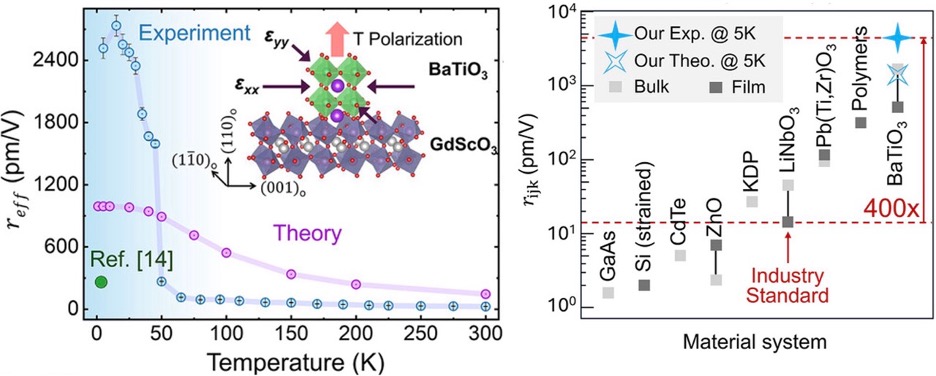
PARADIM researchers engineered strain-tuned BaTiO3 thin films to stabilize a metastable monoclinic phase with exceptional cryogenic electro-optic response. They measured 2516 ± 100 pm/V at 5 K, 100× higher as temperature drops, using adsorption-controlled growth and high-temperature MBE. This enables large, low-field beam steering for quantum applications; patent filed.
Feb 1, 2026
Cornell University
Understanding Misfits—Theory and Measurement unravel 50+ Years of Mystery
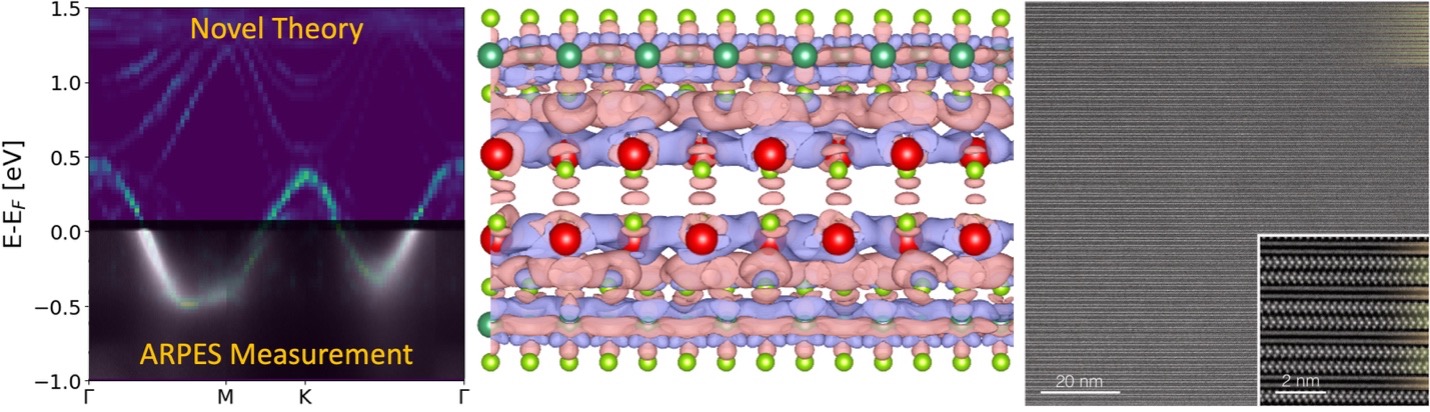
PARADIM’s In-House Team developed MINT, an ab initio framework for mismatched layered materials, revealing that apparent doping in misfit rock-salt/TMD structures arises from intra-layer electron rearrangement, not net interlayer charge transfer. Theory agrees with ARPES; framework enables first-principles study of superconductivity, transport, and thermoelectric properties in incommensurate systems.
Nov 1, 2025
Cornell University
High-Temperature Superconductivity in New Nickelate at 1 atm Pressure
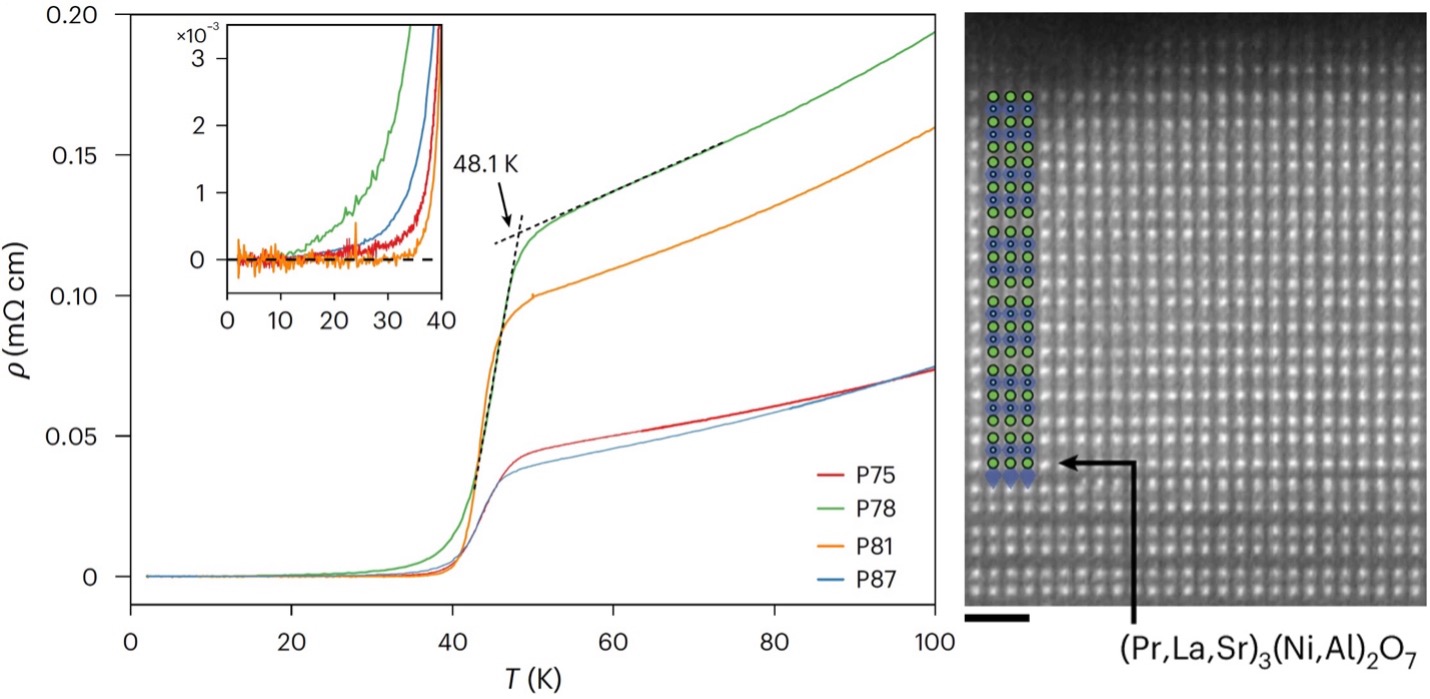
PARADIM Highlight #113 reports ambient-pressure superconductivity in compressively strained La2PrNi2O7 thin films, achieved via Pr substitution, growth optimization, and ozone annealing. Onset above 48 K with zero resistance above 30 K; high critical current. Atomic-resolution EM reveals film-substrate interface details, defects, and oxygen’s key role.
![<p><em>Figure 1.<strong> Magnetic Resonant Scattering and X-Ray Absorption of La<sub>3</sub>Ni<sub>2</sub>O<sub>7</sub>. a) </strong>The crystal structure of La<sub>3</sub>Ni<sub>2</sub>O<sub>7,</sub> with the pseudo tetragonal axes a<sub>T</sub> and b<sub>T</sub> denoting the in-plane NiO bond directions. <strong>b)</strong> The intensity (scattering + background) for cuts along the (H, H, 1.86) direction through the SDW peak at various temperatures, measured at the Ni L<sub>3</sub> absorption edge with π incident polarization for sample A. Inset: SDW peak amplitude (red) and correlation length along the [1 1 0] direction (blue) as a function of temperature.</em></p>](https://www.paradim.org/sites/default/files/inline-images/MIP_112.jpg)
Nov 1, 2025
Cornell University
Shared Ingredient of High-Tc Superconductors: Spin Stripe Domains
PARADIM In-House researchers study La3Ni2O7 under pressure, where superconductivity above 80 K raises questions about common high-Tc mechanisms. Using resonant soft x-ray scattering and polarimetry on thin films, they find a unidirectional diagonal spin-stripe SDW in the NiO2 plane, with in-plane moments and no strong charge disproportionation.
Nov 1, 2025
Cornell University
Unconventional Superlattice Ordering in Intercalated Transition Metal Dichalcogenide
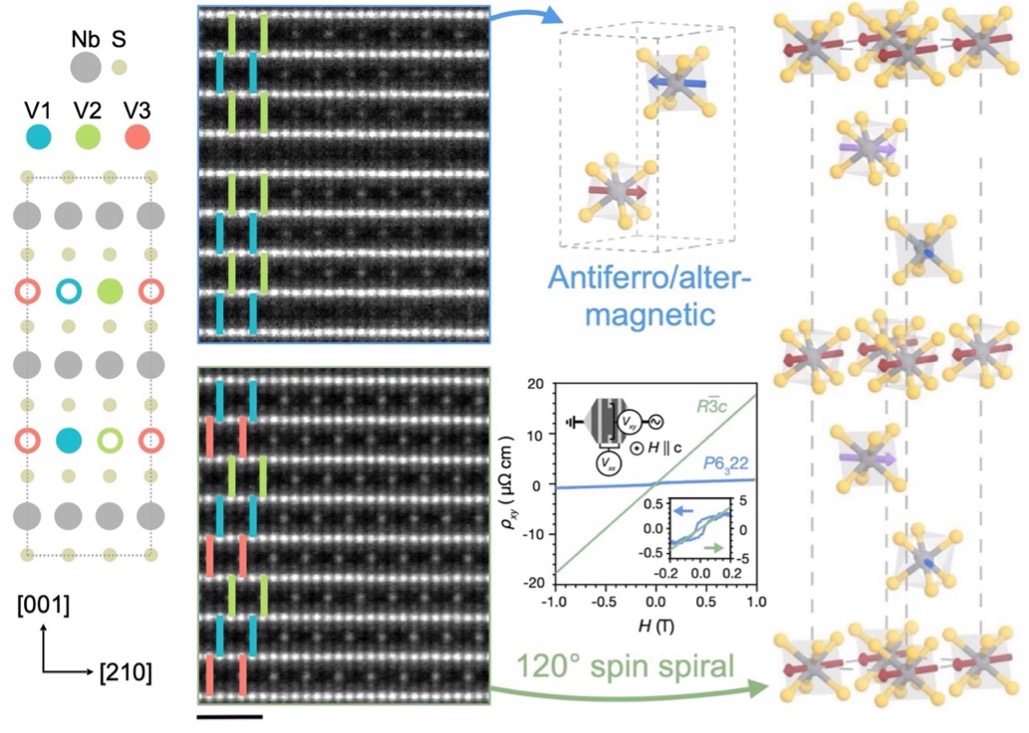
UC Berkeley researchers show V1/3NbS2 can crystallize into two ordered intercalant superlattices (ABAB and ABC) with distinct magnetism and electronics. One is metallic with altermagnetism; the other semimetallic noncollinear antiferromagnet with potential topological properties. This enables tunable magnetic/electronic states for spintronics and topological devices.
Sep 1, 2025
Cornell University
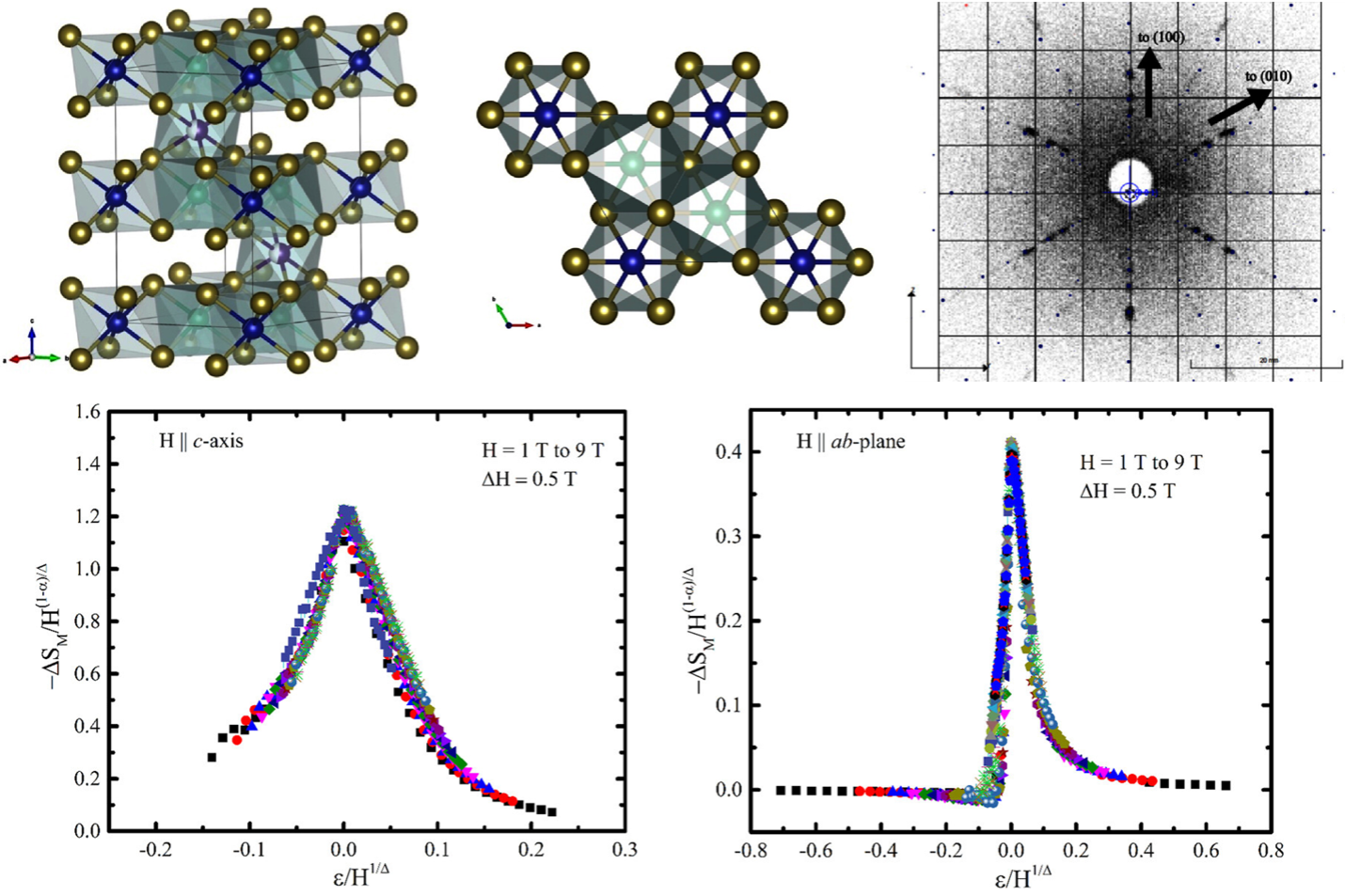
Intertwined Phases and Magnetocaloric Anisotropy in Cr2+xTe4
PARADIM researchers (Guchhait, Howard Univ.) explored Cr-Te layered phases CrTe2–Cr3Te4, synthesizing compositionally precise Cr2+xTe4 crystals to study magnetic properties. They found Cr2Te3 exhibits a large, anisotropic magnetocaloric effect at 170 K; thin films show ordering near 280 K, promising room-temperature magnetocaloric devices. CVT growth enabled precise interstitial ordering.

Sep 1, 2025
Cornell University
“Infinite Layer” Nickelates Superconduct even without Doping?
PARADIM's In-House team reports superconductivity with onset up to 11 K in high-crystallinity, undoped NdNiO2 thin films. Superconductivity appears when residual resistivity drops below the NiO2 sheet quantum resistance, suggesting intrinsic, clean-limit behavior akin to cuprates. Apical oxygens could also contribute; film quality is key.
Showing 1 to 10 of 237