An understanding of the surface chemistry of substrates used as support for 2D-chalcogenide growth is essential for controlling the synthesis of these materials. As such, we need computational methods that can be used to study the reaction dynamics of these support materials. The ReaxFF method which allows for relatively large (>> 10,000 atoms), long-time (>> 1 nanoseconds) fully reactive, fully dynamics simulations of complex materials and their interfaces
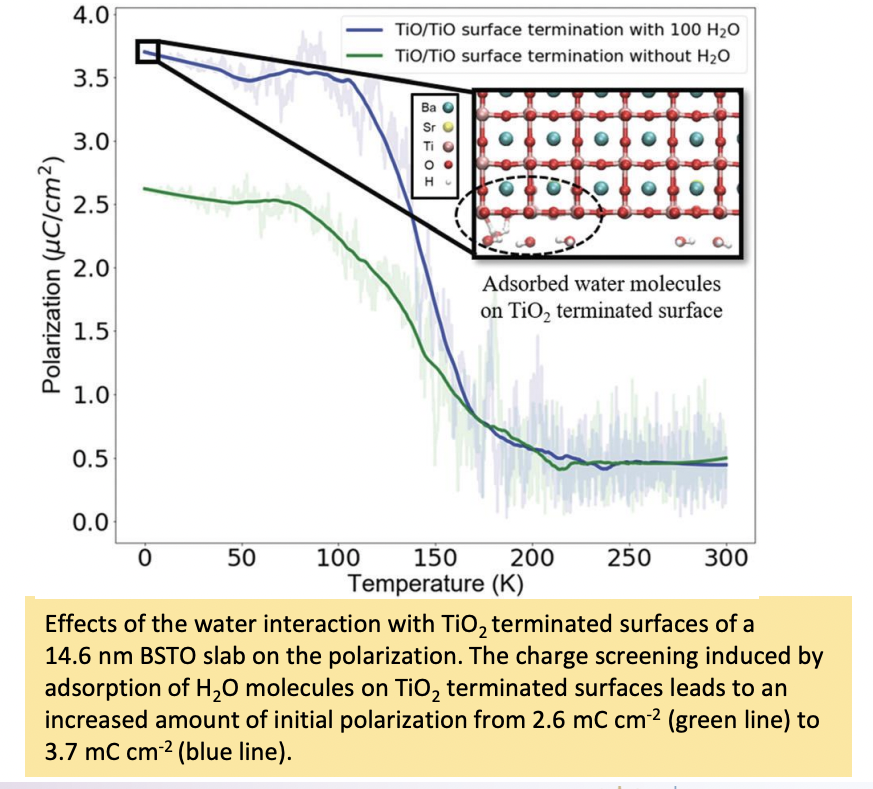
allows for atomistic-scale simulations that can directly connect to experimental synthesis efforts. In order to expand the ReaxFF capability for support material simulations, we have extended a previously developed ReaxFF parameter set for BaTiO3 to SrTiO3 (STO) – a highly relevant support material for 2D-chalcogenide growth. This ReaxFF description can be used for any Ba/Sr ratio and can describe key surface chemistry – including water vapor and oxidation/reduction reactions at the STO surface. These ReaxFF parameters were validated against Density Functional Theory (DFT) data and was validated be studying ferroelectric transitions in mixed Ba/SrTiO3 materials.
allows for atomistic-scale simulations that can directly connect to experimental synthesis efforts. In order to expand the ReaxFF capability for support material simulations, we have extended a previously developed ReaxFF parameter set for BaTiO3 to SrTiO3 (STO) – a highly relevant support material for 2D-chalcogenide growth. This ReaxFF description can be used for any Ba/Sr ratio and can describe key surface chemistry – including water vapor and oxidation/reduction reactions at the STO surface. These ReaxFF parameters were validated against Density Functional Theory (DFT) data and was validated be studying ferroelectric transitions in mixed Ba/SrTiO3 materials.
 Download

2D Crystal Consortium - Materials Innovation Platform (2DCC-MIP)
The 2DCC-MIP combines a vibrant in-house research effort focused on transformative advances in the synthesis and characterization of 2D chalcogenide layered materials with a robust external user program that provides access to expertise and state-of-the-art facilities. The 2DCC-MIP platform enables cutting edge research and discovery, across in-house research and the user program, on the synthesis and characterization of 2D chalcogenide materials by a national user community guided by four science drivers: Physics of 2D Systems, Epitaxy of 2D Chalcogenides, Next-generation 2D Electronics, and Advanced Characterization and Modeling.