Quasi-two-dimensional transition-metal dichalcogenides are a key platform for exploring emergent nanoscale phenomena arising from complex interactions. Access to the underlying degrees-of-freedom on their natural time
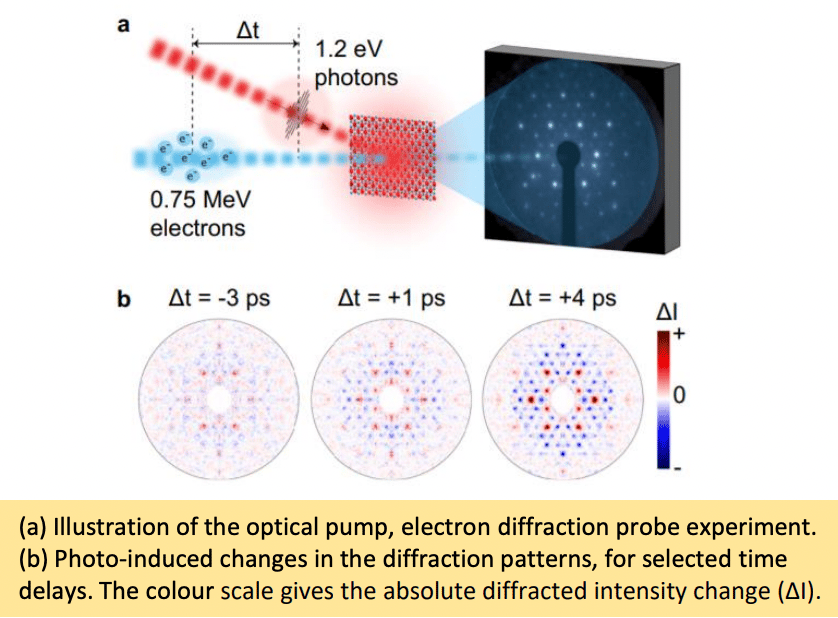
scales motivates the use of advanced ultrafast probes sensitive to self-organized atomic-scale patterns. The Kaindl group at Lawrence Berkeley National Lab recently reported the ultrafast investigation of 1T’-TaTe2 , demonstrating a rapid picosecond melting of its trimer cluster lattice superstructure in the low temperature (LT) phase. They observed photo-induced melting of the LT order on 1.4 ps timescale, indicative of fast switching, followed by recovery into a hot (3 × 3) trimer phase. Insight into the nature of trimer cluster melting is obtained via density functional calculations, which indicate an initial quench driven by charge-transfer transitions from bonding to non-bonding states of the Ta trimer—suggesting pathways for a photo-induced transition that is unique among the family of TaX2 materials. This work establishes TaTe2 as a promising material for optical control, motivating examination of concomitant electronic dynamics for device applications. Published in Communications Physics 4, 152 (2021).
scales motivates the use of advanced ultrafast probes sensitive to self-organized atomic-scale patterns. The Kaindl group at Lawrence Berkeley National Lab recently reported the ultrafast investigation of 1T’-TaTe2 , demonstrating a rapid picosecond melting of its trimer cluster lattice superstructure in the low temperature (LT) phase. They observed photo-induced melting of the LT order on 1.4 ps timescale, indicative of fast switching, followed by recovery into a hot (3 × 3) trimer phase. Insight into the nature of trimer cluster melting is obtained via density functional calculations, which indicate an initial quench driven by charge-transfer transitions from bonding to non-bonding states of the Ta trimer—suggesting pathways for a photo-induced transition that is unique among the family of TaX2 materials. This work establishes TaTe2 as a promising material for optical control, motivating examination of concomitant electronic dynamics for device applications. Published in Communications Physics 4, 152 (2021).
 Download

2D Crystal Consortium - Materials Innovation Platform (2DCC-MIP)
The 2DCC-MIP combines a vibrant in-house research effort focused on transformative advances in the synthesis and characterization of 2D chalcogenide layered materials with a robust external user program that provides access to expertise and state-of-the-art facilities. The 2DCC-MIP platform enables cutting edge research and discovery, across in-house research and the user program, on the synthesis and characterization of 2D chalcogenide materials by a national user community guided by four science drivers: Physics of 2D Systems, Epitaxy of 2D Chalcogenides, Next-generation 2D Electronics, and Advanced Characterization and Modeling.