Research Highlights
Cornell University
Quantification of Interfacial Electron-Phonon Coupling from Photoemission Replica Bands in a High-Tc Superconductor
Darrell G. Schlom, Kyle M. Shen
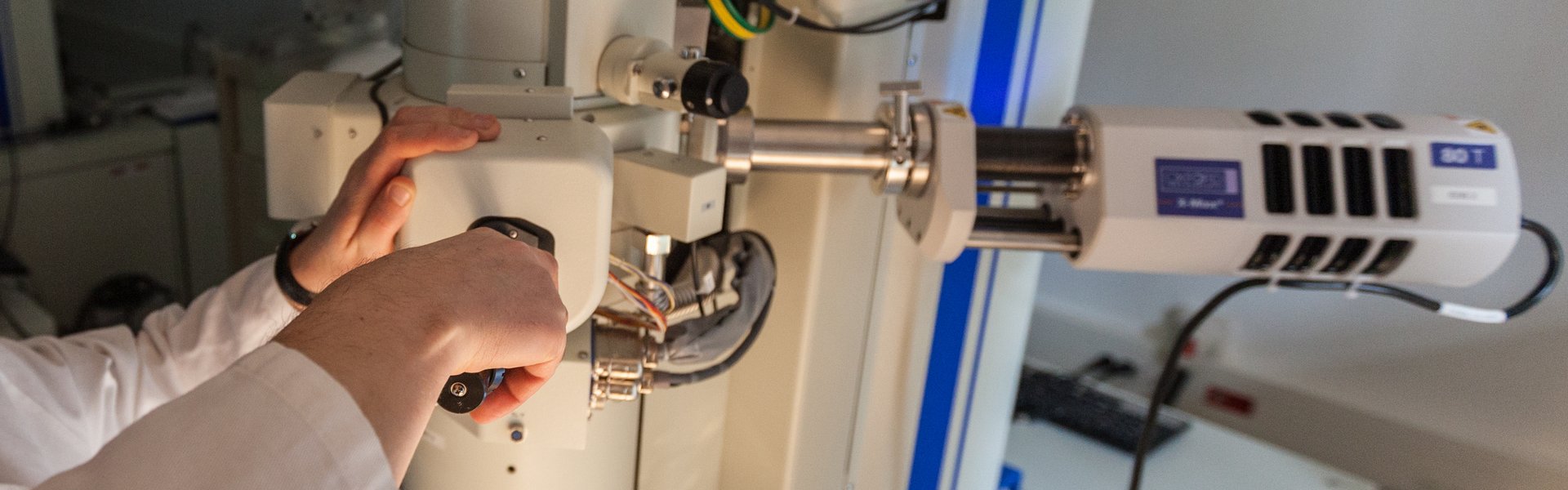
The PARADIM research team has developed a system to transfer sensitive samples from ultrahigh vacuum directly into an inert environment glovebox for transport to the Advance Light Source for beamline ARPES measurements.
Pennsylvania State University
Dual-sided Adsorption onto 2D
When an atomically thin 2D material is suspended as a membrane so that adsorbed atoms can stick to both sides, these atoms can interact through the membrane and thus act as two coupled adsorbate systems, with new properties that are absent in either system alone. Computational modeling in the 2D Crystal Consortium predicts new patterns that emerge, such as an infinite staircase of fractional coverages of opposing sides with simple rational fractions being favored, a so-called “Devil’s Staircase.”
Pennsylvania State University
Scalable Substitutional Re-Doping and its Impact on the Optical and Electronic Properties of Tungsten Diselenide
Doping is the cornerstone of semiconductor technology, enabling the success of modern digital electronics. Successful realization of wafer-scale, electronic grade, intrinsic 2D TMDCs via common deposition methods is rapidly progressing, however, advances in scalable doping still remain in the “proof-of-concept” stage, delaying the large-scale fabrication of logic circuits based on extrinsic 2D semiconductors. This work is presenting a wafer-scale synthesis of rhenium doping of WSe2 films via MOCVD at front-end-of-line (FEOL) and back-end-of-line (BEOL) compatible temperatures.
Pennsylvania State University
Multiphysics Model and Application Development for Controlled 2D Materials Growth
This review provided an overview of theoretical, computational, and machine learning methods and tools at multiple length and time scales, and how they can be utilized to assist/guide the design and synthesis of 2D materials. It focuses on three methods at different length and time scales.
Pennsylvania State University
Scientific Travel Extension Program For Outreach Representatives Working to Advance Research Diversity (STEPFORWARD)
STEPFORWARD is a geospatial tool built on Google Maps API to identify minority serving institutions (MSIs), primarily undergraduate institutions (PUIs) and non-R1 institutions within a geographical radius of travel. Higher Education R&D data highlights institutions active in research fields of interest. The tool enables 2DCC researchers and the broader community to identify a diverse range of institutions for outreach visits and research interactions. The 2DCC supports visits to these institutions as part of a travel extension program.
Pennsylvania State University
Studying the influence of a capping layer on interfacial superconductivity in FeSe/SrTiO3 heterostructures
Understanding the superconductivity at the interface of FeSe/SrTiO3 is a problem of contemporary interest in condensed matter physics because of the significant increase in the critical temperature (Tc ~ 50 K) for the onset of superconductivity compared to that of bulk FeSe crystals (Tc ~ 9 K). Additional interest in this problem arises from the possibility of an unconventional pairing mechanism. We used the 2DCC multimodule molecular beam epitaxy (MBE) and surface characterization facility to study the influence of various capping layers on the Tc of ultrathin films of FeSe grown on SrTiO3.
Pennsylvania State University
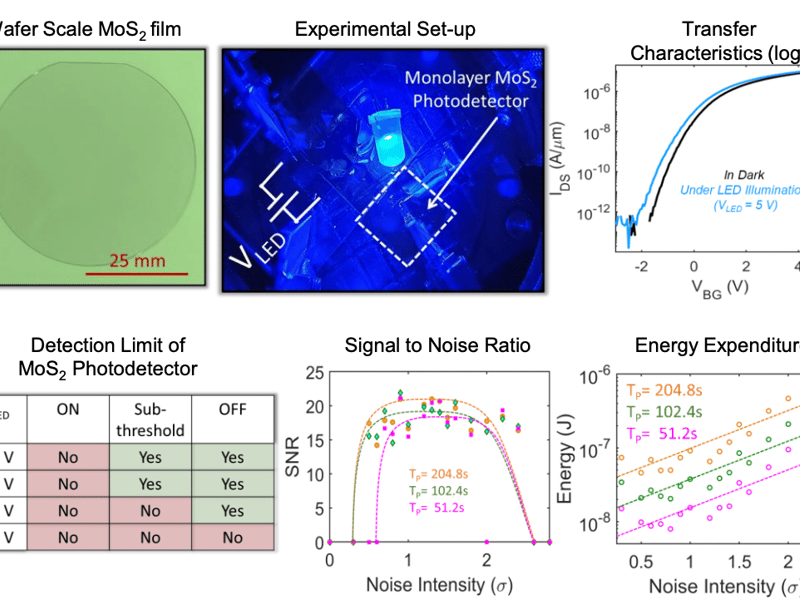
Stochastic Resonance In MoS2 Photodetector
In this project, we use a novel approach for next generation ultra-low-power sensor design by embracing the evolutionary success of animals with extraordinary sensory information processing capabilities that allow them to survive in extreme and resource constrained environments.
Pennsylvania State University
Evidence of 2D Room-temperature Magnetic Semiconductors
Dilute magnetic semiconductors, achieved through substitutional doping of magnetic atoms into semiconducting systems, enable experimental modulation of spin dynamics for novel magneto-electric or magneto-optical devices, especially in 2D transition metal dichalcogenides that accentuate interactions and activate valley degrees of freedom.
Pennsylvania State University
Topological Hall Effect in Topological Insulator/Magnetic Insulator Bilayer
The topological Hall effect (THE) is a phenomenon that is a consequence of a Berry phase created by spin textures in real space. Interfacing a topological insulator with a magnetic insulator provides a model platform for studying this phenomenon in a well-controlled manner. This paper reports the first clear evidence for the THE in heterostructures that combine a model topological insulator (Bi2Se3) with a ferromagnetic insulator (BaFe12O19).
Pennsylvania State University
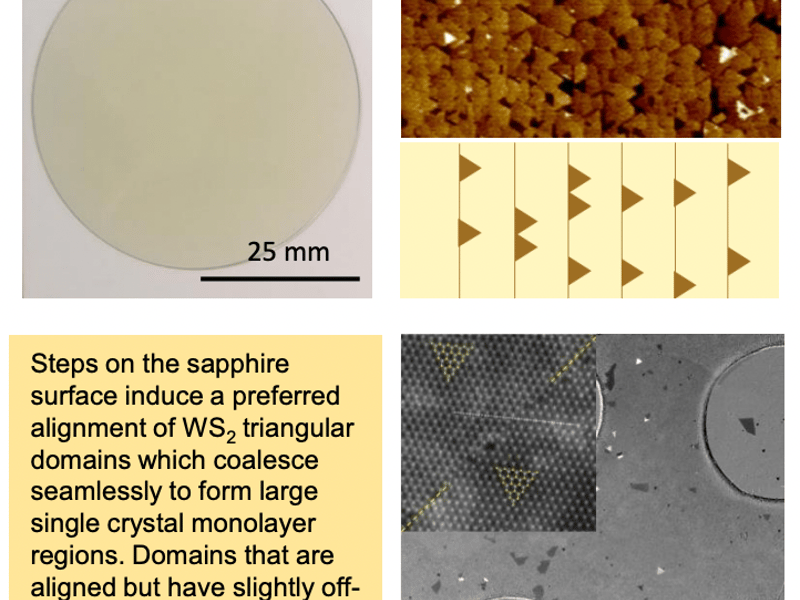
Wafer scale epitaxial growth of unidirectional WS2 monolayers on sapphire
Realization of wafer-scale single-crystal films of transition metal dichalcogenides (TMDs) such as WS2 requires epitaxial growth and coalescence of oriented domains to form a continuous monolayer. The domains must be oriented in the same crystallographic direction on the substrate to inhibit the formation of inversion domain boundaries (IDBs), which form when oppositely oriented triangular domains coalesce.
Showing 201 to 210 of 237