Latest News

Image courtesy of PARADIM
News · Mar 7, 2016
Cornell University

The Cornell Daily Sun Features PARADIM’s Role in Materials Innovation

By PARADIM News

An article in The Cornell Daily Sun highlights PARADIM’s mission to accelerate the discovery of new interface materials.
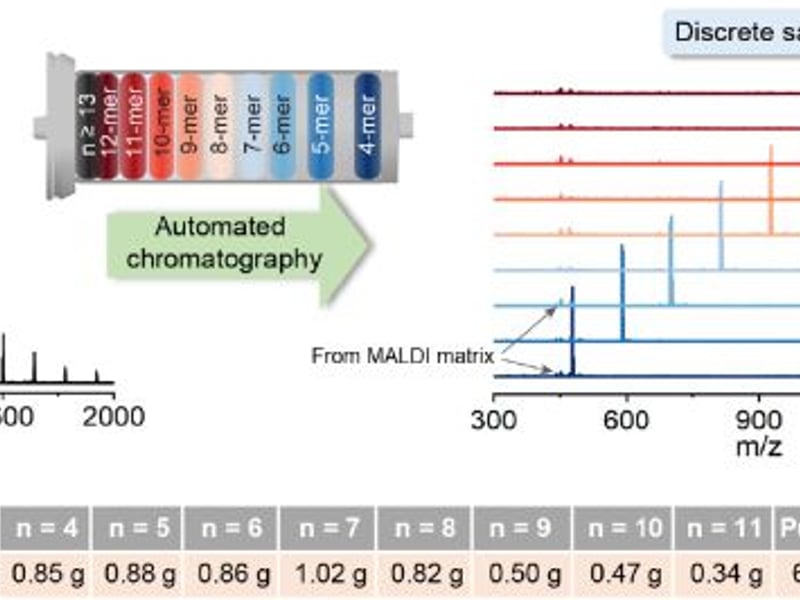
Separation of discrete alkyne containing oligomers. Automated chromatographic separation of oligomers from n = 3 to n = 11, and MALDI mass spectra of the discrete alkyne containing oligomers before and after separation.
Highlight · Mar 15, 2014
University of California, Santa Barbara

High-Throughput Synthesis, Purification, and Application of Alkyne-Functionalized Discrete Oligomers

Junfeng Chen, Vittal Bhat, and Craig J. Hawker, UC Santa Barbara
A novel strategy for the synthesis and purification of discrete, highly functionalized oligomer libraries in a 96-well, high-throughput format was developed.
Benchmarking monolayer MoS, and W, field-effect transistors
Highlight ·
Pennsylvania State University

Benchmarking monolayer MoS, and W, field-effect transistors

A. Sebastian, R. Pendurthi, S. Das, T.H. Choudhury, J.M. Redwing

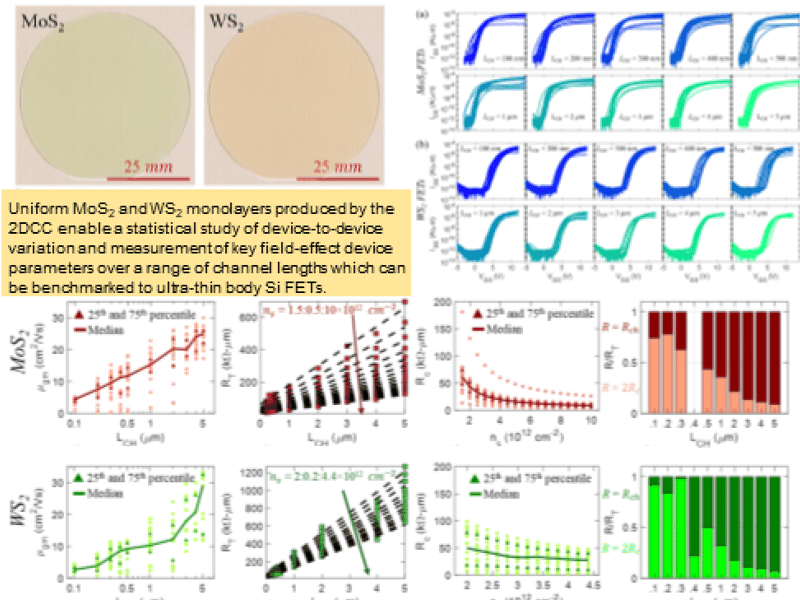
To assess the potential of transition metal dichalcogenides (MDs) for future circuits, it is important to study the variation in key device parameters across a large number of devices. Here we benchmark device-to-device variation in field- effect transistors (FETs) based on wafer-scale monolayer MoS, and WS.
Highlight ·
Cornell University

Discovery and Single Crystal Growth of High Entropy Pyrochlores

L.A. Pressley, A. Torrejon, W.A. Phelan, T.M. McQueen
High entropy compounds are an emerging class of functional materials in which short range order enables superior combinations of properties not present in traditional pure or doped structures.
Ultrafast low-pump fluence all-optical modulation based on graphene-metal hybrid metasurfaces
Highlight ·
Pennsylvania State University

Ultrafast low-pump fluence all-optical modulation based on graphene-metal hybrid metasurfaces

Ali Basiri, Md Zubair Ebne Rafique, Jing Bai, Shinhyuk Choi, Yu Yao, Ben Huet, Joan Redwing

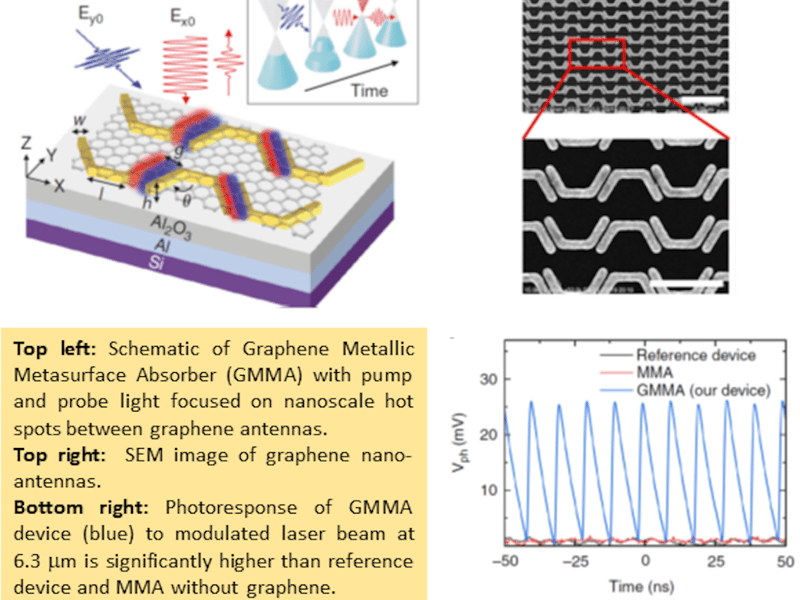
We present modulator designs based on graphene-metal hybrid plasmonic metasurfaces with highly enhanced light- graphene interaction in the nanoscale hot spots at pump and probe (signal) wavelengths. Based on this design concept, we have demonstrated high-speed all optical modulators at near and mid-infrared wavelengths (1.56 um and above Gum) with significantly reduced pump fluence (1-2 orders of magnitude) and enhanced optical modulation.
Highlight ·
Cornell University

Pushing boundaries: High pressure, supercritical optical floating zone materials discovery

W.A. Phelan
An invited perspective highlighting research in the high pressure domain at PARADIM was recently published in the Journal of Solid State Chemistry as part of a 50th anniversary special edition.
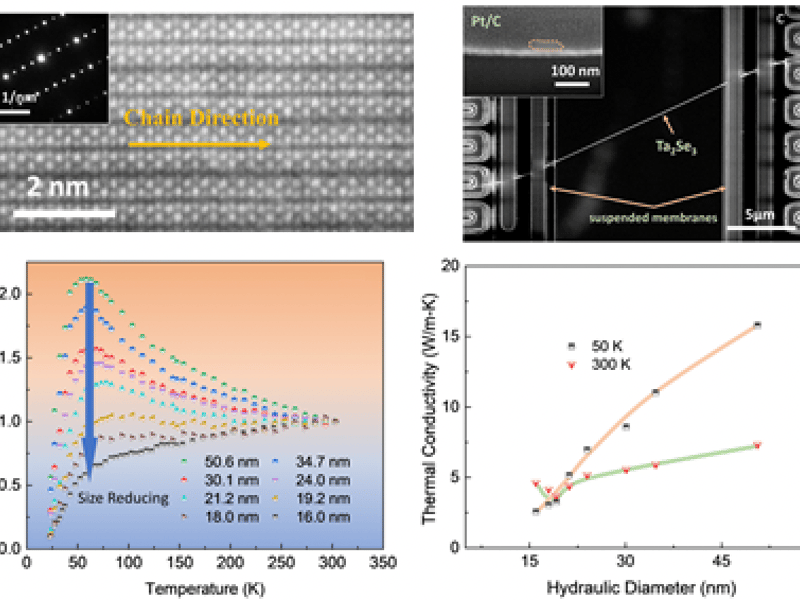
Elastic stiffening induces one-dimensional phonons in thin DMR-2039351 TaSe; nanowires
Highlight ·
Pennsylvania State University

Elastic stiffening induces one-dimensional phonons in thin DMR-2039351 TaSe; nanowires

Z. Pan, Deyu Li, K. Wang, S. H. Lee, Z. Q. Mao

While previously, experimental studies of one-dimensional transform have been largely limited to earlier studies of thermal transport through single-walled carbon or boron nitride nanotubes, recent attempts have been made to probe thermal transport in quasi-1D van der Waals crystal nanowires, revealing interesting observations in the process.
Highlight ·
Cornell University

Cleaning up a Quantum Material: from Quantum Enigma to Quantum Oscillations

B.J. Ramshaw, D.G. Schlom, K.M. Shen, L.F. Kourkoutis

Sr2RuO4 is the most disorder-sensitive superconductor known. It has also been a leading candidate for a novel type of quantum computer that would enable calculations to occur over much longer time scales before suffering decoherence than is the case for today’s superconductor-based quantum computers.
Highlight ·
Cornell University

When Seemingly Passive Substrates are Active

X. Zheng, E. Gerber, J. Park, D. Werder, O. Kigner, E.-A. Kim, S. Xie, D.G. Schlom

Substrates traditionally play a supporting role for the thin films grown upon them by providing purely structural support. Nonetheless for monolayer-thick transition metal dichalcogenides , the substrate plays an active role by providing or removing charge from the TMD layer in which it is in intimate contact.
Highlight ·
University of California, Santa Barbara

Fellows Cohort Selected

Javier Read de Alaniz , Heather Maynard

This cohort of more than 20 fellows marks the official start of the BioPACIFIC MIP in-house research and training programs.