
Latest News

Highlight · Aug 1, 2018
Cornell University

High-Resolution Electron Microscopy gets Cooler

B.H. Savitzky, I. El Baggari, C.B. Clement, E. Waite, B.H. Goodge, D.J. Baek, J.P. Sheckelton, C. Pasco, H. Nair, N.J. Schreiber, J. Hoffman, A.S. Admasu, J. Kim, S.-W. Cheong, A. Bhattacharya, D.G. Schlom, T.M. McQueen, R. Hovden, L.F. Kourkoutis
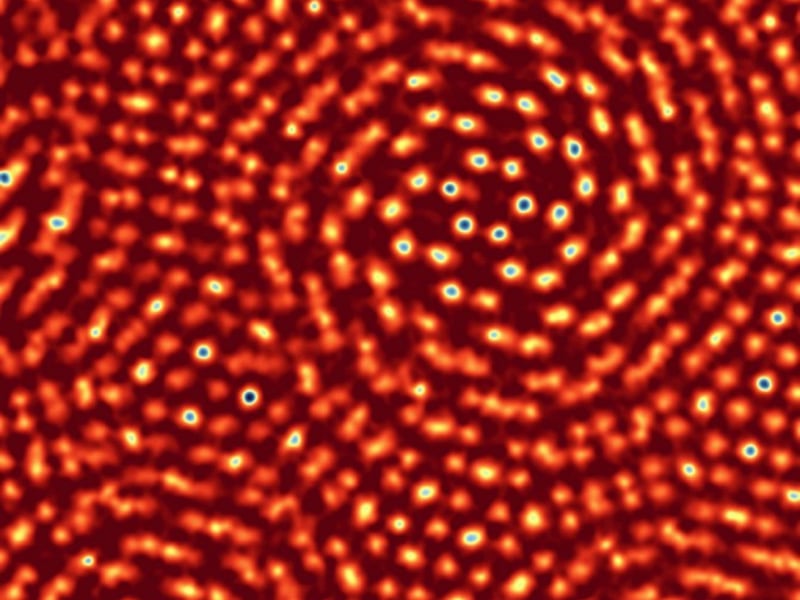
Today, sub-angstrom resolution scanning trans-mission electron microscopy (STEM) imaging is routinely achieved. In addition to resolving individual atomic columns in crystals, STEM performed at room temperature can be used to determine their positions with picometer precision which allows us to directly map local properties.
A ptychographic image of two sheets of molybdenum disulfide, with one rotated by 6.8 degrees with respect to the other. The distances between individual atoms range from a full atomic bond length down to complete overlap. Image courtesy of PARADIM.
News · Jul 18, 2018
Cornell University

PARADIM Researchers Achieve World Record in Electron Microscopy Resolution

By PARADIM News

Using a Cornell-developed detector, PARADIM’s David A. Muller and collaborators set a new world record in electron microscope resolution.
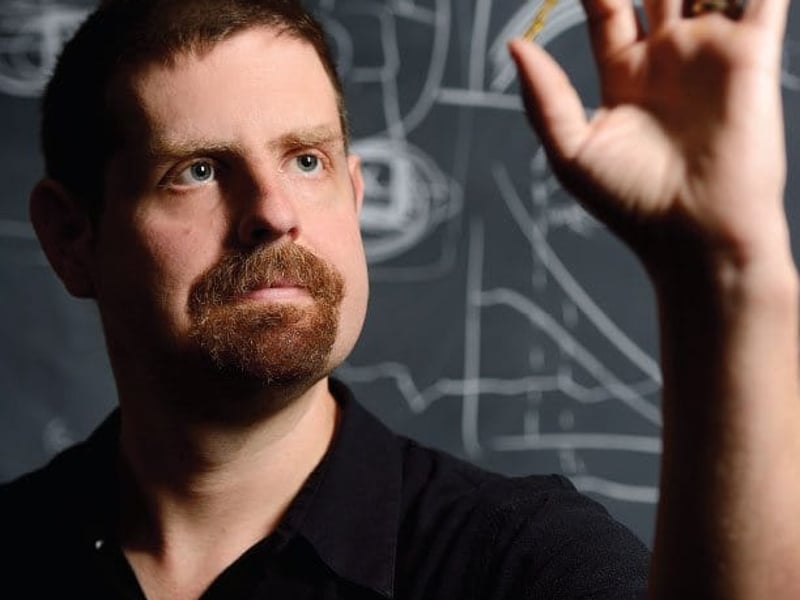
Tyrel McQueen, featured in a PARADIM video on the process and impact of materials discovery. Image credit: Will Kirk, courtesy of PARADIM.
News · Feb 16, 2018
Cornell University

PARADIM Video: Tyrel McQueen on Materials Discovery

By PARADIM News

In a PARADIM video feature, Tyrel McQueen discusses how new materials are discovered and why they matter.

Image courtesy of PARADIM
News · Nov 15, 2017

PARADIM Featured in JHU Magazine Article on Materials Discovery

By PARADIM News

PARADIM is highlighted in Arts & Sciences Magazine for its role in enabling the discovery of next-generation materials.

Highlight · Sep 20, 2017
Cornell University

Valleytronics Made to Order: Layer-by-Layer Stacking of TMD Sheets with ~cm Dimensions

Kang, K. Lee, y. Han

Building on their growing expertise with valleytronic materials, PARADIM researchers, Jiwoong Park (University of Chicago) and David Muller (Cornell University) have discovered a way to assemble multi-layer stacks of monolayers of transition metal dichalcogenide (TMD) materials (MoS2, MoSe2, and WS2) with centimeter-scale dimensions in a user-defined sequence. The assembly is achieved without the use of etchants or solvents by exploiting the stronger binding that occurs between TMD layers than between the TMD layer and the underlying substrate.
Eun-Ah Kim. Image courtesy of PARADIM.
News · Apr 11, 2017
Cornell University

PARADIM’s Eun-Ah Kim Contributes to Next-Gen Superconductor Research

By PARADIM News

PARADIM researcher Eun-Ah Kim is part of a collaborative effort to develop the next generation of superconducting materials.

Highlight · Apr 11, 2017
Cornell University

Perturbing ValleytronicMaterials to make them Relevant to Ground-State Quantum Computing

Y. Hsu, A. Vaezi, M. Fischer
PARADIM theorists have recognized that lightly hole-doped transition metal dichalcogenides (TMDs) are natural candidates for the long sought odd-parity topological superconductor vital for ground-state topological quantum computing.
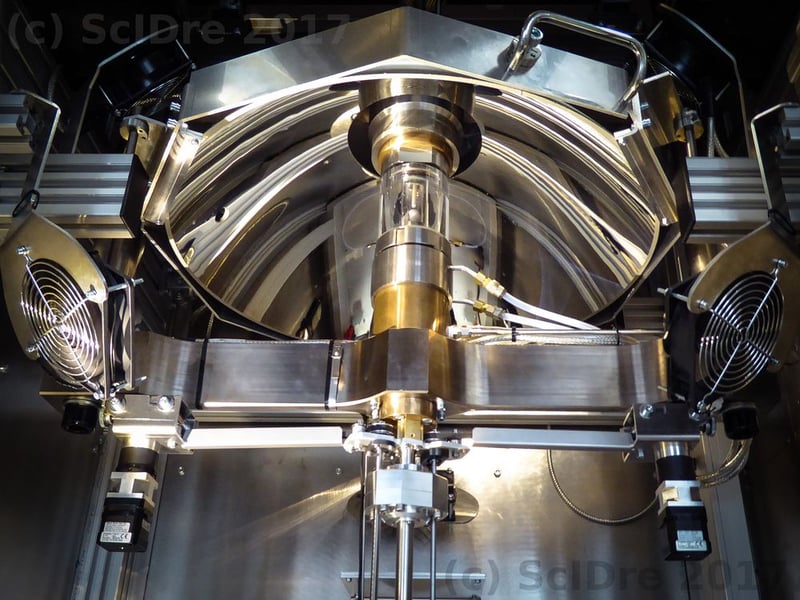
The world-record 300 bar floating zone furnace installed at PARADIM’s Bulk Crystal Growth Facility. Image courtesy of PARADIM.
News · Feb 7, 2017
Cornell University

PARADIM’s 300 Bar Floating Zone Furnace Sets World Record

By PARADIM News

PARADIM’s floating zone furnace, built by ScIDre, operates at a world-record 300 bar pressure—enabling growth of materials previously beyond reach.

Highlight · Nov 7, 2016
Cornell University

Low Symmetry Valleytronic Materials Enable Energy Efficient Switching for Magnetic Memories

D. MacNeill, G.M. Stiehl, M.H.D. Guimaraes, R.A. Buhrman, J. Park, D.C. Ralph

Building on their growing expertise with interface materials, PARADIM researchers discovered a new mechanism for reorienting magnetization that is 10 times more energy efficient than prior techniques. An electrical current is passed through a low symmetry valleytronic material containing heavy atoms that is positioned under a magnetic layer.