News

Turning Beam Damage Into Beam-Enabled Chemistry
Electron beams are often treated as a problem in molecular electron microscopy: powerful enough to reveal structure, but also capable of damaging the very samples under study. A recent paper published in Angewandte Chemie International Edition suggests a different possibility: what if beam damage could be harnessed as beam-enabled chemistry?
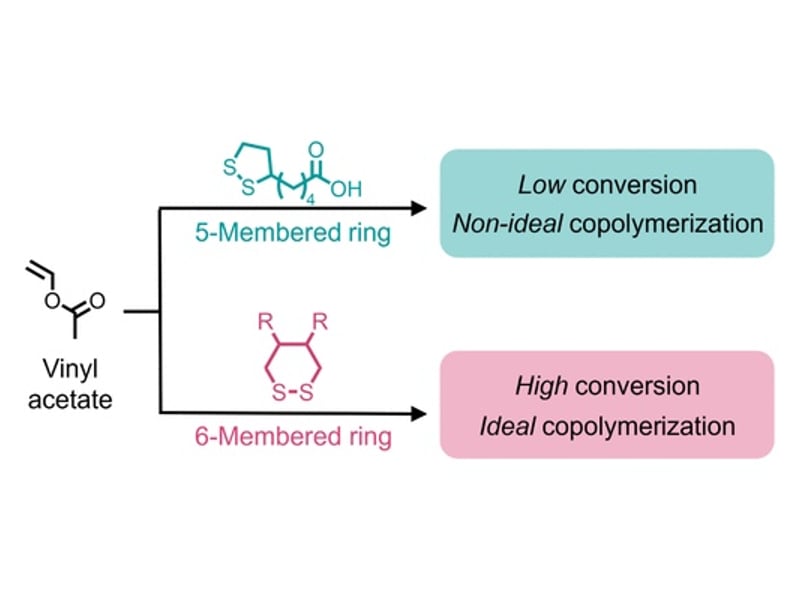
New Study Points to Degradable Commodity Plastics Without Changing Manufacturing
Researchers from UC Santa Barbara’s BioPACIFIC MIP have reported a new route to making commodity plastics more sustainable without requiring major changes to existing manufacturing methods.
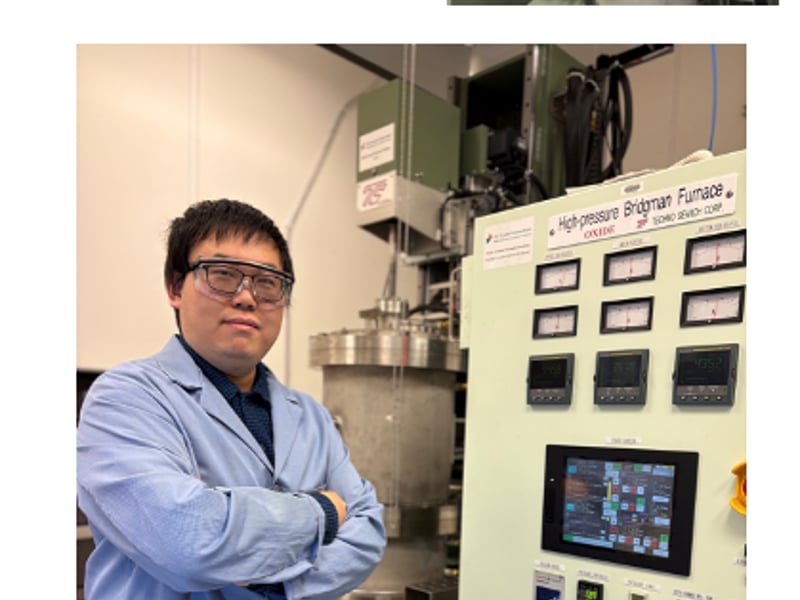
A First-of-Its-Kind Crystal Growth Method Advances Stoichiometry Control at Penn State
Large single crystals with precise stoichiometry control are the cornerstones of modern-day microelectronics, global positioning systems, optical communications, energy harvesting, etc. In addition, fundamental research also relies heavily on ideal single crystals to access intrinsic properties. One central challenge in crystal growth by conventional techniques such as Czochralski and Bridgman is that large, high-quality crystals can be grown only for congruent melting compositions where the solid and liquid compositions are the same.
Penn State, Battalion launch research collaboration focused on national security
Two projects led by Materials Research Institute scientists and in partnership with Battalion Advanced Technology Ltd. aim to advance semiconductor integration and high-temperature alloys for national security applications
By Jamie Oberdick
Penn State and Battalion Advanced Technology Ltd. have entered into two research agreements worth up to $6 million to develop advanced semiconductor platforms and high-temperature materials that aim to enable next-generation energy, transportation, aerospace and industrial systems while also providing critical capabilities for national security.
Led by researchers at Penn State’s Materials Research Institute (MRI), the projects bring together researchers from across the University to address two major materials challenges in technologies that operate under extreme conditions: integrating advanced semiconductors with high-performance substrates that can withstand the conditions and dissipate heat as well as developing durable, oxidation-resistant alloys that can withstand extreme-temperature environments including hypersonic flight.
Battalion Advanced Technology Ltd., a U.K.-based company focused on advancing next-generation materials for dual-use applications, will provide up to $1 million per year for each project. The agreements went into effect on July 16 and will run for three years.
“Penn State materials brings together expertise in semiconductor science, computation, manufacturing and characterization,” said Joshua A. Robinson, director of the MRI and professor of materials science and engineering. “This collaboration allows us to apply that breadth to two complex materials challenges with direct implications for U.S. technological leadership and national security.”
The semiconductor project is led by Joan Redwing, distinguished professor of materials science and engineering and of electrical engineering. Her team will explore new ways to integrate gallium nitride, a wide-bandgap semiconductor material that is more versatile than conventional silicon, and related wide-bandgap and ultrawide-bandgap semiconductors with substrates that offer improved thermal and electrical performance.
These semiconductors can operate at higher voltages, temperatures and power densities than many traditional materials, making them promising for advanced electronics, communications and sensing. Their performance, however, can be limited by the substrates and interfaces on which the semiconductor layers are grown.
The researchers will investigate whether atomically thin interlayers — materials designed to improve how different materials connect and perform together — can help gallium nitride semiconductors integrate more effectively with materials such as diamond and aluminum nitride, relieve stress where the materials meet and reduce defects during semiconductor growth.
The work will combine materials synthesis and characterization, with the goal of moving beyond conventional approaches for growing crystalline layers. The collaboration draws on the University’s interdisciplinary materials research community, as well as specialized facilities and technical capabilities available through the MRI and other University research units.
“By using atomically thin two-dimensional materials as interlayers, we aim to minimize crystalline defects and interfacial thermal resistance while enabling wide-bandgap semiconductor growth on high-thermal-conductivity substrates that have traditionally been incompatible with direct deposition,” Redwing said.
The co-principal investigators on the semiconductor project include Robinson; Adrianus van Duin, distinguished professor of mechanical engineering; and Chen Chen, assistant research professor in MRI.
The second project is led by Douglas Wolfe, associate vice president for research and professor of materials science and engineering. It will focus on refractory metal alloys — metals that maintain their strength and stability under extreme heat — for hypersonic and other demanding, high-temperature applications.
Refractory metals such as tungsten, molybdenum and niobium offer high-temperature strength, toughness and thermal conductivity, but oxidation and material loss can limit their use. The researchers plan to develop new alloy compositions and material architectures designed to retain mechanical performance while forming more stable, protective surfaces during high-temperature exposure.
The team will also investigate functionally graded materials, in which composition or structure changes across a component, and environmental protection systems intended to improve oxidation resistance, thermal compatibility and durability.
“By integrating computational prediction, next-generation manufacturing and rigorous validation, we can accelerate the development of refractory alloys that enable breakthroughs in defense applications, hypersonics, nuclear systems, space exploration and other extreme environmental applications,” Wolfe said.
Long-Qing Chen, Evan Pugh University Professor and Hamer Professor of Materials Science and Engineering, and Bed Poudel, research professor of materials science and engineering, are co-principal investigators on the refractory-alloy project.
“We are very pleased to be supporting the development of leading innovations with essential dual uses for national security and economic technologies,” said R. Michael Jones, CEO of Battalion Advance Technology. “We are able to work on highly sophisticated solutions immediately through our partnership with Penn State.”
"The projects reflect MRI's role in connecting researchers and facilities across Penn State with external partners to move materials discoveries toward technologies that can operate in demanding, real-world environments," Robinson added. "This is an important step for MRI's and Penn State's research future."
More information may be found in the press release issued by Battalion.
(e) [email protected], (e) [email protected] (o) 814-865-8665 N-336 Millennium Science Complex
(e) [email protected] (o) 814-865-0316 119 230 Building

Upgrades to the Chemspeed Robotic Polymer Synthesis Platform significantly expand automated handling of challenging materials

$12M grant to build animal-inspired sensing for autonomous drones and robots

NSF funding supports Two-Dimensional Crystal Consortium's next chapter

UCSB to lead national cloud laboratory for advanced materials
The Computation-Optimized Automated Soft materials Technology Programmable Cloud Laboratory (COAST PCL) will be built around BioPACIFIC MIP research infrastructure located at OASIS, an innovation hub established by The Robert Mehrabian College of Engineering at UCSB to support discovery, prototyping and scaling up innovative technology.

Penn State scientists to lead three Genesis Mission projects

Penn State awarded $20M to lead an NSF ‘programmable cloud laboratory’

UCSB to Lead National Cloud Laboratory for Advanced Materials
Quantum material opens new path for studying unusual electronic behavior

Penn State names five new Evan Pugh University Professors

Showing 1 to 10 of 119