
Latest News
Highlight ·
Pennsylvania State University
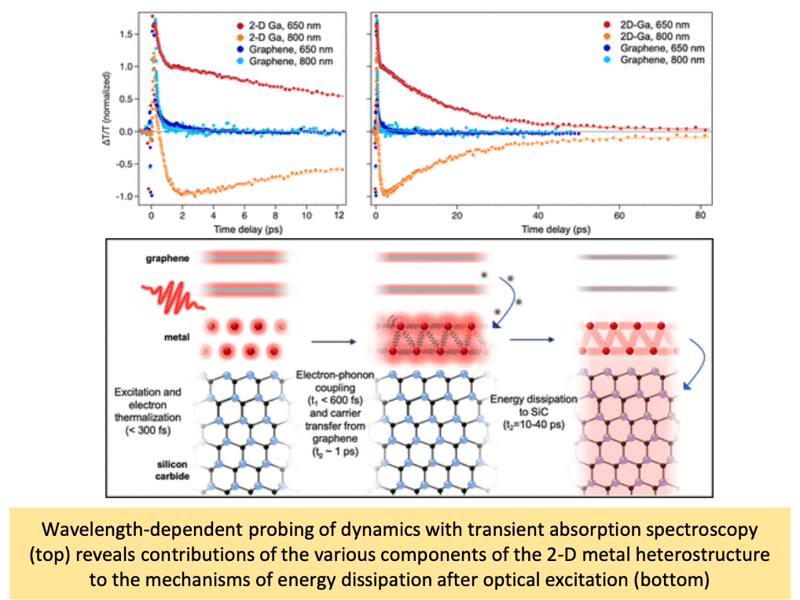
Atomic-Level Structure Determines Electron–Phonon Scattering Rates in 2-D Polar Metal Heterostructures
In this study, we measured the nonequilibrium carrier dynamics in an air-stable 2-D polar metal heterostructures. Using transient absorption spectroscopy, the mechanism for energy dissipation was determined to involve contributions from the various components of the heterostructure, including the 2-D metal layer, SiC substrate, and graphene capping layer.
Highlight ·
Pennsylvania State University
Atomically thin half van der Waals materials via confinement heteroepitaxy
The process of stabilizing 2D superconductors via CHet can be applied to elements beyond p-block metals, opening opportunities to study unconventional properties that enable exploration of new physics and devices.
Highlight ·
Pennsylvania State University
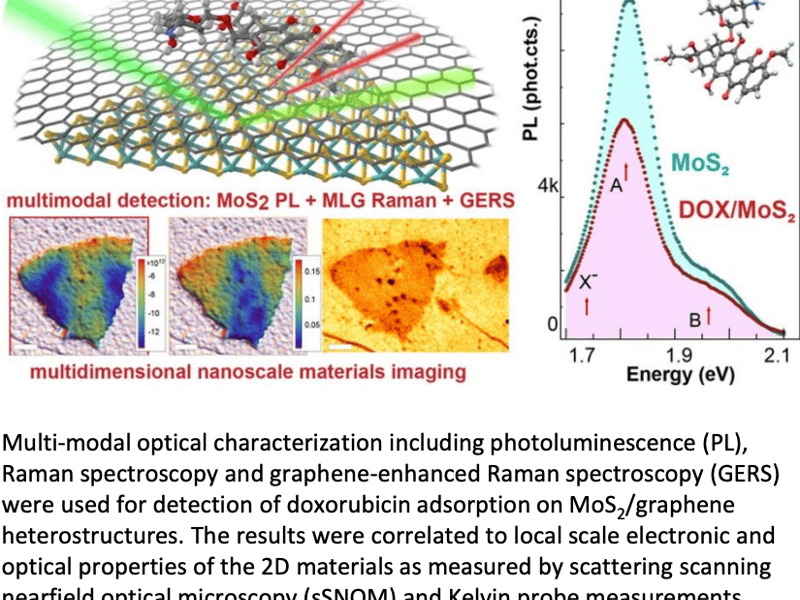
Multidimensional imaging reveals mechanisms controlling multimodal label-free biosensing in vertical 2DM heterostructures
T. Ignatova, S. Pourianejad , K. Schmidt, F. Aryeetey, S. Aravamudhan, S. Rotkin, B. Huet, J.M. Redwing
A multi-dimensional optical imaging technique that combines scattering was developed to map subdiffractional distributions of doping and strain in MoS2 and MoS2 /graphene vertical heterostructures. The variations in doping and strain were correlated to electronic properties and were used to understand the behavior of biosensors fabricated using the 2D material.
Highlight ·
Pennsylvania State University
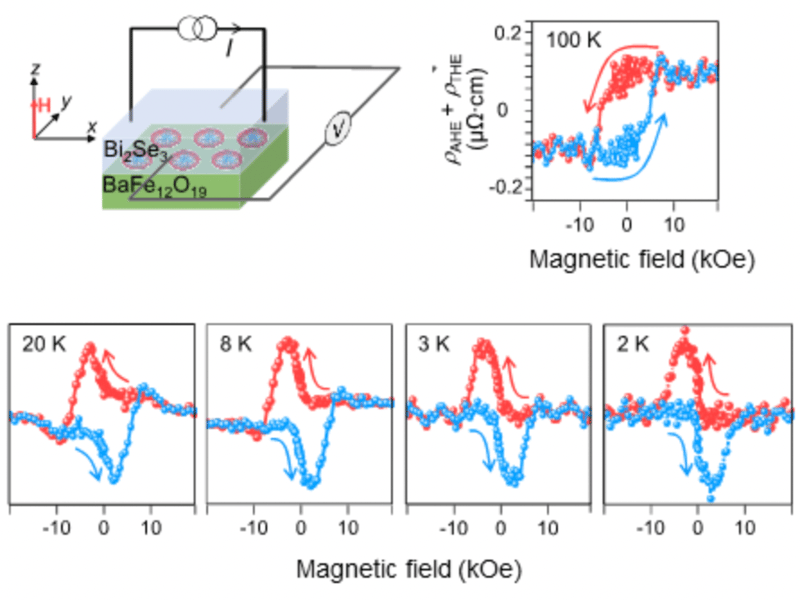
Topological Hall Effect in Topological Insulator/Magnetic Insulator Bilayer
The topological Hall effect (THE) is a phenomenon that is a consequence of a Berry phase created by spin textures in real space. Interfacing a topological insulator with a magnetic insulator provides a model platform for studying this phenomenon in a well-controlled manner. This paper reports the first clear evidence for the THE in heterostructures that combine a model topological insulator (Bi2Se3) with a ferromagnetic insulator (BaFe12O19).
Highlight ·
Pennsylvania State University
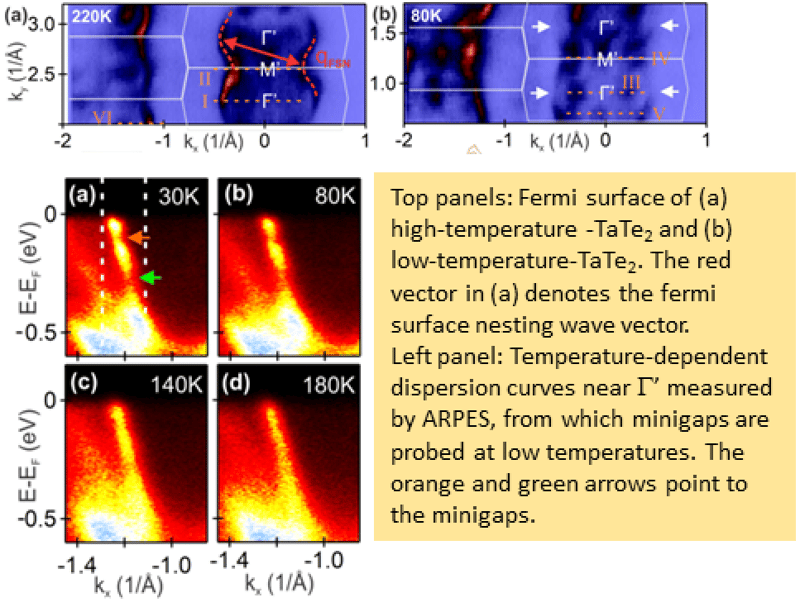
Evidence of nested quasi-one-dimensional Fermi surface and decoupled charge-lattice orders in layered TaTe2
Y. Lin, M. Huber, K. M. Siddiqui, L. Moreschini, P. Ai, S. Rajpurohit, L. Tan, j.D. Denlinger, A Lanzara, D. H. Eilbott, L Moreschini, Y.L. Zhu, Z.Q. Mao
Prof. Lanzara' group at Lawrence Berkeley National Laboratory recently studied the anomalous CDW phase transition of TaTe using APES and low-energy electron diffraction. Their data reveal the presence of a surprising quasi- one-dimensional Fermi surface with nesting condition. They find that the wave vectors of the Fermi surface nesting and periodic lattice distortion are different, suggesting the decoupled formation between charge and lattice orders. This work provides routes for forging unconventional CW phases and charge- lattice entanglement that would otherwise not be available in materials with fixed dimensionality.
Highlight ·
Pennsylvania State University
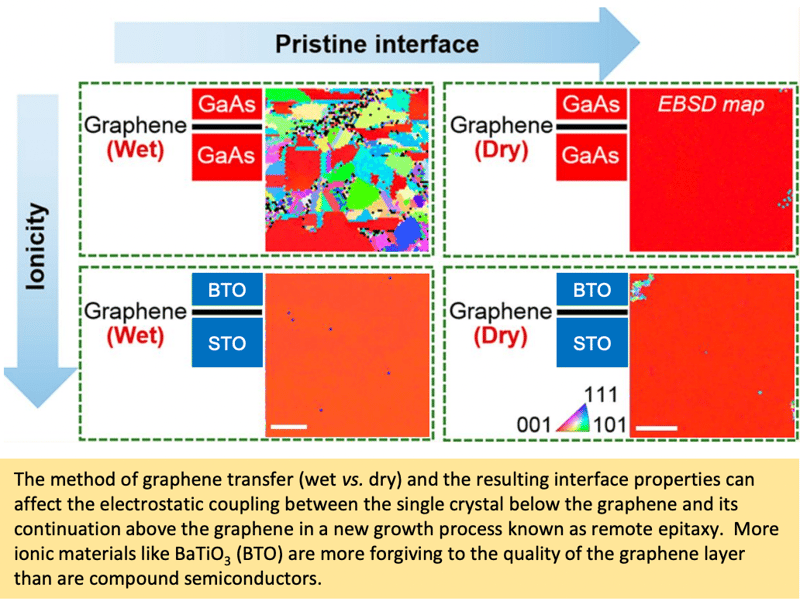
Remote Epitaxy of 3D functional semiconductors and oxides using Graphene as the Interface layer
In this highlight, 2DCC and PARADIM team up to work with the inventor of remote epitaxy, Prof. Kim (MIT), to unveil the respective roles and impacts of the substrate material, graphene, substrate–graphene interface, and epitaxial material for electrostatic coupling of these materials, which governs cohesive ordering and can lead to single crystal epitaxy in the overlying film.
Highlight ·
Pennsylvania State University
Lifetime Sample Tracking (LiST) Database
LiST is a web-based data management software tool developed by the 2DCC to capture, organize and curate experimental and theory/simulation data produced by the facility and external users. Under LiST, data follow the sample from substrate preparation to synthesis protocol, integrated UHV characterization, ex situ characterization, modeling, delivery, and publication, with fine-grained access control and community-accessible tools and data.
Highlight ·
Pennsylvania State University
Electronic correlations in nodal-line semimetals
Through optical studies on the ZrSiSe single crystals provided by 2DCC, Basov’s group at Univ. of Columbia find prominent correlation effects in nodal-line semimetals. They observed spectroscopic hallmarks of electronic correlations: strong reduction of the Drude weight and the Fermi velocity.
Highlight ·
Pennsylvania State University
Magnetism Modified by Topology
In a user project led by Mingzhong Wu (Colorado State), 2DCC scientists used molecular beam epitaxy (MBE) to synthesize topological insulator (Bi2Se3) thin films on ferrimagnetic insulator Y3Fe5O12 (YIG) thin film substrates grown by sputtering at Colorado State. Wu’s group then used ferromagnetic resonance measurements to show that the magnetic anisotropy, gyromagnetic ratio, and damping of the YIG were modified by interfacing with Bi2Se3.
Highlight ·
Pennsylvania State University
Excitons Bound To Defects
Identifying crystal defects in a 2D crystal usually requires an electron microscope to directly resolve atomic details, a complex and time-consuming process on expensive equipment that can damage the sample under electron irradiation. By establishing a correlation between the modified optical response and certain defects, the MIP team and collaborators have demonstrated a quick and non-destructive method of identifying defects in 2D crystals.
Showing 291 to 300 of 363