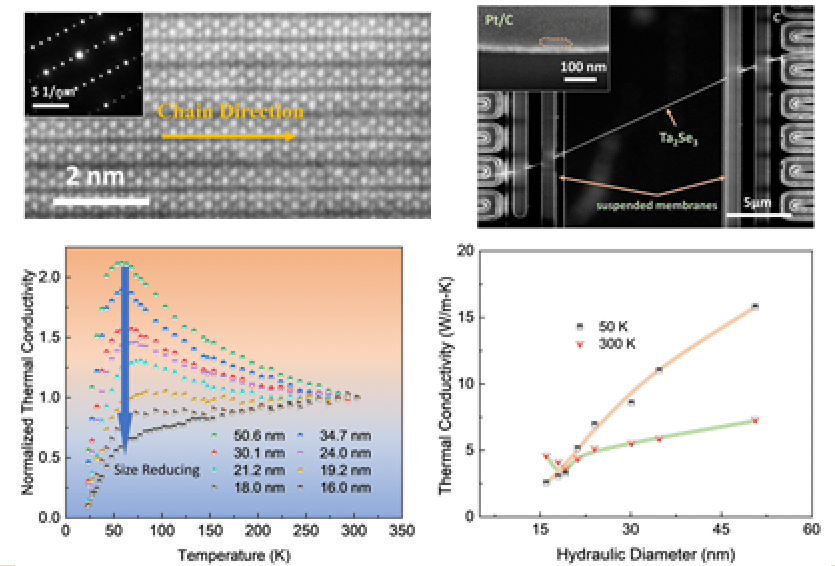
Confined transport of energy carriers in low-dimensional materials could induce unusual phenomena, leading to properties promising for various applications. In the past, extensive efforts have been carried out to explore and understand thermal transport through a plethora of two- dimensional (2D) materials, while experimental studies of one-dimensional (1D) transport have been largely limited to earlier studies of thermal transport through single-walled carbon or boron nitride nanotubes. Only very recently, attempts to probe thermal transport in quasi-1D van der Waals (vdW) crystal nanowires have been made, which reveal interesting observations. Recently, Prof. Deyu Li's group at Vanderbilt University experimentally demonstrated 1D phonon-mediated thermal transport in TagSeg nanowires, which is enabled by a phonon stiffening effect. This conclusion is based on diameter dependent thermal conductivity measurement of the nanowires, with the diameter ranging from -15 to ~50 nm. Normally the thermal conductivity of (3D) phonons in nanowires would reduce with decreasing diameter. However, in the case of TagSeg nanowires, an unusual increasing trend was found when the diameter is below a certain value (~20 nm) at 300 K. This non-monotonic trend is absent at 50 K. This can only be explained by 1D phonon in the thin nanowires at 300k. The detailed findings are published in Appl. Phys. Lett. 120, 062201 (2022).
 Download

2D Crystal Consortium - Materials Innovation Platform (2DCC-MIP)
The 2DCC-MIP combines a vibrant in-house research effort focused on transformative advances in the synthesis and characterization of 2D chalcogenide layered materials with a robust external user program that provides access to expertise and state-of-the-art facilities. The 2DCC-MIP platform enables cutting edge research and discovery, across in-house research and the user program, on the synthesis and characterization of 2D chalcogenide materials by a national user community guided by four science drivers: Physics of 2D Systems, Epitaxy of 2D Chalcogenides, Next-generation 2D Electronics, and Advanced Characterization and Modeling.