
Research Highlights

Feb 8, 2019
Cornell University

An atomically thin ferromagnet—just one atom thick

H. Boschker, T. Harada, T. Asaba, R. Ashoori, A.V. Boris, H. Hilgenkamp, C.R. Hughes, M.E. Holtz, L. Li, D.A. Muller, H. Nair, P. Reith, X. Renshaw Wang, D.G. Schlom, A Soukiassian, J. Mannhart

This highlight provides an example of the precise interface quantum materials that can be created by MBE and characterized by high-resolution STEM and elemental analysis in PARADIM facilities.
Aug 1, 2018
Cornell University

High-Resolution Electron Microscopy gets Cooler

B.H. Savitzky, I. El Baggari, C.B. Clement, E. Waite, B.H. Goodge, D.J. Baek, J.P. Sheckelton, C. Pasco, H. Nair, N.J. Schreiber, J. Hoffman, A.S. Admasu, J. Kim, S.-W. Cheong, A. Bhattacharya, D.G. Schlom, T.M. McQueen, R. Hovden, L.F. Kourkoutis

Today, sub-angstrom resolution scanning trans-mission electron microscopy (STEM) imaging is routinely achieved. In addition to resolving individual atomic columns in crystals, STEM performed at room temperature can be used to determine their positions with picometer precision which allows us to directly map local properties.
Sep 20, 2017
Cornell University

Valleytronics Made to Order: Layer-by-Layer Stacking of TMD Sheets with ~cm Dimensions

Kang, K. Lee, y. Han

Building on their growing expertise with valleytronic materials, PARADIM researchers, Jiwoong Park (University of Chicago) and David Muller (Cornell University) have discovered a way to assemble multi-layer stacks of monolayers of transition metal dichalcogenide (TMD) materials (MoS2, MoSe2, and WS2) with centimeter-scale dimensions in a user-defined sequence. The assembly is achieved without the use of etchants or solvents by exploiting the stronger binding that occurs between TMD layers than between the TMD layer and the underlying substrate.
Apr 11, 2017
Cornell University

Perturbing ValleytronicMaterials to make them Relevant to Ground-State Quantum Computing

Y. Hsu, A. Vaezi, M. Fischer

PARADIM theorists have recognized that lightly hole-doped transition metal dichalcogenides (TMDs) are natural candidates for the long sought odd-parity topological superconductor vital for ground-state topological quantum computing.
Nov 7, 2016
Cornell University

Low Symmetry Valleytronic Materials Enable Energy Efficient Switching for Magnetic Memories

D. MacNeill, G.M. Stiehl, M.H.D. Guimaraes, R.A. Buhrman, J. Park, D.C. Ralph
Building on their growing expertise with interface materials, PARADIM researchers discovered a new mechanism for reorienting magnetization that is 10 times more energy efficient than prior techniques. An electrical current is passed through a low symmetry valleytronic material containing heavy atoms that is positioned under a magnetic layer.
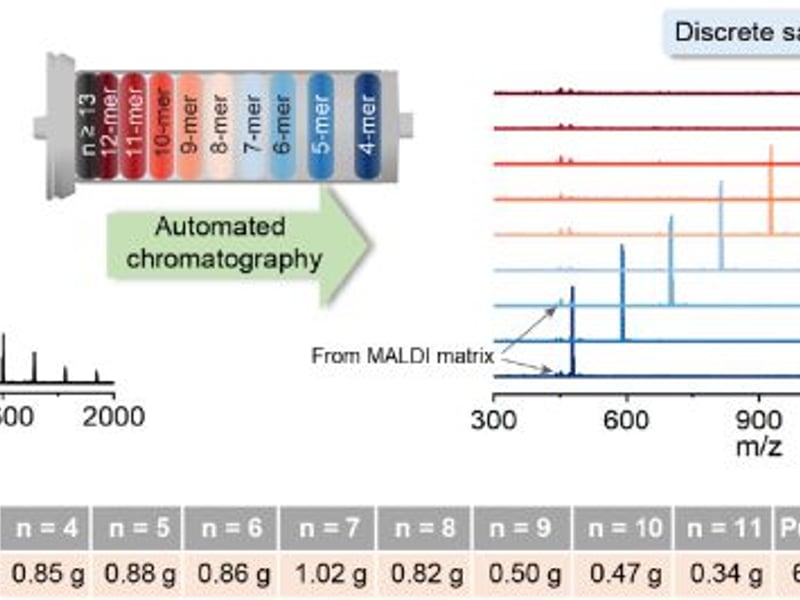
Separation of discrete alkyne containing oligomers. Automated chromatographic separation of oligomers from n = 3 to n = 11, and MALDI mass spectra of the discrete alkyne containing oligomers before and after separation.
Mar 15, 2014
University of California, Santa Barbara

High-Throughput Synthesis, Purification, and Application of Alkyne-Functionalized Discrete Oligomers

Junfeng Chen, Vittal Bhat, and Craig J. Hawker, UC Santa Barbara
A novel strategy for the synthesis and purification of discrete, highly functionalized oligomer libraries in a 96-well, high-throughput format was developed.
Benchmarking monolayer MoS, and W, field-effect transistors
Pennsylvania State University

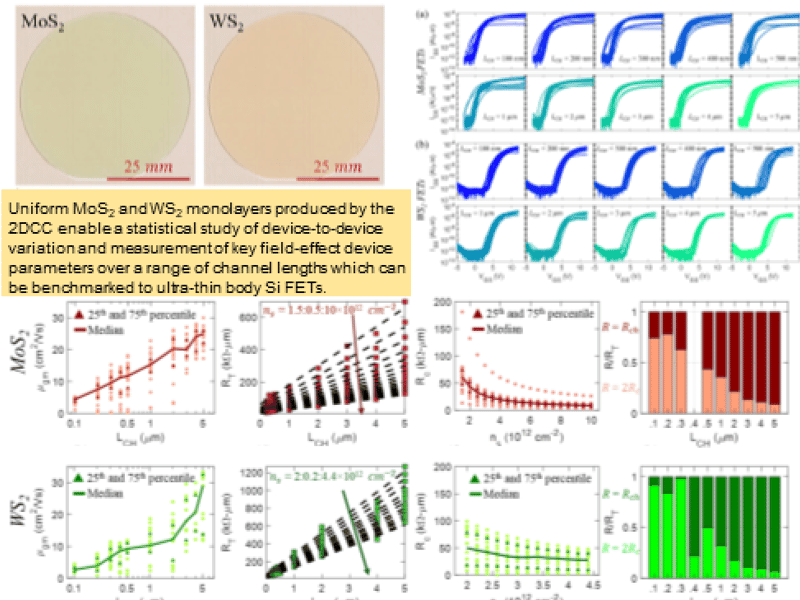
Benchmarking monolayer MoS, and W, field-effect transistors

A. Sebastian, R. Pendurthi, S. Das, T.H. Choudhury, J.M. Redwing

To assess the potential of transition metal dichalcogenides (MDs) for future circuits, it is important to study the variation in key device parameters across a large number of devices. Here we benchmark device-to-device variation in field- effect transistors (FETs) based on wafer-scale monolayer MoS, and WS.
Cornell University

Discovery and Single Crystal Growth of High Entropy Pyrochlores

L.A. Pressley, A. Torrejon, W.A. Phelan, T.M. McQueen
High entropy compounds are an emerging class of functional materials in which short range order enables superior combinations of properties not present in traditional pure or doped structures.
Ultrafast low-pump fluence all-optical modulation based on graphene-metal hybrid metasurfaces
Pennsylvania State University

Ultrafast low-pump fluence all-optical modulation based on graphene-metal hybrid metasurfaces

Ali Basiri, Md Zubair Ebne Rafique, Jing Bai, Shinhyuk Choi, Yu Yao, Ben Huet, Joan Redwing

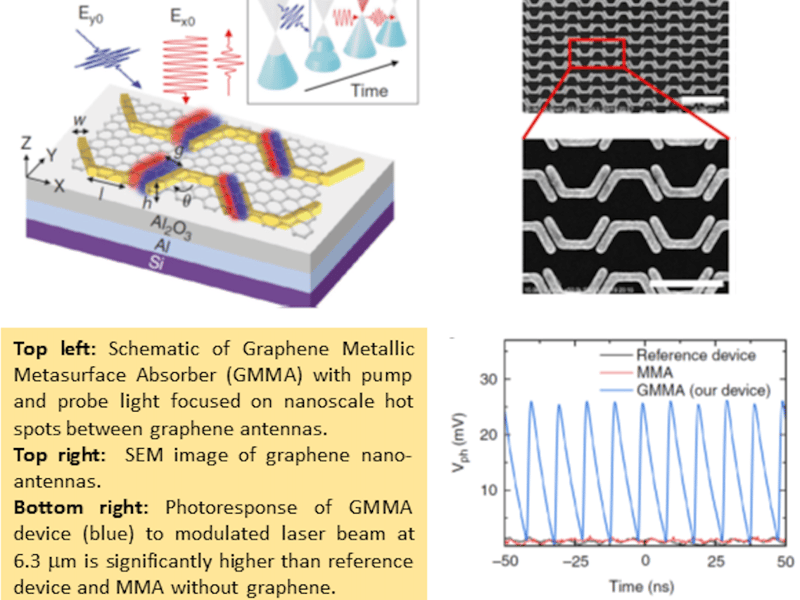
We present modulator designs based on graphene-metal hybrid plasmonic metasurfaces with highly enhanced light- graphene interaction in the nanoscale hot spots at pump and probe (signal) wavelengths. Based on this design concept, we have demonstrated high-speed all optical modulators at near and mid-infrared wavelengths (1.56 um and above Gum) with significantly reduced pump fluence (1-2 orders of magnitude) and enhanced optical modulation.
Cornell University

Pushing boundaries: High pressure, supercritical optical floating zone materials discovery

W.A. Phelan

An invited perspective highlighting research in the high pressure domain at PARADIM was recently published in the Journal of Solid State Chemistry as part of a 50th anniversary special edition.