Research Highlights

May 21, 2021
Cornell University

The Highest Resolution Microscope, enabled by a new detector technology, reaches an ultimate resolution limit – the vibrations of atoms themselves

Z. Chen, Y. Jiang, Y. Shao, M.E. Holtz, M. Odstrčil, M. Guizar-Sicairos, D.G. Schlom, D.A. Muller

By combining PARADIM’s new design of electron microscope pixel array detector (EMPAD), which has the dynamic range to record the complete distribution of transmitted electrons at every beam position and a phase retrieval algorithm to process the data, the research team has increased the spatial resolution well beyond the traditional lens limitations, setting a world record in 2018 for the highest resolution microscope.
May 12, 2021
Cornell University

Beyond Terfenol-D

For nearly 50 years, Terfenol-D (Tb:x:Dy:1-:x:Fe:2:) has reigned as the material for which an applied magnetic field results in the greatest change in shape, a property known as magnetostriction. A distant second to Terfenol-D is Galfenol (Fe:1–:x:Ga:x:), the best magnetostrictor free of rare-earth elements.
Synchrotron diagnostic imaging of crystal growth processes
Apr 23, 2021
Cornell University

Synchrotron diagnostic imaging of crystal growth processes

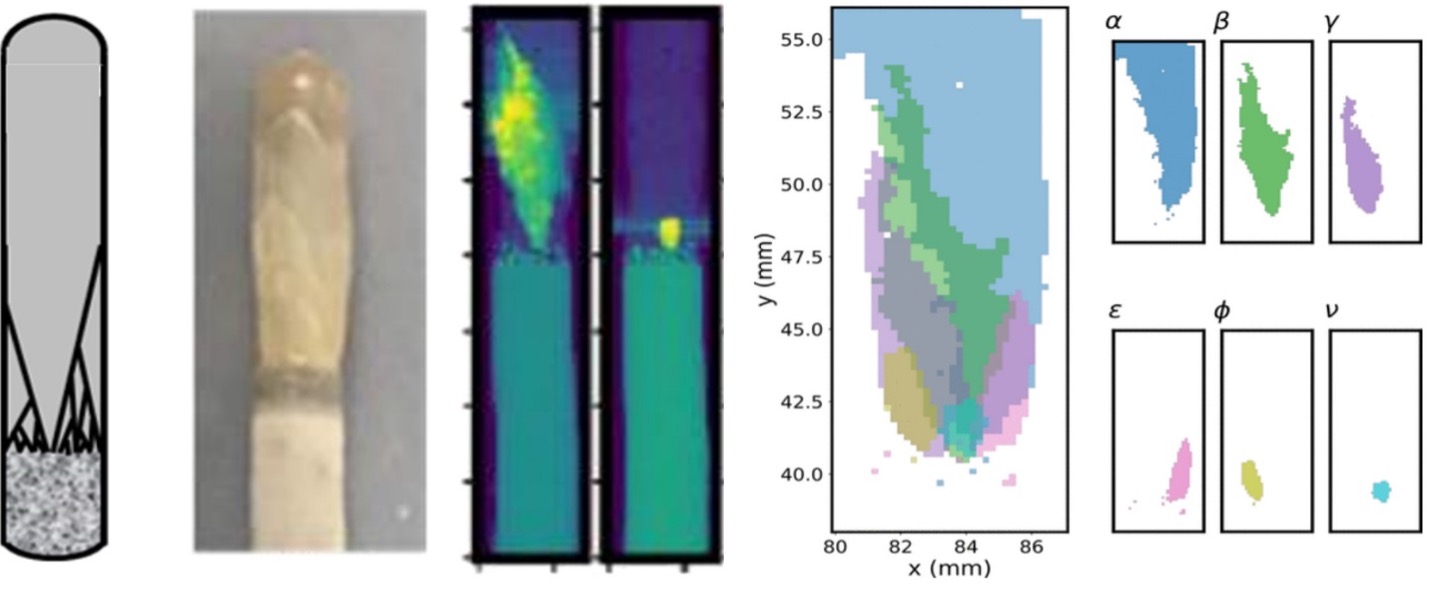
PARADIM Highlight #40 reports an automated, nondestructive method using high-energy synchrotron X-rays to map grains during floating-zone growth of TiO2. The study tracks grain position, size, and shape, revealing a single grain that dominates and fills the boule. This advances growth models and accelerates materials development; data published and available.
Apr 12, 2021
Cornell University

Unit-Cell-Thick Domains in Quasi-2D Ferroelectric Material
Many electronic devices, like non-volatile high-density memories, ultra-fast switches, and thin film capacitors, rely on ferroelectric materials—a class of materials with spontaneous electrical polarization which can be reproducibly switched. In two-dimensional (2D) and quasi-2D ferroelectric materials the size of ferroelectric domains can be small which may enable the miniaturization of devices. Understanding of ferroelectric domain structure at the atomic scale is, however, limited, hindering the development of functional device units at the microscopic level.
Studying the influence of a capping layer on interfacial superconductivity in FeSe/SrTiO3 heterostructures
Mar 22, 2021
Pennsylvania State University

Studying the influence of a capping layer on interfacial superconductivity in FeSe/SrTiO3 heterostructures

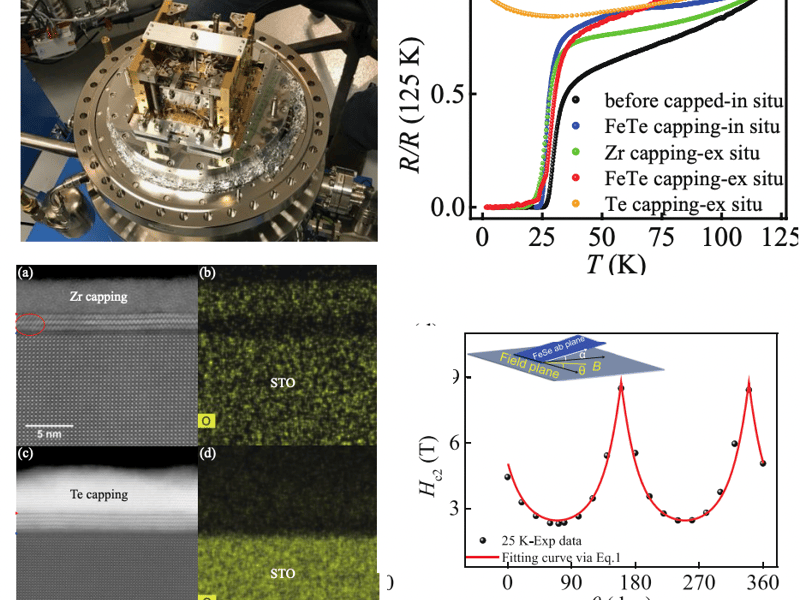
We used the 2DCC multimodule molecular beam epitaxy (MBE) and surface characterization facility to study the influence of various capping layers on the Tc of ultrathin films of FeSe grown on SrTiO3. The multimodule facility’s in vacuo four-probe electrical resistance measurement capability provided critical information about the Tc of MBE-grown FeSe films in their pristine state, while ex situ magneto-transport measurements elucidated the key role of distinct charge transfer from different capping layers (compound FeTe, non-metallic Te, and metallic Zr). Our results show that FeTe provides an optimal cap that barely influences the inherent Tc found in pristine FeSe/SrTiO3, while the transfer of holes from a non-metallic Te cap completely suppresses superconductivity and leads to insulating behavior.
Jan 1, 2021
Cornell University

Transverse Thermoelectrics—A Route to more Efficient Energy Conversion
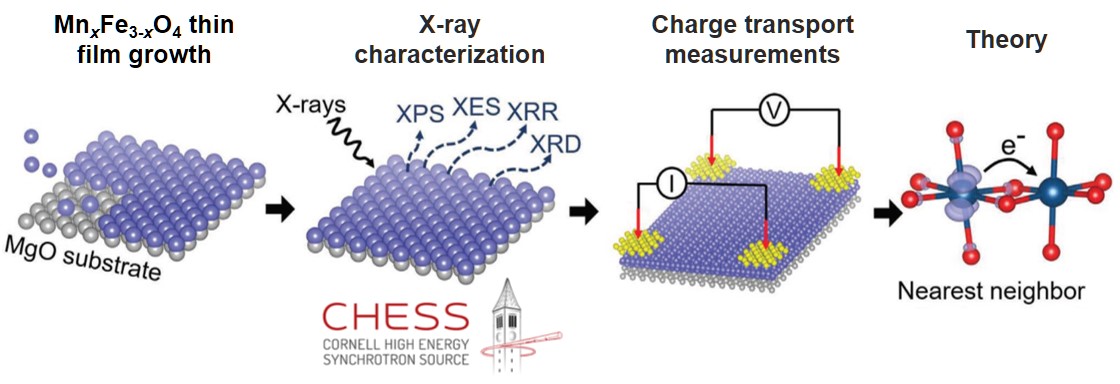
The principal challenges in current thermoelectric power generation modules are the availability of stable, diffusion-resistant, lossless electrical and thermal metal–semiconductor contacts that do not degrade at the hot end nor cause reductions in device efficiency. Transverse thermoelectric devices, in which a thermal gradient in a single material induces a perpendicular voltage, promise to overcome these problems.
A Classic Model for Oxides gets a much-needed Update
A PARADIM for Jumpstarting Academic Careers
Nov 1, 2020
Cornell University

A PARADIM for Jumpstarting Academic Careers

Materials Innovation Platforms provide free access and training at state-of-the-art equipment. Based on accepted projects to use PARADIM, our User Program is particularly interesting for young researchers and faculty at the start of their own research group, when required equipment or well-trained personnel might not be readily available at their home institutions.

Breakdown of early careers launched by PARADIM

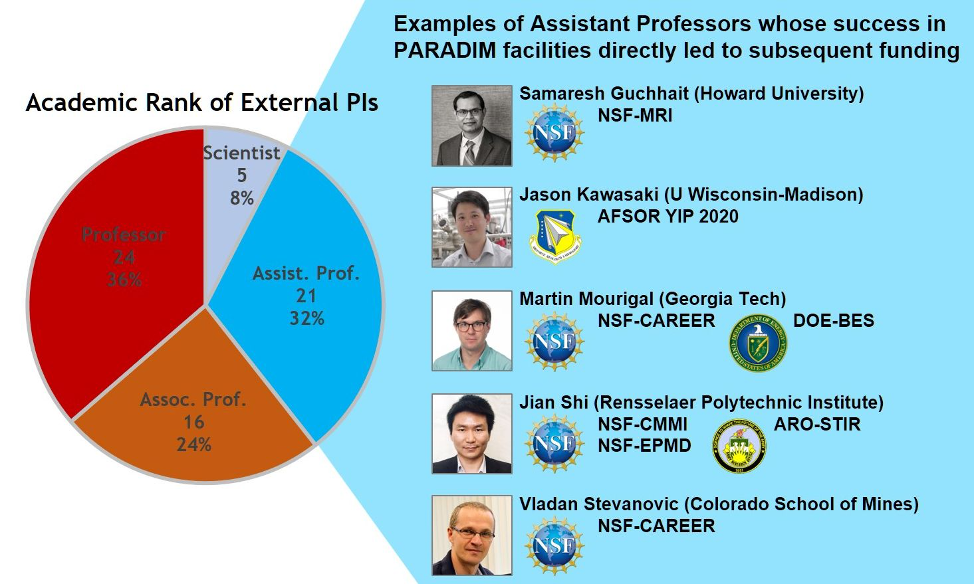
Figure:  Pie chart representing the distribution of academic ranks among PARADIM's 66 external PIs, Scientists 8%, Assistant Professors 32%, Associate Professors 24%, and Full Professors 36%. Portraits of 5 examples of Assistant Professors whose success at PARADIM led to subsequent funding.

Details of Presented Examples:

Prof. Samaresh Guchhait (Howard): NSF MRI, “Acquisition of a Physical Property Measurement System to Study Quantum, Magnetic and Functional Materials and Quantum Devices,” https://www.nsf.gov/awardsearch/showAward?AWD_ID=2018579.

Prof. Jason Kawasaki (U Wisconsin-Madison): AFOSR YIP: "Topological superconductivity and induced phase transitions in strained Heusler membranes and twisted bilayers,” https://www.afrl.af.mil/News/Article-Display/Article/2406086/afosr-awards-grants-to-36-scientists-and-engineers-through-its-young-investigat/.

Prof. Martin Mourigal (Georgia Tech): NSF-DMR: “CAREER: Anomalous spin dynamics in triangular quantum magnets: from materials discovery to quantitative neutron spectroscopy,” https://www.nsf.gov/awardsearch/showAward?AWD_ID=1750186 and DOE-BES: “New Controlling quantum coherence in frustrated spin-orbit magnets“ (DE-SC0018660).

Prof. Jian Shi (RPI): PARADIM provided important results for obtaining tenure at home institution and the following grants: NSF award CMMI #2024972, “Scalable Manufacturing of Single Crystalline Halide Perovskite Film via Interface Engineering,” https://www.nsf.gov/awardsearch/showAward?AWD_ID=2024972;  NSF award EPMD #2031692 “Symmetry-protected spin dynamics in ferroelectric spin device” https://www.nsf.gov/awardsearch/showAward?AWD_ID=2031692; and ARO STIR.

Prof. Vladan Stevanovic (Colorado School of Mines): NSF-DMR: “CAREER: Toward Rational Discovery and Design of Metastable Materials” https://www.nsf.gov/awardsearch/showAward?AWD_ID=1945010.

User Data Statistics.

66 PIs and their research groups from universities and research centers across the US (only non-PARADIM institutions) received access to PARADIM based on reviewed proposals: Full Professor: 24 (36%), Assoc. Prof.: 16 (24%), Assist. Prof.: 21(32%), Scientist: 5 (8%)
Research Highlight
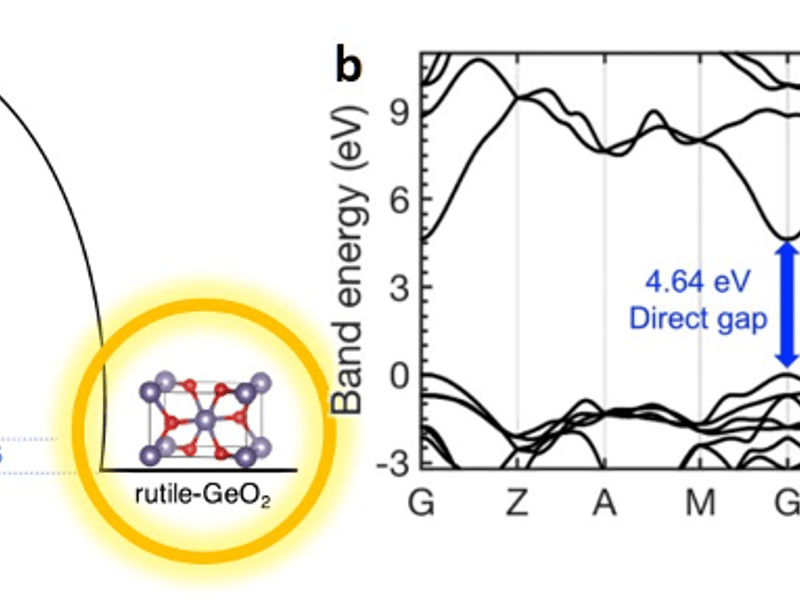
Figure 1: Rutile-GeO2, a promising material: identified by theory—realized at PARADIM. a) Reaction coordinate energy diagram for common phases of GeO2, including quartz GeO2, glass GeO2, and rutile GeO2, and the volatile species GeO. b) Band structure of rutile GeO2 with the direct bad gap of 4.64 eV indicated. c) Phase diagram of substrate temperature and ozone pressure used for the growth of various samples. Property of the achieved sample (crystalline or amorphous) is indicated.
Aug 21, 2020
Cornell University

Realizing a New Semiconductor for Power Electronic Applications 

John T. Heron and Emmanouil Kioupakis, University of Michigan

Materials discovery is more than calculating the properties that a material should have if the atoms were in desired positions. It is also key to get the atoms into those desired positions, to see what the properties really are, and thus realize the potential benefit of a new material. Making this happen takes a combination of ideas, capabilities, and execution—as the recent success by a team led by Assistant and Associate Professors from the University of Michigan illustrates.
Aug 1, 2020
Cornell University

Suboxide Molecular Beam Epitaxy—A new Thin Film Growth PARADIM

PARADIM’s in-house team worked with a collaborator at Penn State to develop a new variant of MBE that we call “suboxide MBE.” In contrast to conventional MBE where the molecular beams are elemental, in suboxide MBE the molecular beams are pre-oxidized. Achieving the desired suboxide beams relies on extensive thermodynamic calculations made for the entire periodic table, as shown in Figure 1. [1]