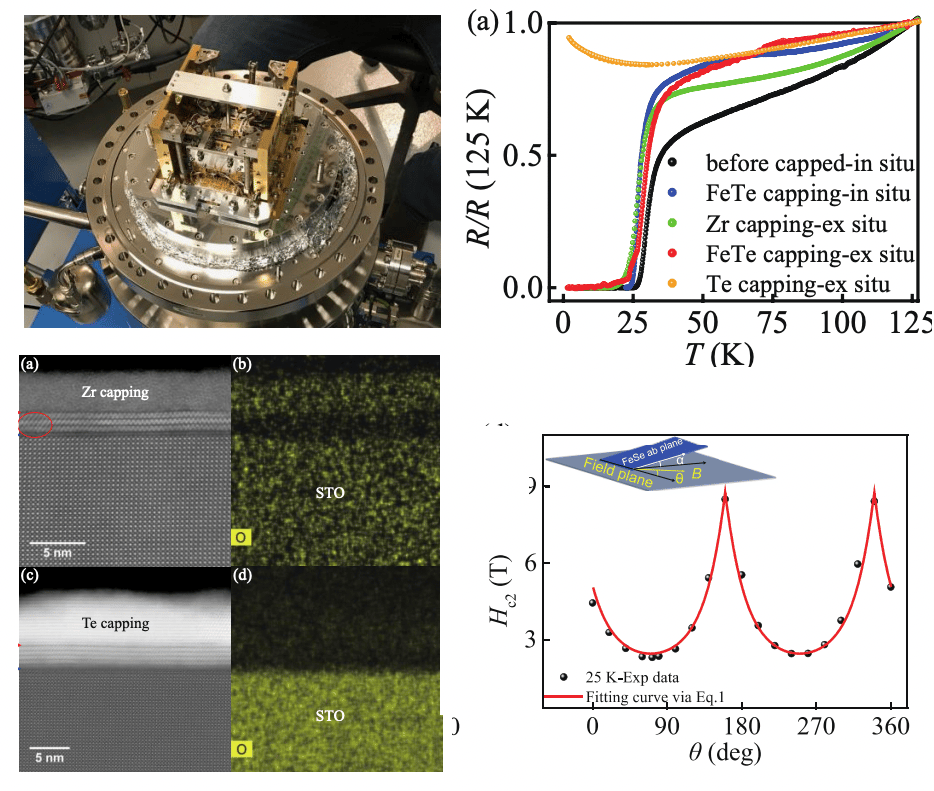
Understanding the superconductivity at the interface of FeSe/SrTiO3 is a problem of contemporary interest in condensed matter physics because of the significant increase in the critical temperature (Tc ~ 50 K) for the onset of superconductivity compared to that of bulk FeSe crystals (Tc ~ 9 K). Additional interest in this problem arises from the possibility of an unconventional pairing mechanism. We used the 2DCC multimodule molecular beam epitaxy (MBE) and surface characterization facility to study the influence of various capping layers on the Tc of ultrathin films of FeSe grown on SrTiO3. The multimodule facility’s in vacuo four-probe electrical resistance measurement capability provided critical information about the Tc of MBE-grown FeSe films in their pristine state, while ex situ magneto-transport measurements elucidated the key role of distinct charge transfer from different capping layers (compound FeTe, non-metallic Te, and metallic Zr). Our results show that FeTe provides an optimal cap that barely influences the inherent Tc found in pristine FeSe/SrTiO3, while the transfer of holes from a non-metallic Te cap completely suppresses superconductivity and leads to insulating behavior. We also used ex situ magneto-resistance measurements in FeTe-capped FeSe films to extract the angular dependence of the in-plane upper critical magnetic field. Our observations reveal an almost isotropic in-plane upper critical field. Although this does not show any obvious signature of exotic physics, our study provides insight into the symmetry and pairing mechanism of high temperature
superconductivity in FeSe.
superconductivity in FeSe.
 Download
Publication
Capping layer influence and isotropic in-plane upper critical field of the superconductivity at the FeSe/SrTiO3 interface
Physical Review Materials
View Publication

2D Crystal Consortium - Materials Innovation Platform (2DCC-MIP)
The 2DCC-MIP combines a vibrant in-house research effort focused on transformative advances in the synthesis and characterization of 2D chalcogenide layered materials with a robust external user program that provides access to expertise and state-of-the-art facilities. The 2DCC-MIP platform enables cutting edge research and discovery, across in-house research and the user program, on the synthesis and characterization of 2D chalcogenide materials by a national user community guided by four science drivers: Physics of 2D Systems, Epitaxy of 2D Chalcogenides, Next-generation 2D Electronics, and Advanced Characterization and Modeling.