Research Highlights
Mar 24, 2022
Pennsylvania State University
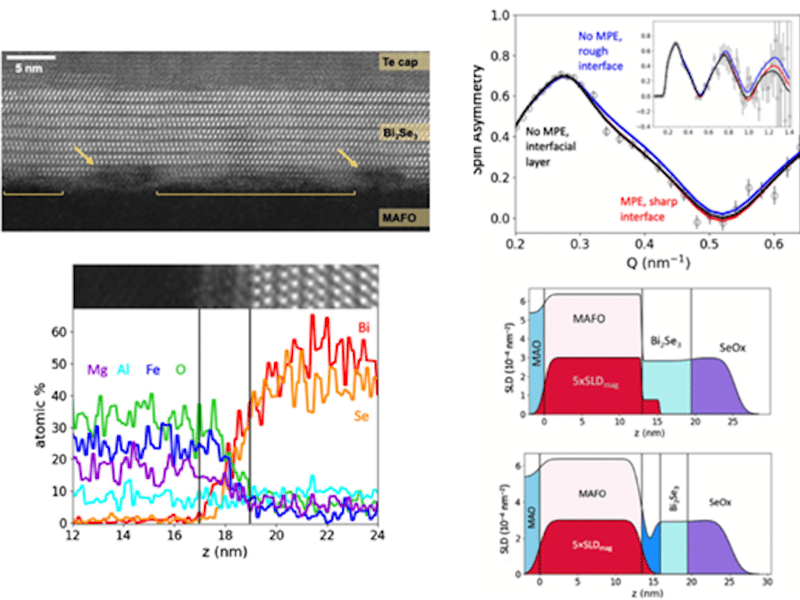
Understanding signatures of emergent magnetism in topological insulator/ferrite bilayers
Lauren J. Riddiford,, Yuri Suzuki, Alexander J. Grutter, Peng Li, Timothy Pillsbury, Max Stanley, Danielle Reifsnyder Hickey, Nasim Alem, Nitin Samarth
Magnetic proximity effects have been studied in a variety of magnetic heterostructures for many applications including spintronics, valleytronics, and topological phenomena.
Mar 18, 2022
Cornell University
The Dawn of a New Generation of High-Brightness Electron Sources
The ultimate performance of some of the most powerful characterization tools including x-ray free electron lasers, ultrafast electron microscopes, and particle accelerators are determined by the ability of their electron sources to emit electrons. This small, yet vital element of these multimillion to multibillion dollar systems, has the potential to be improved greatly; the performance of commonly used electron sources pales in comparison to the theoretical limit due to roughness, disorder, and polycrystallinity. The path to maximally efficient electron sources is thus believed to lie with single-crystal films, where the smoothness, homogeneity, and termination can be controlled at the atomic level. Unfortunately, the most desired materials for electron sources contain highly reactive species like cesium, which has stymied the preparation of single-crystal films of these desired electron sources—until now.
Mar 16, 2022
University of California, Santa Barbara
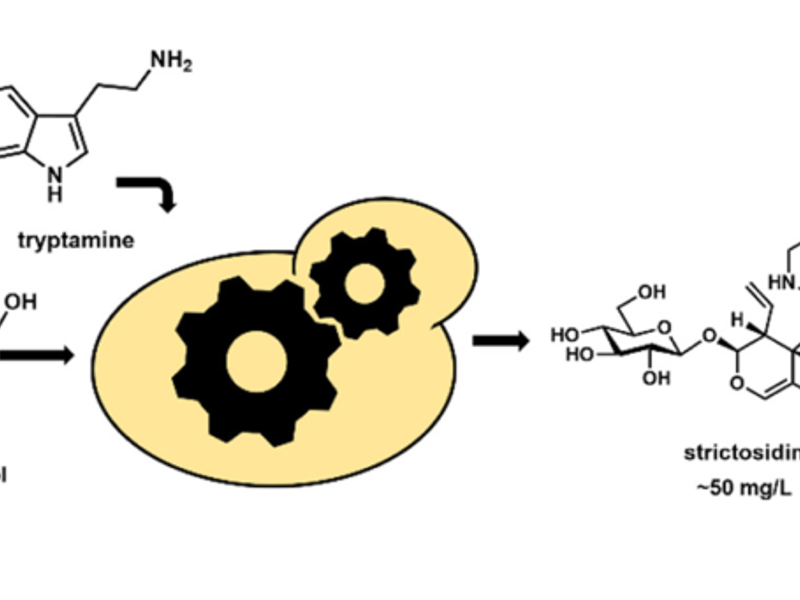
Engineered Production of Strictosidine and Analogues in Yeast
Joshua Misa, John M. Billingsley, Kanji Niwa, Rachel K. Yu, and Yi Tang (UCLA)
Development of a yeast-based platform for high-titer production of the universal monoterpene indole alkaloids (MIA) precursor, strictosidine.
Feb 21, 2022
Pennsylvania State University
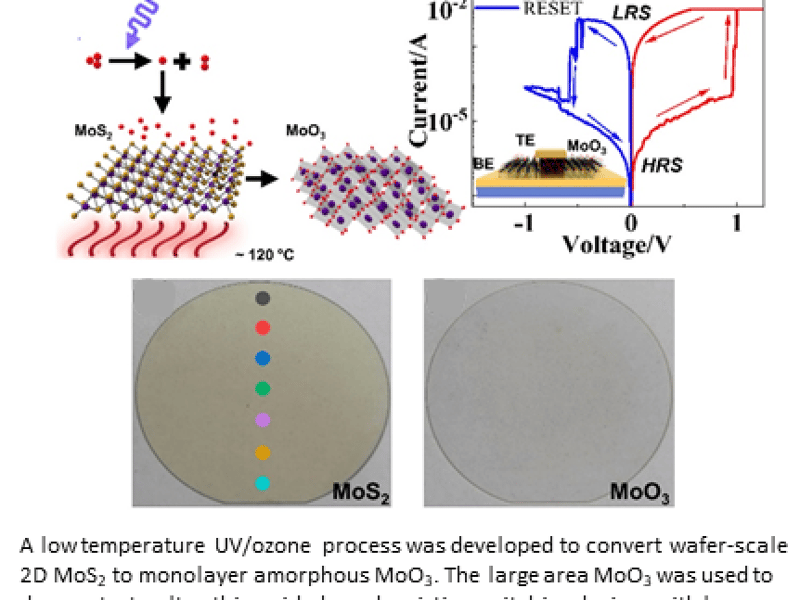
Wafer Scalable Single-Layer Amorphous MoO3
This study demonstrates a facile route to obtain wafer-scale monolayer amorphous MoO, using monolayer 2D MoS, grown by metalorganic chemical vapor deposition (MOCVD) as a starting material, following by UV-ozone oxidate at substrate temperatures as low as 120-C. The process yields smooth, continuous, uniform and stable monolayer oxide with wafer-scale homogeneity.
Feb 4, 2022
Cornell University
Metallicity of Ultrathin SrIrO3/SrRuO3 Heterostructures
J.N. Nelson, N.J. Schreiber, A.B. Georgescu, B.H. Goodge, B.D. Faeth, C.T. Parzyck, C. Zeledon, L.F. Kourkoutis, A.J. Millis, A. Georges, D.G. Schlom, K.M. Shen
Ultrathin quantum materials present a unique platform for the control of electronic, magnetic, and topological properties. A commonly observed phenomenon in many ultrathin quantum materials is that an undesired crossover from a metallic to insulating state occurs below a critical thickness. This presents a potential challenge for realizing ultrathin heterostructures of quantum materials when metallic properties are desired.
Jan 24, 2022
Cornell University
Robotic Assembly of Quantum Fabrics from Atomically Thin Layers
Quantum fabrics offer novel electronic, magnetic, or topological textures with functionalities that do not exist in bulk and could play an important role in future quantum technologies. Quantum fabrics are created by weaving together "threads" with different properties, such as superconductivity or magnetism. One method to make them is the atomically precise assembly of layered two-dimensional Van der Waals (vdW) materials. This assembly has traditionally been accomplished using artisan methods from micromechanical exfoliated flakes, but such fabrication is not compatible with scalable and rapid manufacturing.
Jan 20, 2022
Cornell University
Polytype Engineering—A new Route to Accessing 2D Quantum States
Charge density waves (CDW) are an emergent periodic modulation of the electron density that permeates crystals with strong electron-lattice coupling. TaS:2: and TaSe:x:S:2-x: host several charge density wave states that spontaneously break crystal symmetries, mediate metal-insulator transitions, and compete with superconductivity. These quantum states are promising candidates for novel devices, efficient ultrafast nonvolatile switching, and suggest elusive chiral superconductivity.
Jan 1, 2022
University of California, Santa Barbara
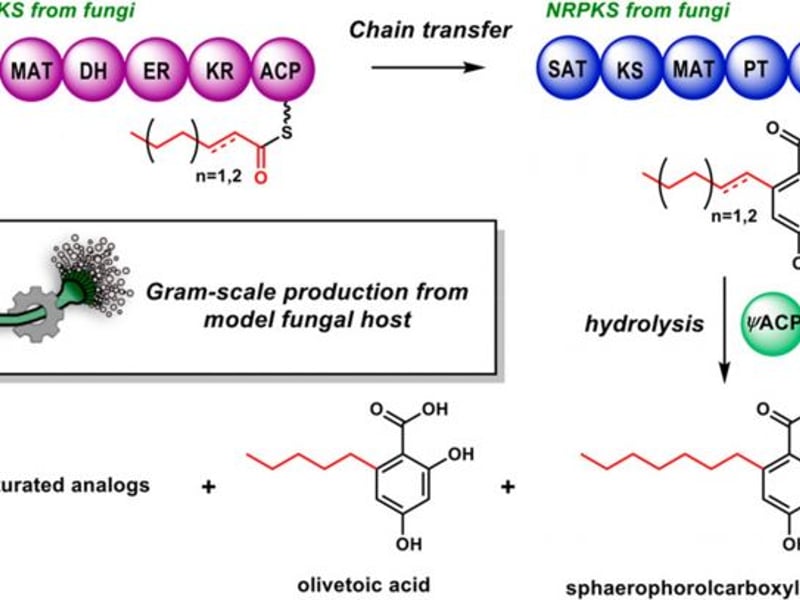
High-Titer Production of Olivetolic Acid in Engineered Fungal Host
Ikechukwu C. Okora, Mengbin Chen, Yi Tang
A non-plant biosynthetic pathway that produces olivetolic acid (OA) has been elucidated.
Jan 1, 2022
University of California, Santa Barbara
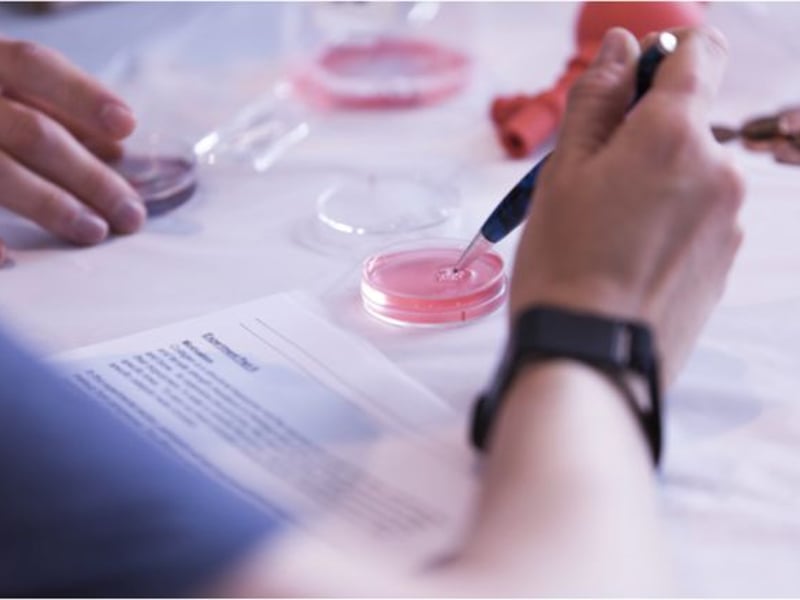
2021 Biopolymers Elementary Workshop for Teachers
As part of its outreach mission, BioPACIFIC MIP sponsored a ‘Biopolymers Elementary Workshop’ for elementary and middle school teachers.
Jan 1, 2022
University of California, Santa Barbara
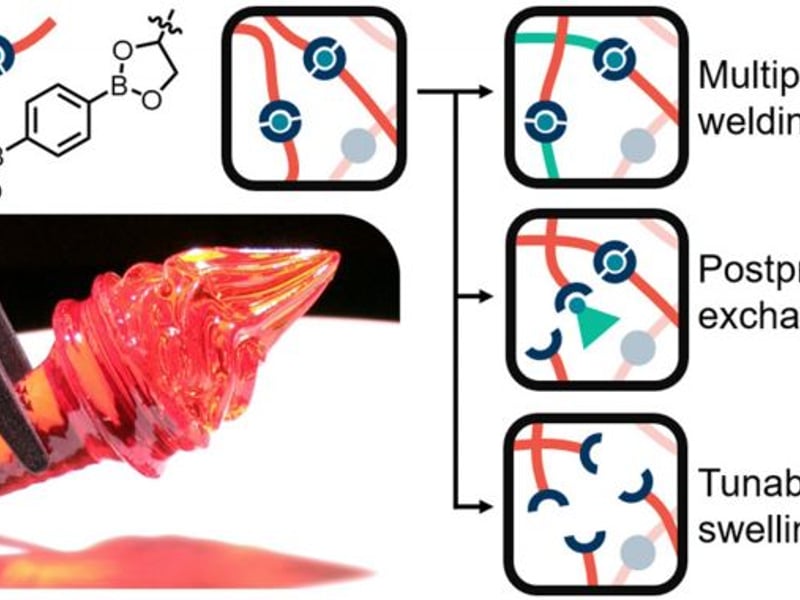
Modular 3D-Printed Polymer Networks
Lindsay L. Robinson, Jeffrey L. Self, Alexander D. Fusi, Morgan W. Bates, Javier Read de Alaniz, Craig J. Hawker, Christopher M. Bates, Caitlin S. Sample
A strategy for making a new class of additive manufacturing resins has been developed.
Showing 101 to 110 of 237