
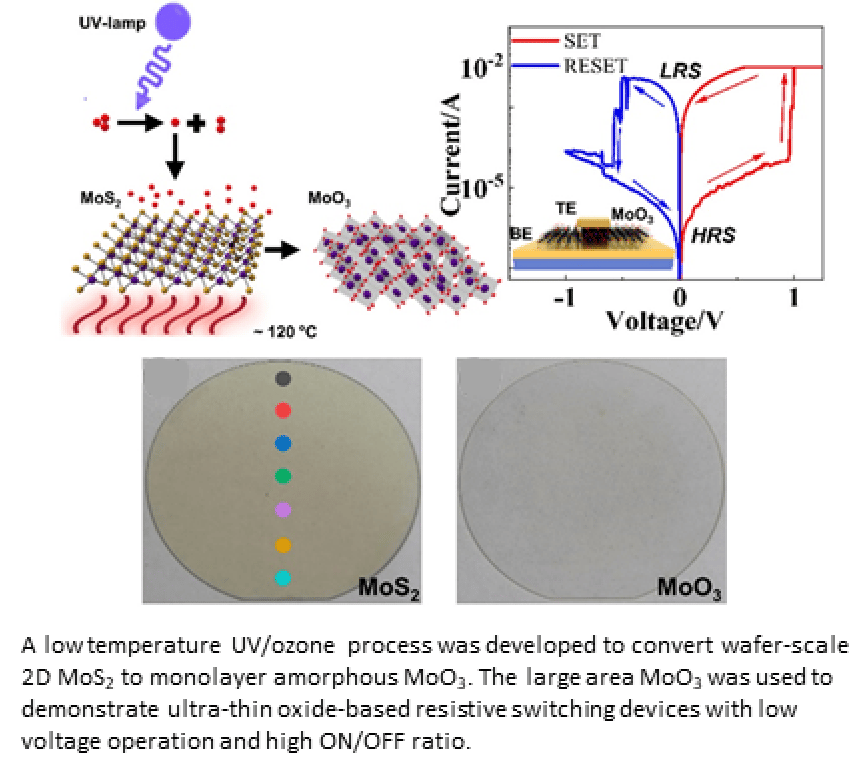
Summary: Molybdenum trioxide (a-MoO.) is a wide bandgap 2D UV.amr layered oxide (Eg-3 eV) that is of interest for resistive switching-based nonvolatile memory devices. It is difficult to produce large-area monolayer MoO through exfoliation of bulk crystals or other techniques. This study demonstrates a facile route to obtain wafer-scale monolayer amorphous MoO, using monolayer 2D MoS, grown by metalorganic chemical vapor deposition (MOCVD) as a starting material, following by UV-ozone oxidate at substrate temperatures as low as 120-C. The process yields smooth, continuous, uniform and stable monolayer oxide with wafer-scale homogeneity. Using the subnanometer MoO as the active layer sandwiched between two metal electrodes, we demonstrate the thinnest oxide-based nonvolatile resistive switching memory with low voltage operation and high ON/OFF ratio. These results, which are potentially extendable to other transition metal oxides, will enable further exploration of subnanometer stoichiometric MoO, extending the frontiers of ultrathin flexible oxide materials and devices. Published in ACS Nano (2022),
 Download

2D Crystal Consortium - Materials Innovation Platform (2DCC-MIP)
The 2DCC-MIP combines a vibrant in-house research effort focused on transformative advances in the synthesis and characterization of 2D chalcogenide layered materials with a robust external user program that provides access to expertise and state-of-the-art facilities. The 2DCC-MIP platform enables cutting edge research and discovery, across in-house research and the user program, on the synthesis and characterization of 2D chalcogenide materials by a national user community guided by four science drivers: Physics of 2D Systems, Epitaxy of 2D Chalcogenides, Next-generation 2D Electronics, and Advanced Characterization and Modeling.