Research Highlights
Jan 1, 2022
University of California, Santa Barbara
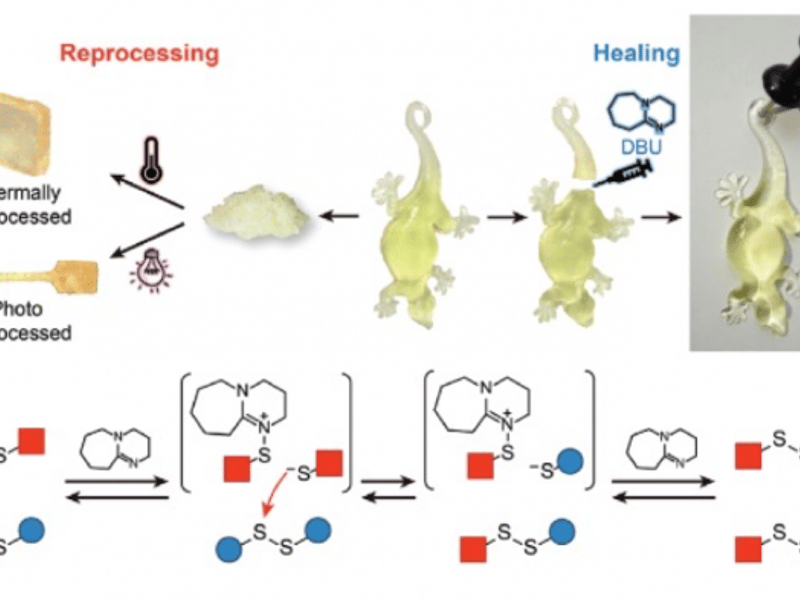
Digital Light Processing of Dynamic Bottlebrush Materials
Chungryong Choi, Yoichi Okayama, Parker T. Morris, Lindsay L. Robinson, Matthias Gerst, Joshua C. Speros, Craig J. Hawker, Javier Read de Alaniz, Christopher M. Bates
3D printing resins that generate super-soft, dynamic, and self-healable elastomers.
Jan 1, 2022
University of California, Santa Barbara
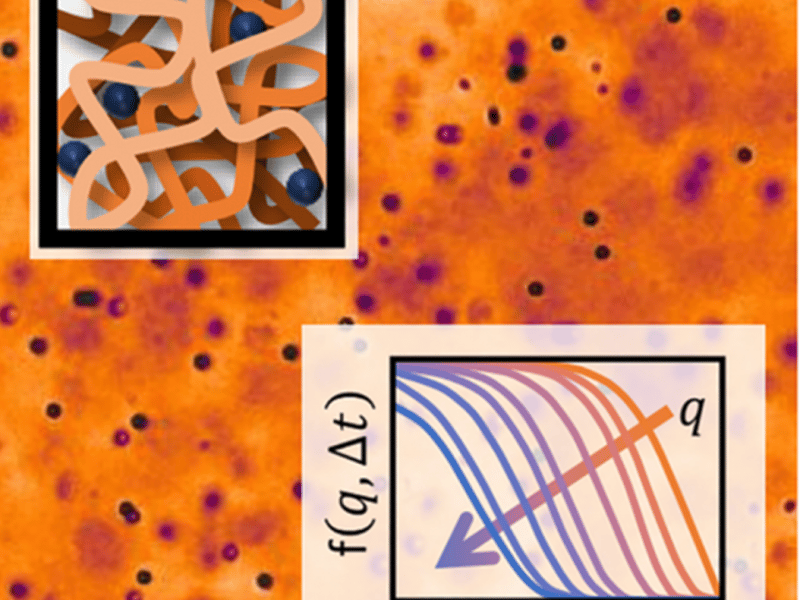
Differential Dynamic Microscopy for the Characterization of Polymer Systems
Roberto Cerbino, Fabio Giavazzi, Matthew E. Helgeson
Differential Dynamic Microscopy or “dynamic light scattering on a microscope” enables access to sample dynamics across a wide range of scattering wave-vectors using video microscopy, enabling contemporary polymer science experiments that would otherwise be difficult or impossible with standard light scattering techniques.

Jan 1, 2022
Cornell University
A PARADIM for Jumpstarting Academic Careers—Update 2022
PARADIM Highlight #56 describes the External User Program (2022), offering free access, training, and staff support to early-career researchers via Materials Innovation Platforms. Projects enable hands-on Materials-by-Design work. The highlight features several assistant professors whose PARADIM activity led to subsequent funding (NSF CAREER, Sloan Fellows, AFOSR YIP, ONR YIP).
Dec 24, 2021
Cornell University
Quantum View of a Superconductor-Semiconductor Junction
Currently, electronic device technology is based mainly on semiconductors. It first emerged in the middle of the 20:th: century and has improved ever since. Further technological advances including energy efficiency and information security might profit from exploiting quantum mechanical properties that are present in superconductors. The challenge is how to combine the two states and to make sure to get the best of both electrical worlds. A collaboration of researchers from Cornell and the Paul Scherrer Institute (PSI) in Switzerland grew thin films of the superconductor niobium nitride (NbN) on top of gallium nitride (GaN), a semiconductor and vital component in many optical and power electronics. The team measured the electronic properties of the two materials directly at their interface using soft-X-ray angle-resolved photoelectron spectroscopy (ARPES).
![Figure 1: (a) Sketch of the experimental time-domain terahertz spectroscopy setup. A dc magnetic field is applied along the sample’s c axis in the Faraday geometry (parallel to the THz propagation). (b)-(g) Single-ion states of Fe2+ ions accessible at low energy correspond to S = 1 magnetic moments with uniaxial anisotropy. The sketches represent a plane of spins in the (b) ground state configuration, and examples of (c) a one-magnon elementary excitation (spin wave), (d) a two-magnon bound state (SIBS), (e) a 4-magnon bound state, (f) a 4-magnon antibound state, and (g) a 6-magnon bound state. The gray shadows represent the particular spins that are deviated as compared to the ground state. (h)-(i) Magnitude of the transmission coefficients for (h) right- and (i) left-handed circularly polarized lights (normalized to 1), at T = 4 K, as a function of frequency and magnetic field (horizontal striations are experimental artifacts). (j) Calculated ω[χ′′xx(q=0,ω)+χ′′yy(q=0,ω)] as a function of energy (or associated frequency) and magnetic field.](https://www.paradim.org/sites/default/files/inline-images/61_Fig1.jpg)
Dec 20, 2021
Cornell University
Discovery of Multimagnon Bound States in FeI2
Martin Mourigal (Georgia Tech), N. Peter Armitage (Johns Hopkins)
Magnons, or spin waves, are quasiparticles describing collective spin excitations of ordered magnets. When magnon-magnon interactions are strong, new multi-magnon excitations and bound states can emerge. Here, magnetic THz spectroscopy of the layered magnet FeI2 revealed a complex series of excitations beyond the one-magnon picture.
Dec 16, 2021
Cornell University
Metal Selenide-Carbon Nanofiber Composites for Battery Anodes
The ever-growing demand for electric vehicles and portable electronic devices continues to drive the craving for lightweight, high-energy-density, and long-lifespan batteries. Currently used lithium-ion batteries are limited by the capacity of the electrode and the scarcity of resources (lithium). The search for next-generation materials not only seeks to replace lithium with sodium but to provide suitable anode materials. Metal selenides (:M:Se, :M := Sn, Fe, Ni, Cu) offer the desired conductivity, stability, cost-effectiveness, and higher theoretical capacity compared to commercial graphite.
Nov 22, 2021
Cornell University
PARADIM – an Incubator for Collaborations II
Since the discovery of high-temperature superconductivity in copper-based oxides (cuprates), there has been a sustained effort to understand its origin and to discover new superconductors based on similar building principles. Indeed, superconductivity has recently been discovered in the doped rare-earth nickelate Nd:0.8:Sr:0.2:NiO:2:. Undoped NdNiO:2: is the infinite-layer end member of a larger family of layered nickelates, which can be explored by molecular-beam epitaxy (MBE).
Sep 24, 2021
University of California, Santa Barbara
Uncertainty Quantification and Estimation in Differential Dynamic Microscopy
Mengyang Gu, Matthew Helgeson, Megan Valentine
A statistical analysis that reduces computational times by 25-120 times in Differential Dynamic Microscopy (DDM), was achieved.
Sep 13, 2021
Cornell University
Stromataxy – Enabling the (otherwise) Unreachable
The properties of any material are largely governed by its constituting elements and the arrangement of those atoms. Different structures can result in vastly different behavior, even for the same chemical composition. Thus, to achieve a desired structure—the one with the desired properties—it is vital to be able to navigate synthesis pathways.:Here, users from the Naval Research Lab wanted to grow ScFeO3, where five different ways are known in which the same atoms can be arranged. In the past, different substrates have been used to select between the various polymorphs by altering the energetics of materials growth through a process known as epitaxial stabilization.
Jul 30, 2021
Cornell University
Cleaning up a Quantum Material: from Quantum Enigma to Quantum Oscillations
Sr:2:RuO:4: is the most disorder-sensitive superconductor known. It has also been a leading candidate for a novel type of quantum computer that would enable calculations to occur over much longer time scales before suffering decoherence than is the case for today’s superconductor-based quantum computers. Establishing whether Sr:2:RuO:4: is viable for such applications would be aided by the ability to make structures containing superconducting Sr:2:RuO:4: films.
Showing 111 to 120 of 237