
Latest News
Highlight ·
Pennsylvania State University
Graphene and Beyond Workshop - 2017 Edition
The Graphene and Beyond Workshop, in its 5th year (2nd year of joint sponsorship with 2DCC), is a collaboration between the Center for 2D and Layered Materials (2DLM) and the 2DCC-MIP at Penn State. The workshop aims to enhance synergy in the community and build toward a strong future in 2D crystal science and technology.
Highlight ·
Pennsylvania State University
Observation of Axion Physics in Condensed Matter
The strongly spin-momentum coupled electronic states on the surfaces of topological insulators (TIs) exist because of time-reversal symmetry. The theoretical description of these states is fundamentally analogous to a picture used to describe particles known as ‘axions’ theoretically postulated to exist in Nature but never observed. Demonstrating and understanding this conceptual analogy is important for gaining new insights into how our universe works.
Highlight ·
Pennsylvania State University
Sticking coefficients of selenium and tellurium
The sticking coefficients of thermally evaporated chalcogen elements selenium and tellurium were experimentally determined as a function of temperature. Their direct and quantitative determination provides important insights to comprehend and realistically model the growth kinetics of chalcogenide-based film growth.
Highlight ·
Pennsylvania State University
Epitaxial Growth of Large Area WSe2 Monolayers By Gas Source Chemical Vapor Deposition
Monolayer 2D transition metal dichalcogenides (TMDs) have been a focus of increasing interest due to their unique properties but the development of device technologies has been hampered by difficulties in synthesizing large area monolayer and few layer films. We developed a multi-step process involving nucleation, ripening and preferential lateral growth to achieve epitaxial WSe2 monolayers on sapphire by gas source chemical vapor deposition.
Highlight ·
Cornell University
1st Forum on NSF-DMR Materials Innovation Platforms
Materials Innovation Platforms (MIPs): are user facilities dedicated to accelerating materials discovery by providing a community of practitioners with access to cutting edge tools in theory, synthesis, and characterization and the ability to share knowledge effortlessly. MIPs are funded by the National Science Foundation (NSF) and are freely available to users from universities and national laboratories in the United States—from scientists just beginning their careers to seasoned experts—from all institutions.:
Highlight ·
Pennsylvania State University
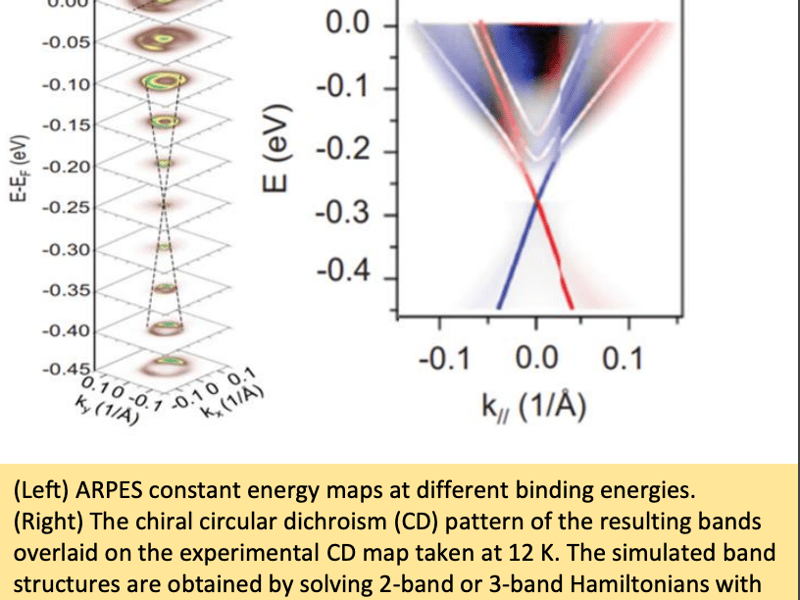
Origins of electronic bands in the antiferromagnetic topological insulator MnBi2Te4
Through an in-depth investigation by ARPES experiment and the numerical calculations, an upper bound of 3 meV for the gap size of the topological surface state (TSS) is estimated. Furthermore, we also reveal band chiralities for both the TSS and quasi-2D bands, which can be well reproduced in a band hybridization model based on the circular dichroism measurements.
Highlight ·
Pennsylvania State University
Strong Exciton Regulation of Raman Scattering
The 2DCC-MIP team has developed an efficient first-principles way to calculate excitonic resonant Raman intensities, thereby explaining the puzzling near-absence of resonant Raman response around the A and B excitons (band-edge excitations with very strong optical absorption) and the pronounced strength of the resonant Raman response from the C exciton (which arises from parallel valence and conduction bands). These insights can now be carried to other semiconducting systems.
Highlight ·
Pennsylvania State University
Local Optical Control Of Ferromagnetism And Chemical Potential In A Topological Insulator
Ferromagnetic topological insulators (TIs) have promise for applications in spintronics, metrology, and quantum computing. However, TI materials are fragile and often incompatible with nanofabrication techniques. We have developed a technique that enables persistent, micron-scale optical control of both magnetization and chemical potential in Cr-(Bi,Sb)2Te3 grown by MBE on SrTiO3.
Highlight ·
Pennsylvania State University
Graphene and Beyond Workshop: 2016-2019 Summary
The 2DCC completed its 4th year of sponsorship of the Graphene and Beyond Workshop. To date, >650 individuals from academia, government and industry across all career levels have attended. The 2DCC has broadened participation by sponsoring travel and registration for dozens of users and potential users particular from MSIs and PUIs. The workshop enhances community synergy toward a strong future in 2D crystal science and technology.
Highlight ·
Pennsylvania State University
Epitaxial growth of large area WSe2 monolayers by gas source chemical vapor deposition
Monolayer 2D transition metal dichalcogenides (TMDs) have been a focus of increasing interest due to their unique properties but the development of device technologies has been hampered by difficulties in synthesizing large area monolayer and few layer films. We developed a multi-step process involving nucleation, ripening and preferential lateral growth to achieve epitaxial WSe2 monolayers on sapphire by gas source chemical vapor deposition.
Showing 341 to 350 of 363