
Latest News
Highlight ·
Pennsylvania State University
Scientific Travel Extension Program For Outreach Representatives Working to Advance Research Diversity (STEPFORWARD)
STEPFORWARD is a geospatial tool built on Google Maps API to identify minority serving institutions (MSIs), primarily undergraduate institutions (PUIs) and non-R1 institutions within a geographical radius of travel. Higher Education R&D data highlights institutions active in research fields of interest. The tool enables 2DCC researchers and the broader community to identify a diverse range of institutions for outreach visits and research interactions. The 2DCC supports visits to these institutions as part of a travel extension program.
Highlight ·
Pennsylvania State University
Studying the influence of a capping layer on interfacial superconductivity in FeSe/SrTiO3 heterostructures
Understanding the superconductivity at the interface of FeSe/SrTiO3 is a problem of contemporary interest in condensed matter physics because of the significant increase in the critical temperature (Tc ~ 50 K) for the onset of superconductivity compared to that of bulk FeSe crystals (Tc ~ 9 K). Additional interest in this problem arises from the possibility of an unconventional pairing mechanism. We used the 2DCC multimodule molecular beam epitaxy (MBE) and surface characterization facility to study the influence of various capping layers on the Tc of ultrathin films of FeSe grown on SrTiO3.
Highlight ·
Pennsylvania State University
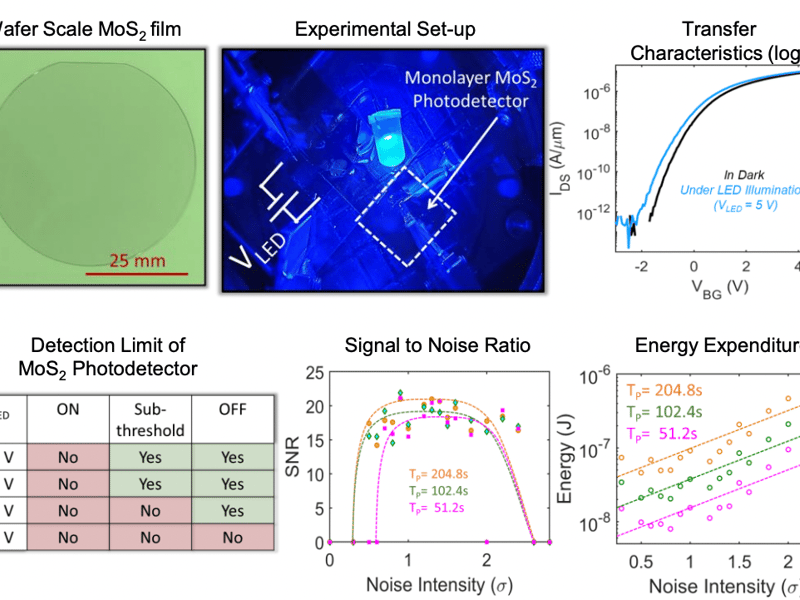
Stochastic Resonance In MoS2 Photodetector
In this project, we use a novel approach for next generation ultra-low-power sensor design by embracing the evolutionary success of animals with extraordinary sensory information processing capabilities that allow them to survive in extreme and resource constrained environments.
Highlight ·
Pennsylvania State University
Evidence of 2D Room-temperature Magnetic Semiconductors
Dilute magnetic semiconductors, achieved through substitutional doping of magnetic atoms into semiconducting systems, enable experimental modulation of spin dynamics for novel magneto-electric or magneto-optical devices, especially in 2D transition metal dichalcogenides that accentuate interactions and activate valley degrees of freedom.
Highlight ·
Pennsylvania State University
Topological Hall Effect in Topological Insulator/Magnetic Insulator Bilayer
The topological Hall effect (THE) is a phenomenon that is a consequence of a Berry phase created by spin textures in real space. Interfacing a topological insulator with a magnetic insulator provides a model platform for studying this phenomenon in a well-controlled manner. This paper reports the first clear evidence for the THE in heterostructures that combine a model topological insulator (Bi2Se3) with a ferromagnetic insulator (BaFe12O19).
Highlight ·
Pennsylvania State University
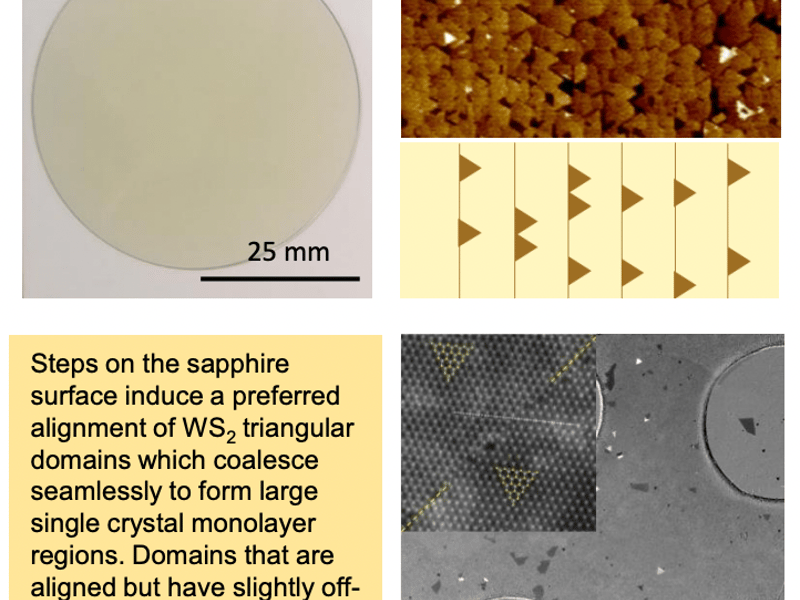
Wafer scale epitaxial growth of unidirectional WS2 monolayers on sapphire
Realization of wafer-scale single-crystal films of transition metal dichalcogenides (TMDs) such as WS2 requires epitaxial growth and coalescence of oriented domains to form a continuous monolayer. The domains must be oriented in the same crystallographic direction on the substrate to inhibit the formation of inversion domain boundaries (IDBs), which form when oppositely oriented triangular domains coalesce.
Highlight ·
Pennsylvania State University
Ferromagnetism in van der Waals compound MnSb1.8Bi0.2Te4
MnBi2Te4 has recently been established as the first intrinsic antiferromagnetic (AFM) topological insulator. Although quantum anomalous Hall effect (QAHE) has been observed in MnBi2Te4, it is only realized with odd numbers of septuple layers due to the AFM interlayer coupling. Therefore, it is crucial to stabilize ferromagnetic (FM) phase in MnBi2Te4. We have discovered a new FM phase with the Curie temperature of 26 K in the MnSb1.8Bi0.2Te4 sample through tuning growth conditions, in contrast to the AFM order seen in the Mn(Bi1-xSbx)2Te4 family.
Highlight ·
Pennsylvania State University
Unveiling Intervalley Scattering In 2D Crystals
Double resonance in two-dimensional MoS2 reveals the dynamics of excitons – robust elementary excitations of a 2D crystal – between two sets of low-energy states known as valleys. The accurate assignment of vibrational signatures elucidates the essential physics limiting the performance of a novel class of “valleytronic” devices exploiting the selectivity of valleys to incident light carrying different polarizations.
Highlight ·
Pennsylvania State University
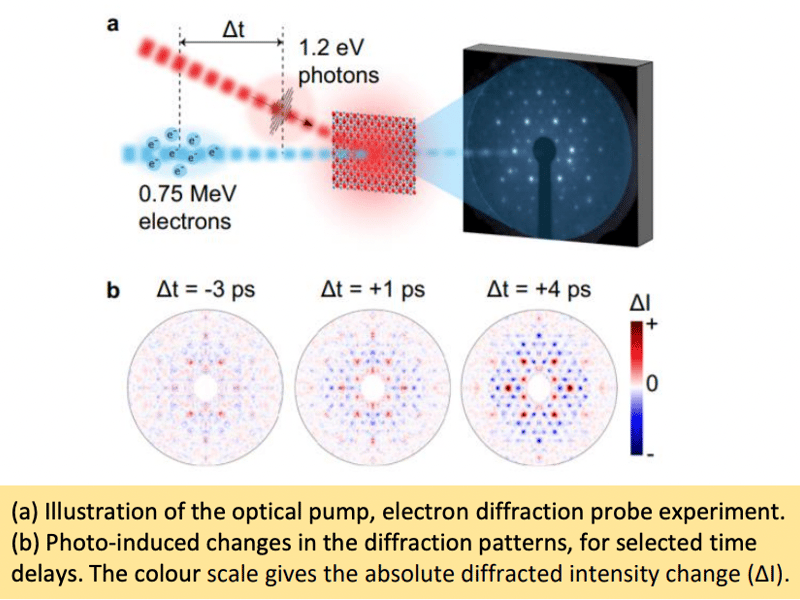
Ultrafast optical melting of trimer superstructure in layered 1T′-TaTe2
The Kaindl group at Lawrence Berkeley National Lab recently reported the ultrafast investigation of 1T’-TaTe2, demonstrating a rapid picosecond melting of its trimer cluster lattice superstructure in the low temperature phase.
Highlight ·
Pennsylvania State University
Room-temperature spin-orbit torque switching induced by a topological insulator
While previous studies show a large discrepancy of the charge-spin conversion efficiency in topological insulators (TI), the 2DCC research group reports spin-orbit torque switching in a TI-ferrimagnet heterostructure with perpendicular magnetic anisotropy at room temperature.
Showing 331 to 340 of 363