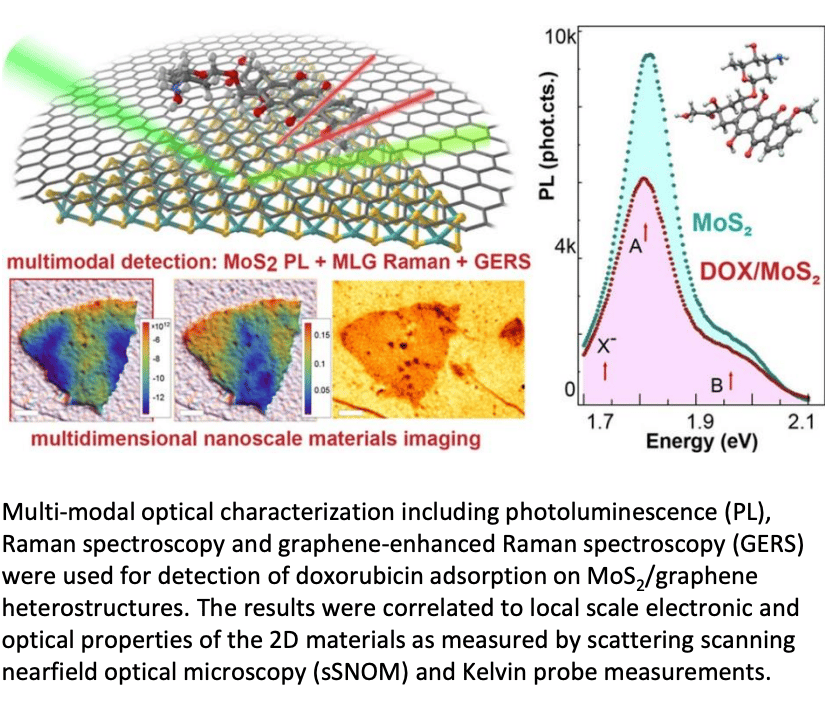
A multi-dimensional optical imaging technique that combines scattering was developed to map subdiffractional distributions of doping and strain in MoS2 and MoS2 /graphene vertical heterostructures. The variations in doping and strain were correlated to electronic properties and were used to understand the behavior of biosensors fabricated using the 2D material. Optical label-free detection of doxorubicin, a common cancer drug was reported via three independent optical detection channels (photoluminescence shift, Raman shift and graphene enhanced Raman scattering). Non-uniform broadening of the components of the multimodal signal correlated with the statistical distribution of local optical properties of the heterostructure. The results demonstrate the ability of multidimensional nanoscale imaging to reveal the physical origin of a local response and propose a strategy to mitigate materials variability for future fabrication of multiplexed biosensing devices. Published in ACS Nano 16, 2598-2607
(2022).
(2022).
 Download

2D Crystal Consortium - Materials Innovation Platform (2DCC-MIP)
The 2DCC-MIP combines a vibrant in-house research effort focused on transformative advances in the synthesis and characterization of 2D chalcogenide layered materials with a robust external user program that provides access to expertise and state-of-the-art facilities. The 2DCC-MIP platform enables cutting edge research and discovery, across in-house research and the user program, on the synthesis and characterization of 2D chalcogenide materials by a national user community guided by four science drivers: Physics of 2D Systems, Epitaxy of 2D Chalcogenides, Next-generation 2D Electronics, and Advanced Characterization and Modeling.