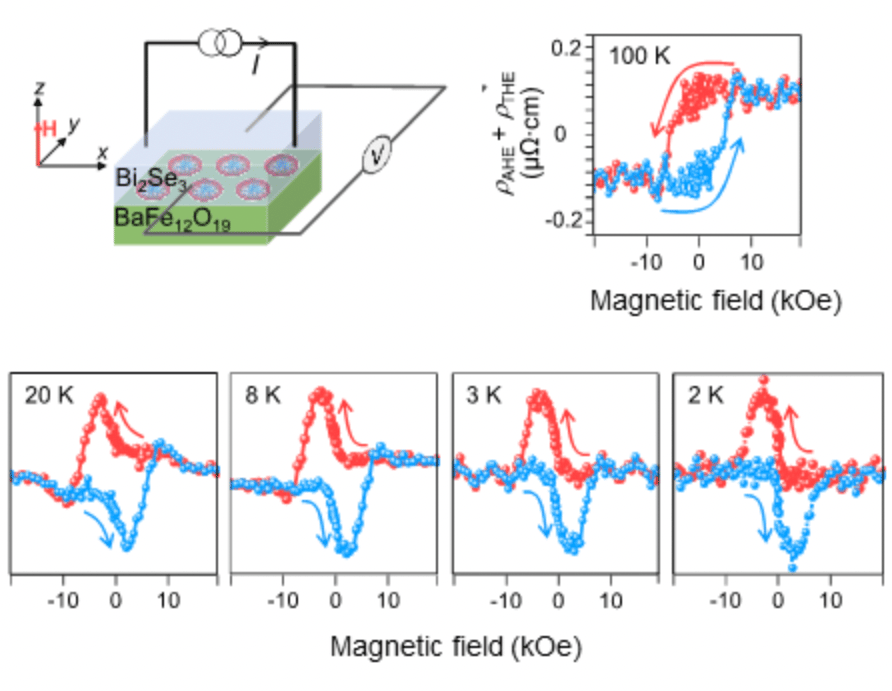
The topological Hall effect (THE) is a phenomenon that is a consequence of a Berry phase created by spin textures in real space. Interfacing a topological insulator with a magnetic insulator provides a model platform for studying this phenomenon in a well-controlled manner. This papers reports the first clear evidence for the THE in heterostructures that combine a model topological insulator (Bi2Se3) with a ferromagnetic insulator (BaFe12O19). The key signature of the THE is an “excess” Hall resistance when the perpendicular to the plane magnetization of the ferromagnet is reversed by an external magnetic field. These samples show a conventional anomalous Hall effect (AHE) at high temperature (T > 80 K) but a pure THE develops in the temperature range of T = 2–3 K. Over T = 3–80 K, the two effects coexist but show opposite temperature dependence. Control measurements, calculations, and simulations together suggest that the observed THE originates from skyrmions (spin textured “bubbles”) that arise due to a Dzyaloshinskii–Moriya interaction at the interface. The estimated strength of this interaction is substantially higher than that in more conventional heavy metal-based systems widely studied in the spintronics community. Publication: Nano Lett. 2021, 21, 1, 84–90
 Download

2D Crystal Consortium - Materials Innovation Platform (2DCC-MIP)
The 2DCC-MIP combines a vibrant in-house research effort focused on transformative advances in the synthesis and characterization of 2D chalcogenide layered materials with a robust external user program that provides access to expertise and state-of-the-art facilities. The 2DCC-MIP platform enables cutting edge research and discovery, across in-house research and the user program, on the synthesis and characterization of 2D chalcogenide materials by a national user community guided by four science drivers: Physics of 2D Systems, Epitaxy of 2D Chalcogenides, Next-generation 2D Electronics, and Advanced Characterization and Modeling.