Latest News

Courtesy of 2DCC News
News · Jul 26, 2023
Pennsylvania State University

Solution found to problem bedeviling semiconductor researchers
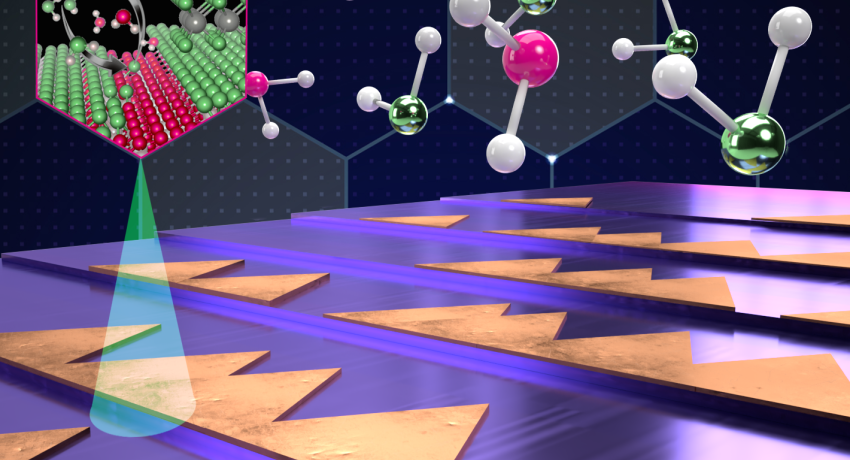
Researchers from the 2D Crystal Consortium developed a method using metal organic chemical vapor deposition (MOCVD) to synthesize high-quality tungsten diselenide for 2D semiconductors, addressing the issue of mirror twin boundaries. This advancement is crucial for enhancing semiconductor technology for next-generation electronics like AI and IoT.
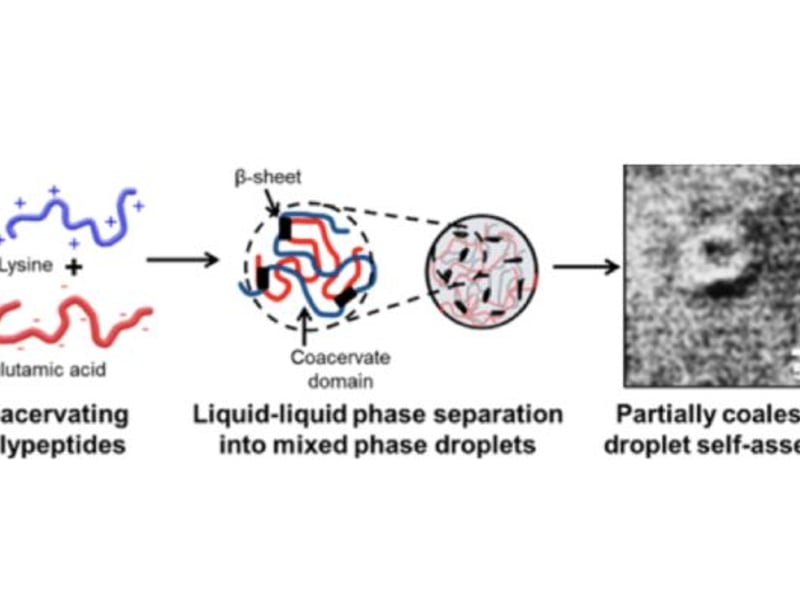
Aqueous mixtures of oppositely charged homochiral polypeptides reveal unexpectedly diverse morphologies at high polypeptide concentration and ionic strength.
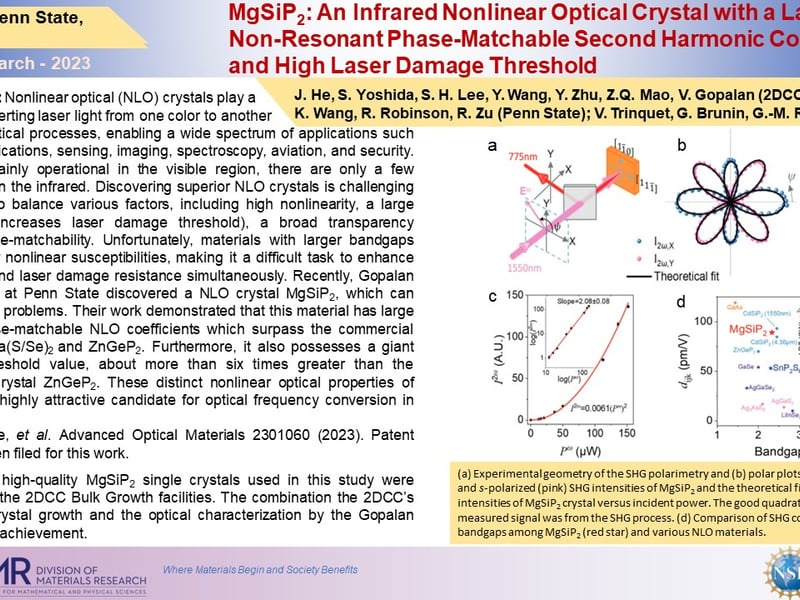
MgSiP2: An Infrared Nonlinear Optical Crystal with a Large Non-Resonant Phase-Matchable Second Harmonic Coefficient and High Laser Damage Threshold
Highlight · Jul 14, 2023
Pennsylvania State University

MgSiP2: An Infrared Nonlinear Optical Crystal with a Large Non-Resonant Phase-Matchable Second Harmonic Coefficient and High Laser Damage Threshold

Nonlinear optical (NLO) crystals play a crucial role in converting laser light from one color to another using nonlinear optical processes, enabling a wide spectrum of applications such as optical communications, sensing, imaging, spectroscopy, aviation, and security. While they are mainly operational in the visible region, there are only a few crystals that work in the infrared.
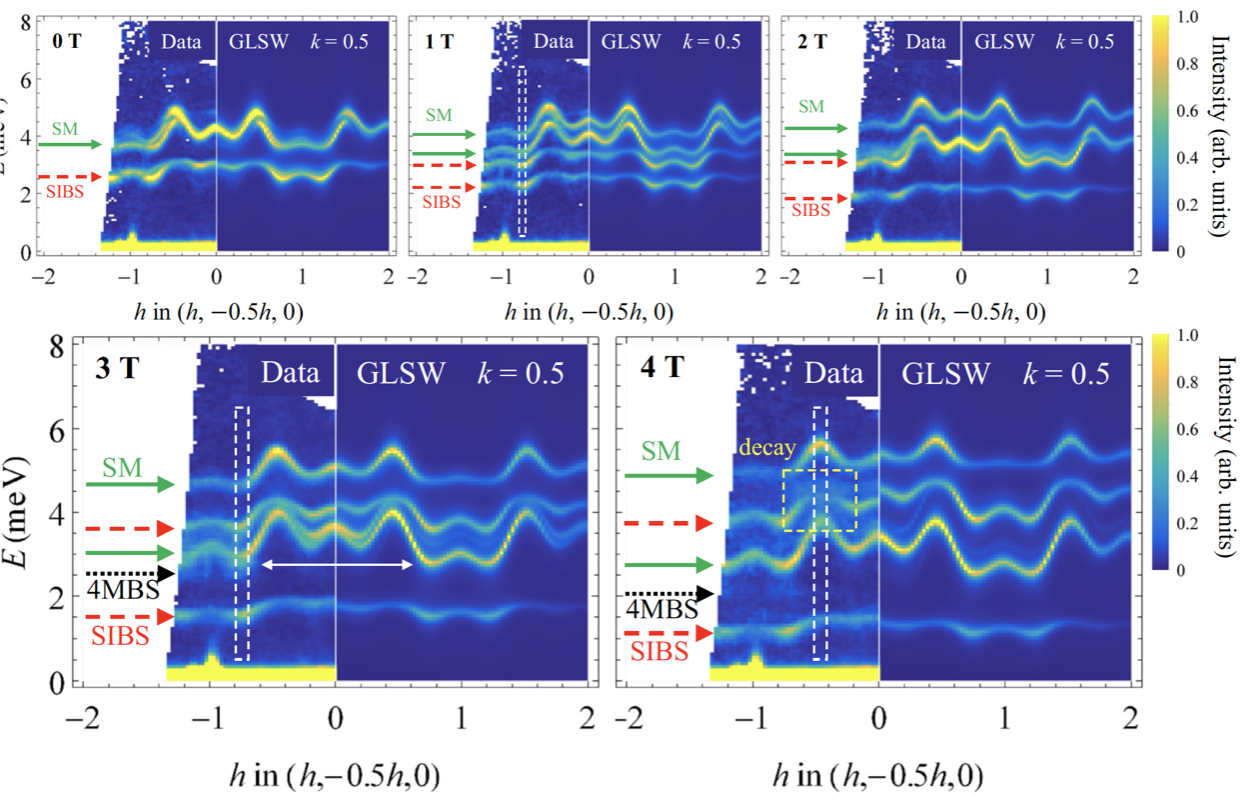
Figure 1:: Momentum and energy-resolved neutron scattering spectra of FeI2 at 1.8 K and applied magnetic fields (Data, 0 – 4Tesla) compared to prediction (GLSW—generalized linear spin wave). SM—single magnon, SIBS—single ion-bound states, 4MBS—4 magnon-bound state.
Highlight · Jul 14, 2023
Cornell University

Instabilities of Heavy Magnons in an Anisotropic Magnet

M. Mourigal (Georgia Tech), Cristian D. Batista (Oak Ridge National Laboratory)
Here, users from Georgia Tech continue their work on single crystals of iron iodide (FeI2) grown by them at the PARADIM Bulk Crystal Facility. In collaboration with Oak Ridge National Lab, they demonstrate that strong quantum interactions exist between three flavors of quasiparticles in the uniaxial spin-one magnet FeI2 through neutron scattering measurements in a transverse magnetic field.
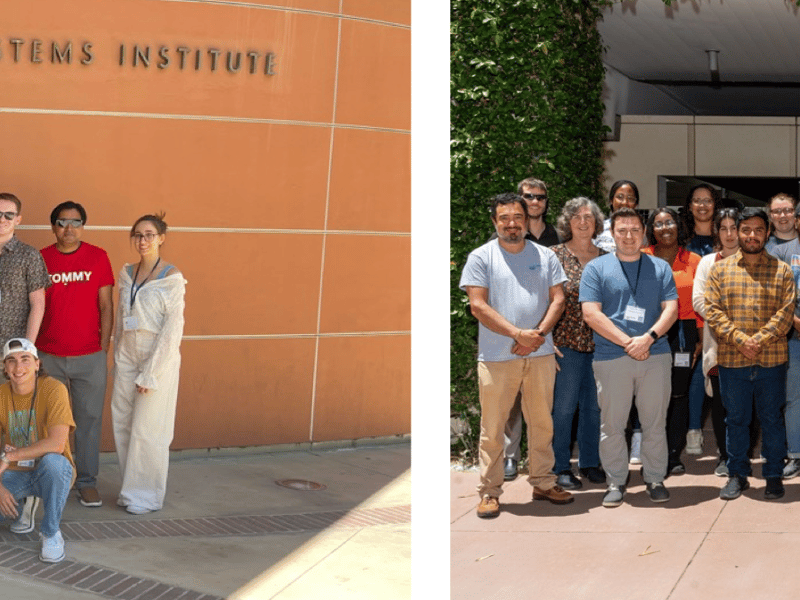
(left) Attendees at the UCLA campus; (right) Attendees at the UCSB campus
Highlight · Jul 14, 2023
University of California, Santa Barbara

Third BioPACIFIC MIP Summer School

In-person training sessions for the third annual BioPACIFIC MIP Summer School were successfully held from July 10th to 14th.
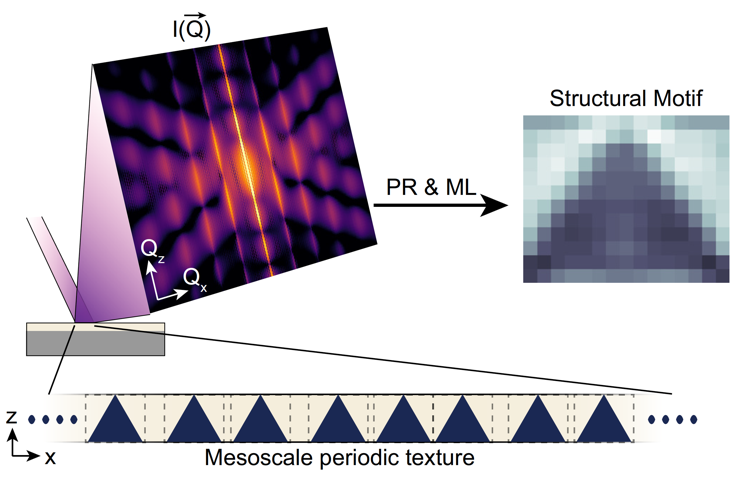
Figure 1: Concept of work. In a reciprocal space map, the mesoscale periodic ordering is evident from satellite peaks around the Bragg reflection. The diffraction intensity shown originates from the schematic periodic textures with triangular motifs, where the dark areas have a constant strain difference compared to the surrounding light area. Figure 2: X-ray imaging (top two rows): Nanotextures calculated to be present in a strained Ca2RuO4 film measured at 7 K. (A) Measured and (B) reconstructed diffraction pattern. Four characteristic structural motifs (SMs) labelled normal strain (NS) and crystal-plane inclination (CI) are identified.
Highlight · Jul 6, 2023
Cornell University

Imaging Nanotextures in Real Space by Inverting X-Ray Diffraction Data

A. Singer, H. Nair, D.G. Schlom, K.M. Shen, L.F. Kourkoutis (Cornell University), V.A. Stoica, L.-Q. Chen (Penn State), J.P. Ruff (CHESS), J.W. Freeland (Advanced Photon Source)
Coherent X-ray diffractive imaging (CXDI) has been widely applied to study the strain distribution in confined systems using an illuminating beam with high spatial coherence. Here, we broaden the capability of CXDI by imaging the strained structural motifs in periodic nanotextured epitaxial thin films with unprecedented nanoscale resolution, exploiting the diffuse scattering pattern from a conventional, partially coherent synchrotron beam. We demonstrate the technique by discovering a previously unreported nanotexture in a Mott insulator epitaxial thin film, which is confirmed by atomic resolution cryo-STEM imaging.
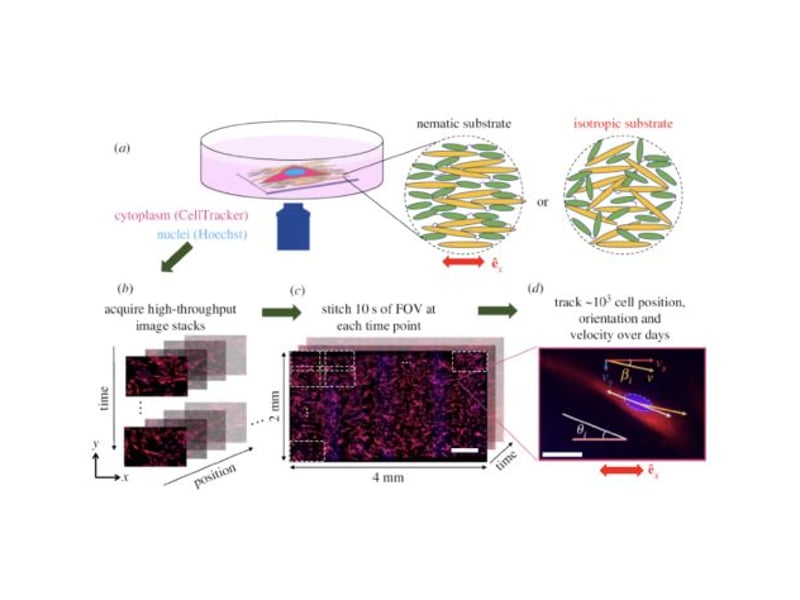
Experimental approach: a) Schematics of the cell placed on a substrate with nematic or isotropic molecular structure. (b,c) A high-throughput automated microscope stage acquires 10 s of images at every time point, which are stitched together to allow reconstruction of 103cell trajectories over the time span of days. The scale bar is 500mm. (d) A close-up image of a single cell. The scale bar is 100mm.
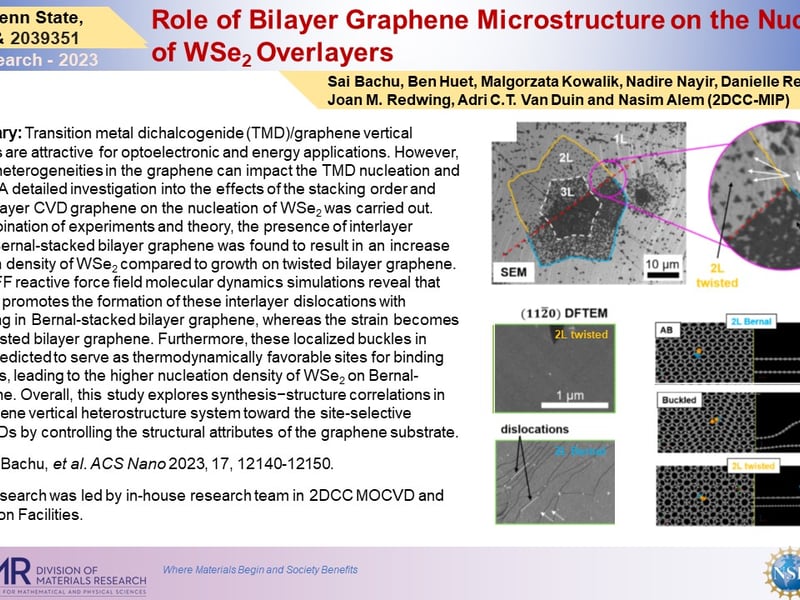
Role of Bilayer Graphene Microstructure on the Nucleation of WSe2 Overlayers
Highlight · Jun 27, 2023
Pennsylvania State University

Role of Bilayer Graphene Microstructure on the Nucleation of WSe2 Overlayers

Sai Bachu, Ben Huet, Malgorzata Kowalik, Nadire Nayir, Danielle Reifsnyder-Hickey, Joan M. Redwing, Adri C.T. Van Duin and Nasim Alem (2DCC-MIP)
Transition metal dichalcogenide (TMD)/graphene vertical heterostructures are attractive for optoelectronic and energy applications. However, microstructural heterogeneities in the graphene can impact the TMD nucleation and domain growth.
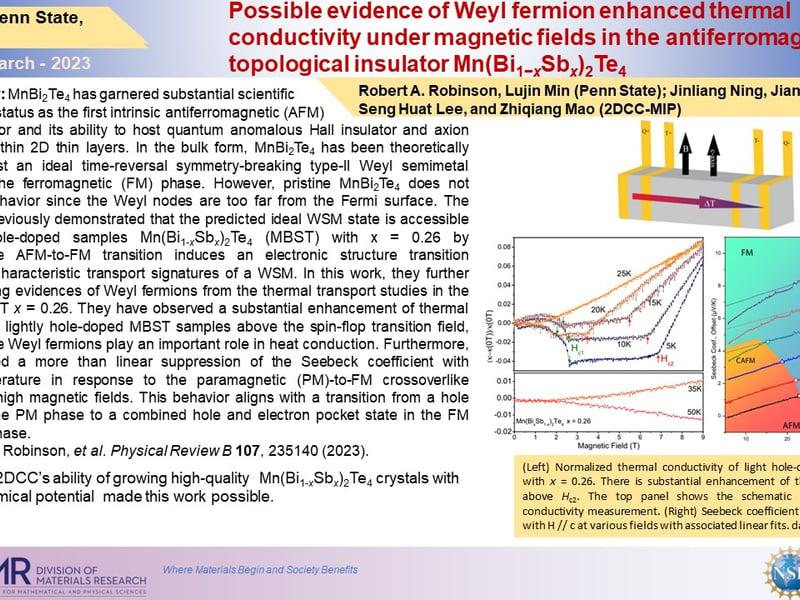
Possible evidence of Weyl fermion enhanced thermal conductivity under magnetic fields in the antiferromagnetic topological insulator Mn(Bi1−xSbx)2Te4
Highlight · Jun 22, 2023
Pennsylvania State University

Possible evidence of Weyl fermion enhanced thermal conductivity under magnetic fields in the antiferromagnetic topological insulator Mn(Bi1−xSbx)2Te4

MnBi2Te4 has garnered substantial scientific interest due to its status as the first intrinsic antiferromagnetic (AFM) topological insulator and its ability to host quantum anomalous Hall insulator and axion insulator states within 2D thin layers.
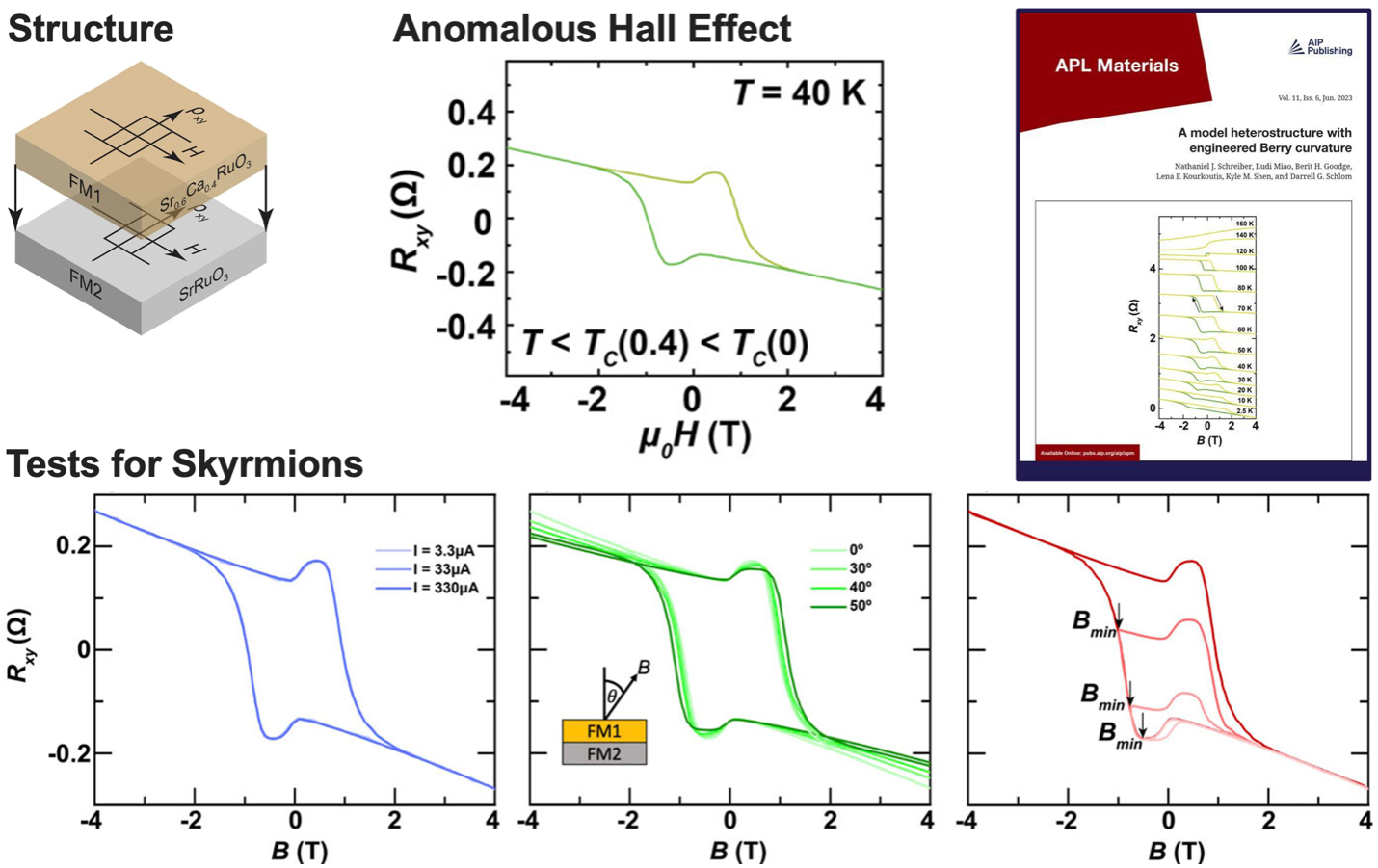
Figure 1: (Top left) structure of the thin film layers of the device. (Top center) Measurement of the Anomalous Hall Effect at 40K showing a hump feature. (Top right) Cover of the journal APL Materials June 2023 issue. (Bottom) Various tests for skyrmions that should be affected by: (1) the current density, but is not seen in transverse resistance, Rxy, at various currents, where all measurements almost perfectly overlap (left); (2) the canting angle, expecting a significant drop off in Rxy , but is not seen for angles up to 50° (center); and (3) minor loops of Rxy, measured with various Bmin, but hysteretic behavior like this is not consistent with the presence of skyrmions (right).
Highlight · Jun 15, 2023
Cornell University

Hump in Hall Measurements Insufficient as Evidence for Skyrmions

D.G. Schlom, L.F. Kourkoutis, and K.M. Shen (Cornell University)

Here, the PARADIM In-House Team synthesized a simple bilayer combining a positive anomalous Hall effect (AHE) layer (Sr0.6Ca0.4RuO3) with a negative AHE layer (SrRuO3). The bilayer shows a hump-like feature in the Hall resistivity that closely resembles the one often attributed to skyrmions. Multiple tests for skyrmions were performed, but no evidence of their existence was found.