Research Highlights

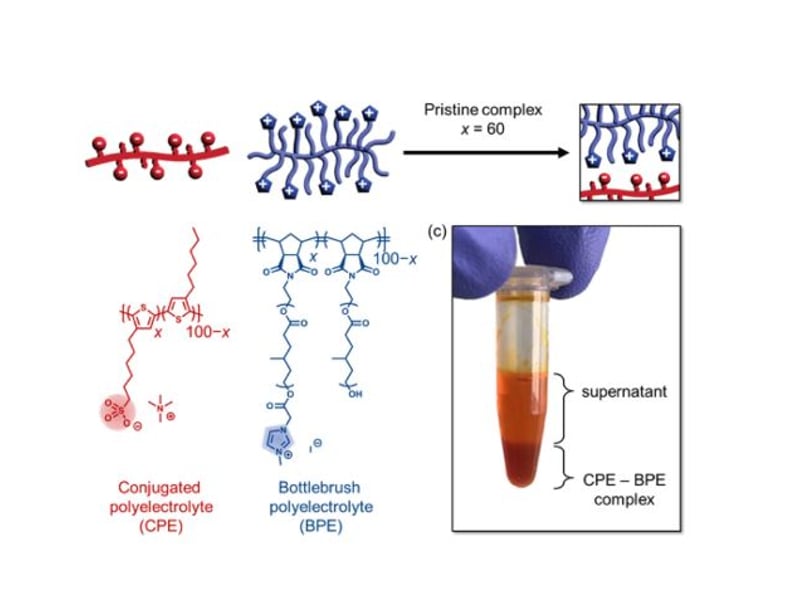
a, b) Coacervation of a conjugated polyelectrolyte (CPE, red) and bottlebrush polyelectrolyte (BPE, blue), each with 60% charge fraction (x = 60), leads to an ionically crosslinked polymer complex. (c) Photograph of phase separation upon mixing CPE and BPE solutions, producing a concentrated coacervate (darker orange, bottom) in coexistence with polymer-deficient supernatant (lighter orange, top).
Aug 29, 2023
University of California, Santa Barbara

Engineering Soft, Elastic, and Conductive Polymers for Stretchable Electronics Using Ionic Compatibilization

My Linh Le, Rachel Segalman, Christopher Bates, and Michael Chabinyc, UC Santa Barbara
Demonstrated design of soft, elastic, and highly conductive polymer complexes through electrostatic interactions between an anionic conjugated polyelectrolyte (CPE) and a cationic bottlebrush polyelectrolyte (BPE) .
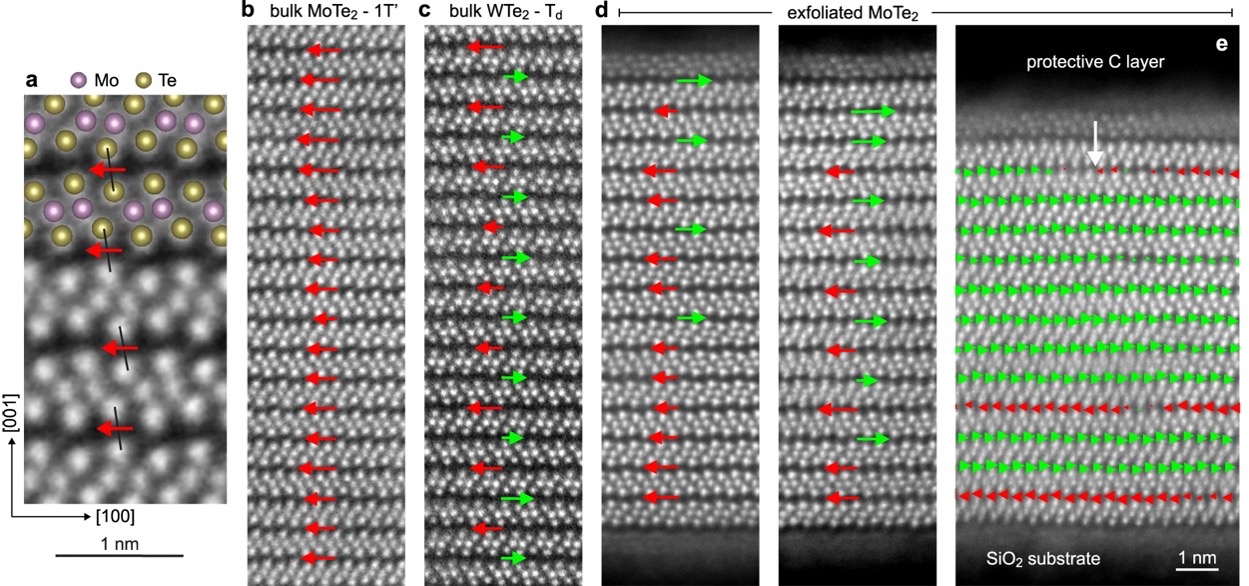
Figure 1: Cross-section atomic-resolution imaging of MoTe2 and WTe2. a) Magnified HAADF-STEM image of bulk MoTe2 with overlaid atomic structure. The black lines show the bridging Te-Te pairs and the red arrows represent the inter-layer shift b-e) HAADF-STEM images of bulk MoTe2 and WTe2, and exfoliated thin film MoTe2 respectively, with overlaid arrows representing the average value of the inter-layer shift.
Aug 9, 2023
Cornell University

Emergent layer stacking arrangements in c-axis confined MoTe2

Judy J. Cha and Lena F. Kourkoutis (Cornell), Yimei Zhu (BNL), Peijun Gou (Yale), Yanbing Zhu, Felipe Jornada, and Evan J. Reed (Stanford)
The study of 2D transition metal dichalcogenides (TMDs) has largely assumed that the layer stacking in the nanoscale limit adopts one or more of the possible precise stacking sequences found in bulk specimens. This work demonstrates – via atomic resolution imaging – that in fact much greater stacking complexity arises in the thin limit than previously assumed. Given the importance of interlayer stacking on electronic, magnetic, and optical properties, this result suggests greater study of stacking is needed during the characterization of 2D TMDs.
Growth of Nanometer-Thick –InSe by Molecular Beam Epitaxy for Field-Effect Transistors and Optoelectronic Devices
Aug 4, 2023
Pennsylvania State University

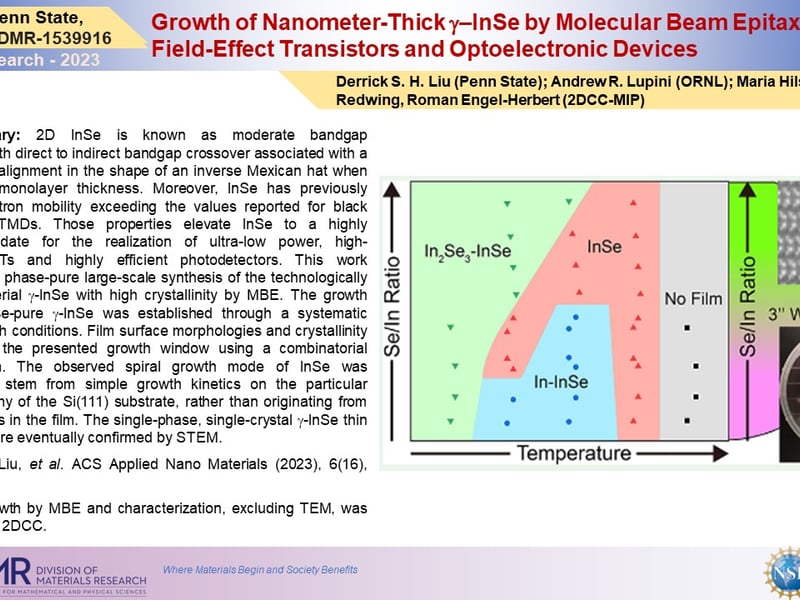
Growth of Nanometer-Thick –InSe by Molecular Beam Epitaxy for Field-Effect Transistors and Optoelectronic Devices

DerrickS. H. Liu (Penn State); AndrewR. Lupini (ORNL); Maria Hilse, Joan M. Redwing, Roman Engel-Herbert (2DCC-MIP)
2D InSe is known as moderate bandgap semiconductor with direct to indirect bandgap crossover associated with a topological band alignment in the shape of an inverse Mexican hat when reduced to the monolayer thickness.
Step engineering for nucleation and domain orientation control in WSe2 epitaxy on c-plane sapphire
Jul 27, 2023
Pennsylvania State University

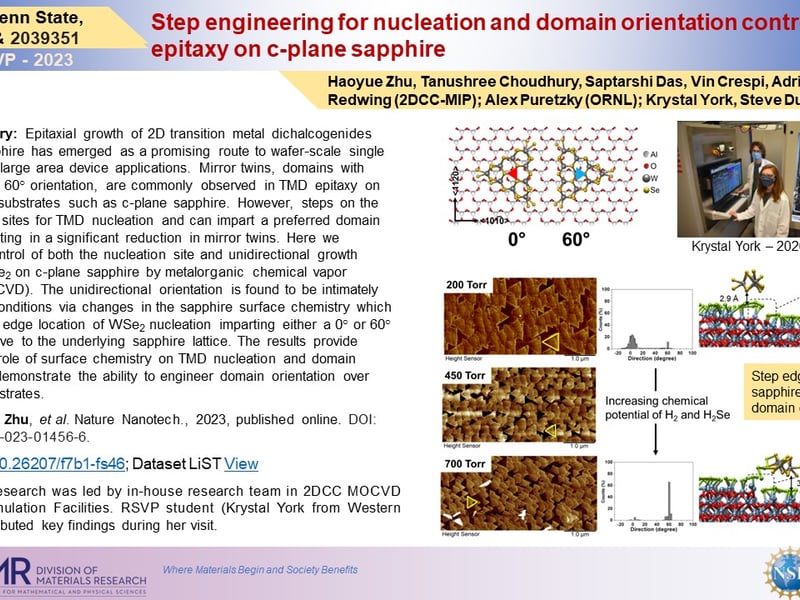
Step engineering for nucleation and domain orientation control in WSe2 epitaxy on c-plane sapphire

Epitaxial growth of 2D transition metal dichalcogenides (TMDs) on sapphire has emerged as a promising route to wafer-scale single crystal films for large area device applications. Mirror twins, domains with opposite 0° and 60° orientation, are commonly observed in TMD epitaxy on high symmetry substrates such as c-plane sapphire.
Illuminating mechanisms of epitaxy of 2D van der Waals crystals via synthesis, characterization and theory/simulation
Jul 27, 2023
Pennsylvania State University

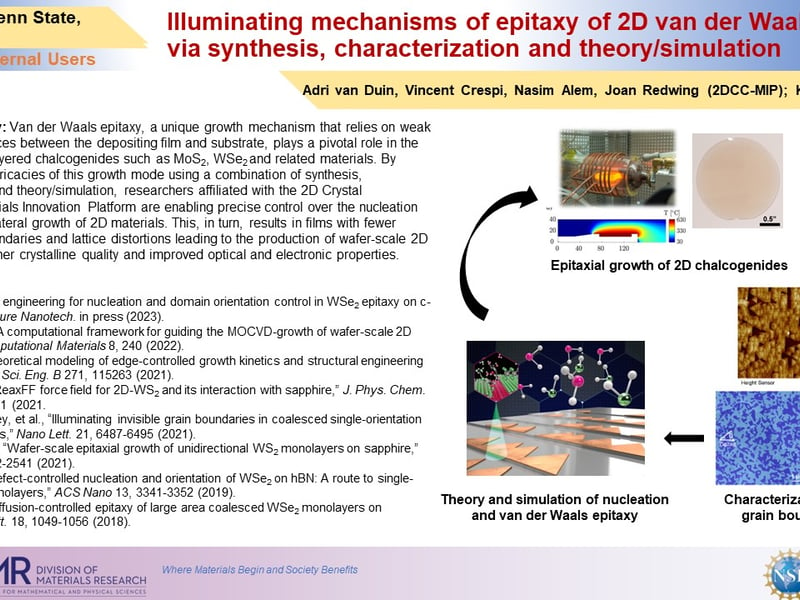
Illuminating mechanisms of epitaxy of 2D van der Waals crystals via synthesis, characterization and theory/simulation

Van der Waals epitaxy, a unique growth mechanism that relies on weak intermolecular forces between the depositing film and substrate, plays a pivotal role in the synthesis of 2D layered chalcogenides such as MoS2, WSe2 and related materials.
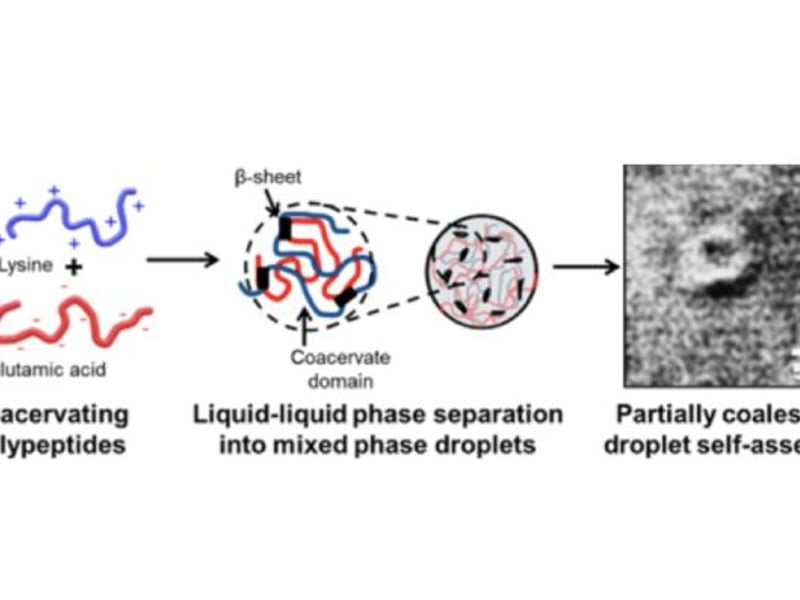
Aqueous mixtures of oppositely charged homochiral polypeptides reveal unexpectedly diverse morphologies at high polypeptide concentration and ionic strength.
MgSiP2: An Infrared Nonlinear Optical Crystal with a Large Non-Resonant Phase-Matchable Second Harmonic Coefficient and High Laser Damage Threshold
Jul 14, 2023
Pennsylvania State University

MgSiP2: An Infrared Nonlinear Optical Crystal with a Large Non-Resonant Phase-Matchable Second Harmonic Coefficient and High Laser Damage Threshold

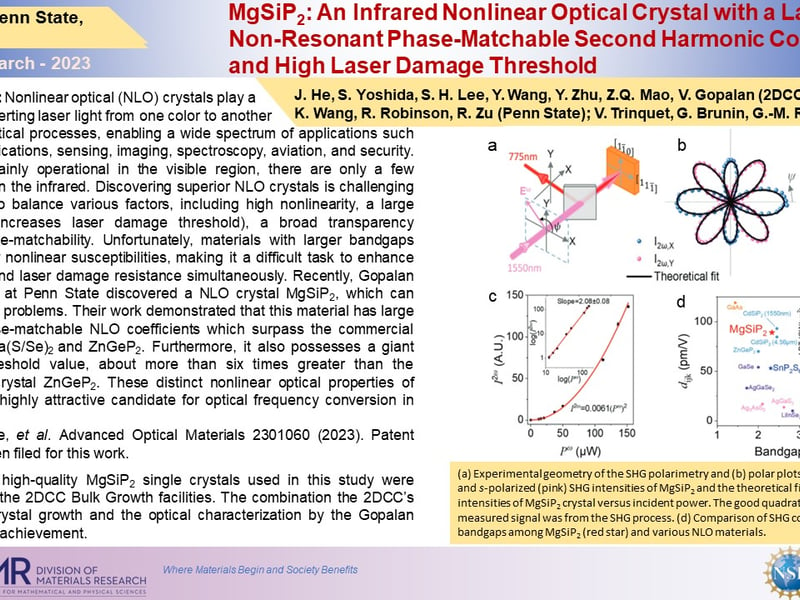
Nonlinear optical (NLO) crystals play a crucial role in converting laser light from one color to another using nonlinear optical processes, enabling a wide spectrum of applications such as optical communications, sensing, imaging, spectroscopy, aviation, and security. While they are mainly operational in the visible region, there are only a few crystals that work in the infrared.
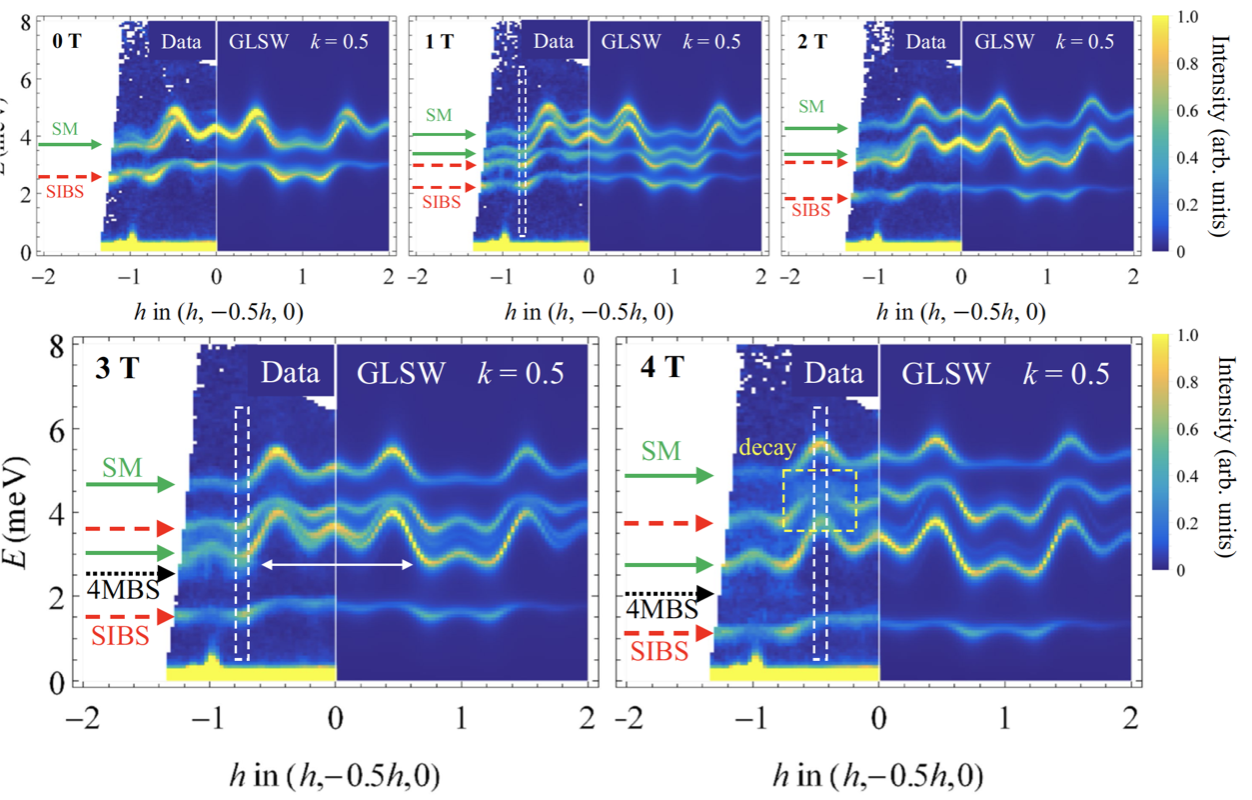
Figure 1:: Momentum and energy-resolved neutron scattering spectra of FeI2 at 1.8 K and applied magnetic fields (Data, 0 – 4Tesla) compared to prediction (GLSW—generalized linear spin wave). SM—single magnon, SIBS—single ion-bound states, 4MBS—4 magnon-bound state.
Jul 14, 2023
Cornell University

Instabilities of Heavy Magnons in an Anisotropic Magnet

M. Mourigal (Georgia Tech), Cristian D. Batista (Oak Ridge National Laboratory)
Here, users from Georgia Tech continue their work on single crystals of iron iodide (FeI2) grown by them at the PARADIM Bulk Crystal Facility. In collaboration with Oak Ridge National Lab, they demonstrate that strong quantum interactions exist between three flavors of quasiparticles in the uniaxial spin-one magnet FeI2 through neutron scattering measurements in a transverse magnetic field.
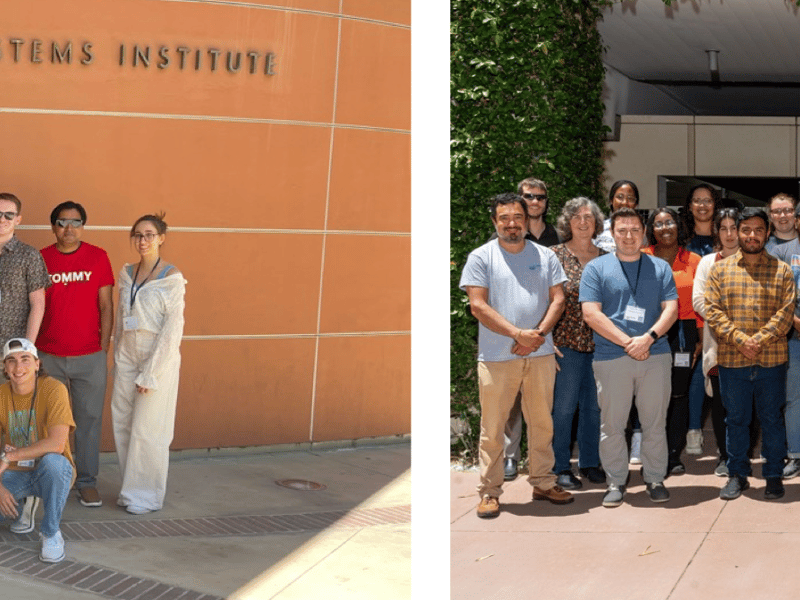
(left) Attendees at the UCLA campus; (right) Attendees at the UCSB campus
Jul 14, 2023
University of California, Santa Barbara

Third BioPACIFIC MIP Summer School

In-person training sessions for the third annual BioPACIFIC MIP Summer School were successfully held from July 10th to 14th.
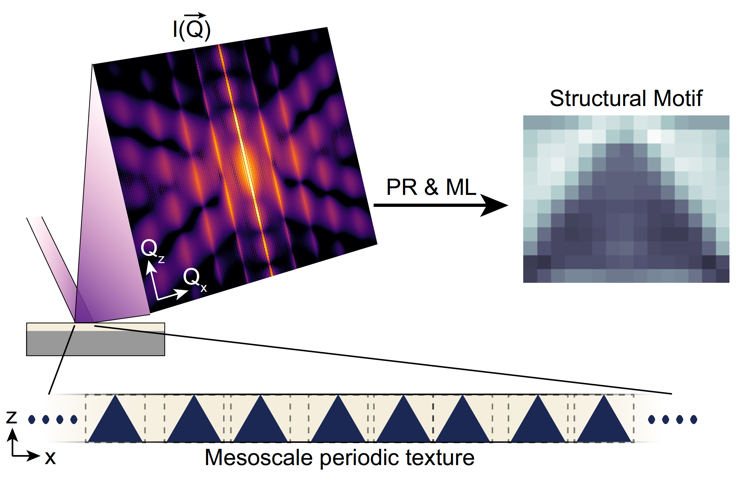
Figure 1: Concept of work. In a reciprocal space map, the mesoscale periodic ordering is evident from satellite peaks around the Bragg reflection. The diffraction intensity shown originates from the schematic periodic textures with triangular motifs, where the dark areas have a constant strain difference compared to the surrounding light area. Figure 2: X-ray imaging (top two rows): Nanotextures calculated to be present in a strained Ca2RuO4 film measured at 7 K. (A) Measured and (B) reconstructed diffraction pattern. Four characteristic structural motifs (SMs) labelled normal strain (NS) and crystal-plane inclination (CI) are identified.
Jul 6, 2023
Cornell University

Imaging Nanotextures in Real Space by Inverting X-Ray Diffraction Data

A. Singer, H. Nair, D.G. Schlom, K.M. Shen, L.F. Kourkoutis (Cornell University), V.A. Stoica, L.-Q. Chen (Penn State), J.P. Ruff (CHESS), J.W. Freeland (Advanced Photon Source)

Coherent X-ray diffractive imaging (CXDI) has been widely applied to study the strain distribution in confined systems using an illuminating beam with high spatial coherence. Here, we broaden the capability of CXDI by imaging the strained structural motifs in periodic nanotextured epitaxial thin films with unprecedented nanoscale resolution, exploiting the diffuse scattering pattern from a conventional, partially coherent synchrotron beam. We demonstrate the technique by discovering a previously unreported nanotexture in a Mott insulator epitaxial thin film, which is confirmed by atomic resolution cryo-STEM imaging.