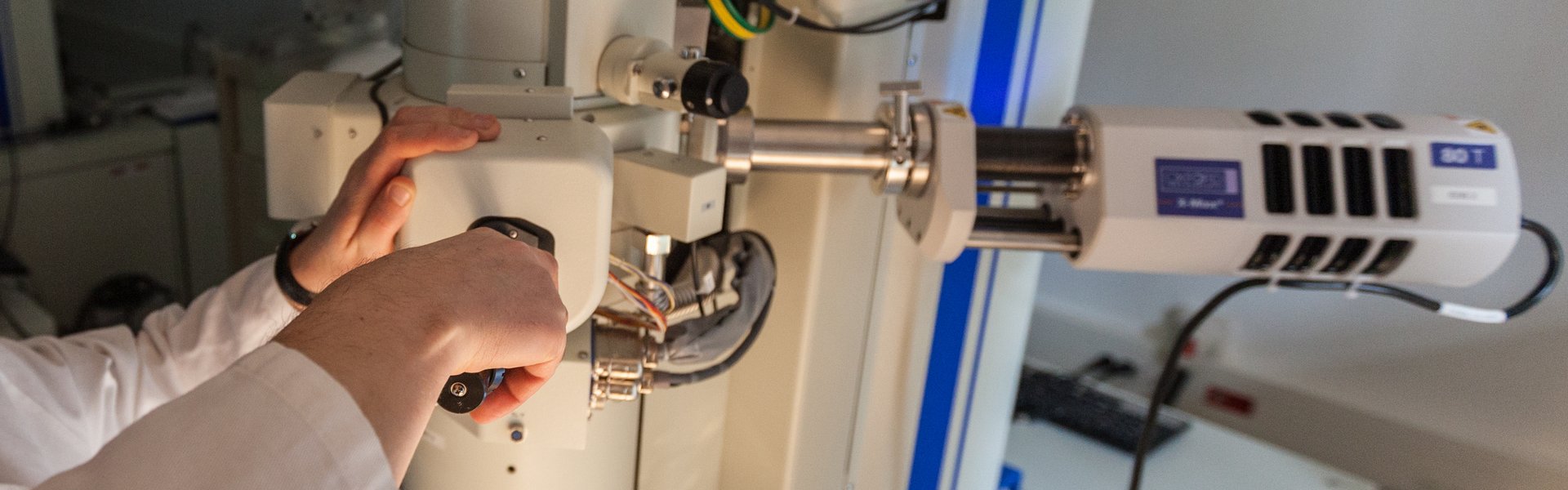
Research Highlights
![Figure 1: a) Magneto-resistance showing quantum oscillations in the insulating state and metallic state, respectively. Inset shows derivative. b) Insulating state quantum oscillations have a field-independent frequency of 740 ± 60 T and metallic state quantum oscillations have a field-dependent frequency (H ∥ [100]). Lines are guides for the eye. All measurements at ≈ 650 mK. c) Schematic of the formation of Landau levels and approaching the normal and reverse quantum limit. d) Categorization of possible high magnetic field behaviors as a function of gap and normalized g-factor.](https://www.paradim.org/sites/default/files/inline-images/MIP_89.png)
Resolving Quantum Oscillations in Insulating YbB12
C.A. Mizzi, M.K. Chan, Neil Harrison, P.F. S. Rosa, and W.A. Phelan (Los Alamos National Laboratory), and S. Kushwaha, L. Pressley, and T.M. McQueen (Johns Hopkins University)
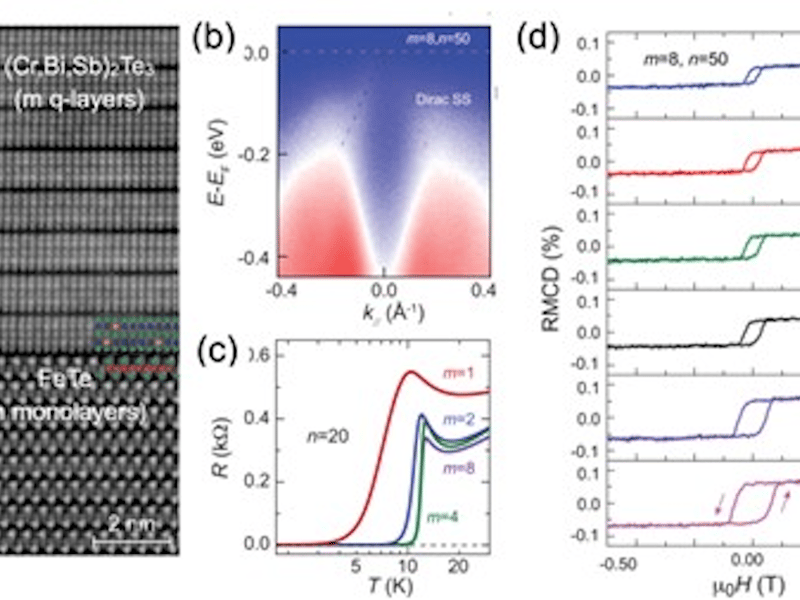
Emergent interfacial superconductivity at the interface of topology and magnetism
Hemian Yi, Yi-Fan Zhao, Ruobing Mei, Zi-Jie Yan, Ling-Jie Zhou, Ruoxi Zhang, Zihao Wang, Stephen Paolini,, Ke Wang, Moses H. W. Chan (Penn State); Run Xiao, Anthony R. Richardella, Nitin Samarth, Chaoxing Liu, Cuizu Chang (2DCC-MIP Penn State)
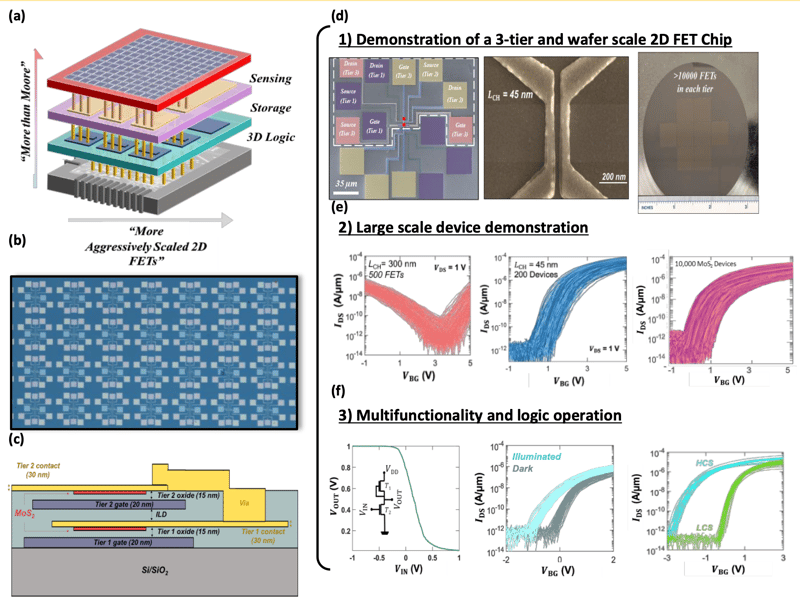
Three-dimensional integration of two-dimensional field-effect transistors
D. Jayachandran, R. Pendurthi, M.U.K Sadaf, N.U. Sakib, A. Pannone, Y. Han, S. Das, Y. Yang, (Penn State); C. Chen, N. Trainor, S. Kumari, T.V. Mc Knight and J.M. Redwing (2DCC-MIP, Penn State)
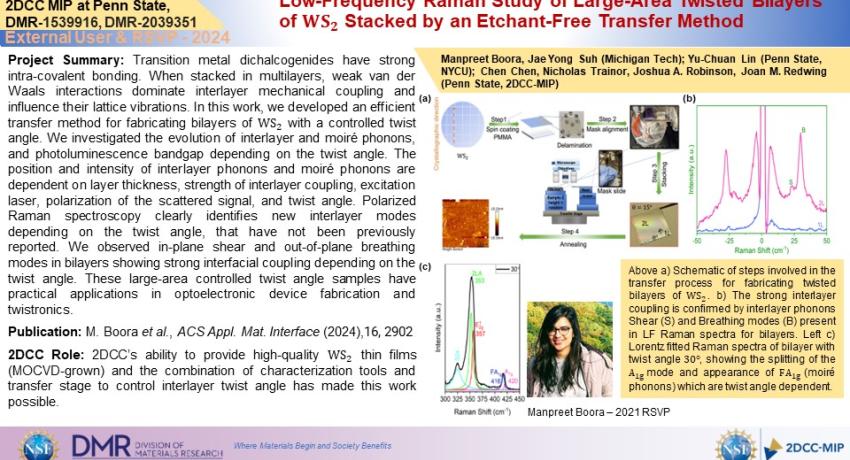
Low-Frequency Raman Study of Large-Area Twisted Bilayers of WS_2 Stacked by an Etchant-Free Transfer Method
Manpreet Boora, Jae Yong Suh (Michigan Tech); Yu-Chuan Lin (Penn State, NYCU); Chen Chen, Nicholas Trainor, Joshua A. Robinson, Joan M. Redwing (Penn State, 2DCC-MIP)
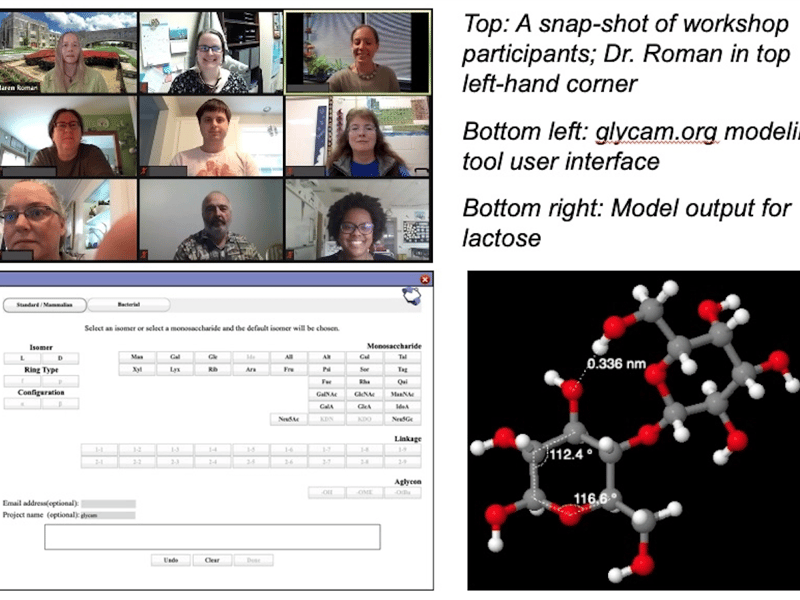
GlycoMIP introduces STEM teachers to glycan modeling tool
Maren Roman, Virginia Tech, Robert J. Woods, University of Georgia
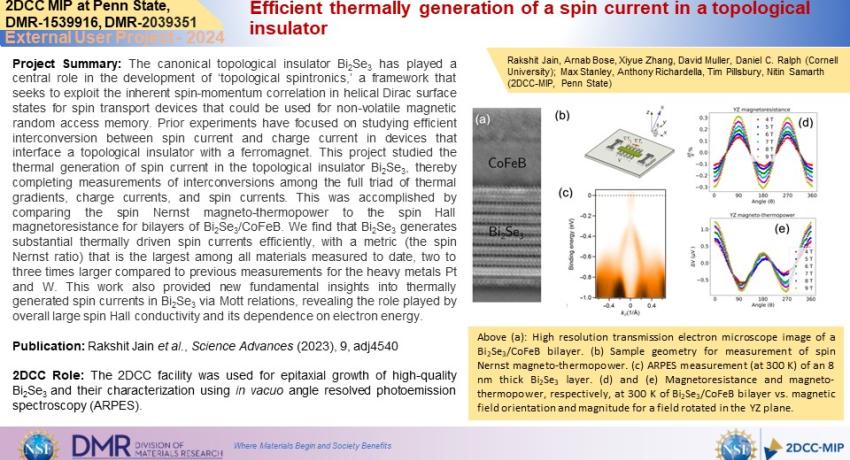
Efficient thermally generation of a spin current in a topological insulator
Rakshit Jain, Arnab Bose, Xiyue Zhang, David Muller, Daniel C. Ralph (Cornell University); Max Stanley, Anthony Richardella, Tim Pillsbury, Nitin Samarth (2DCC-MIP, Penn State)
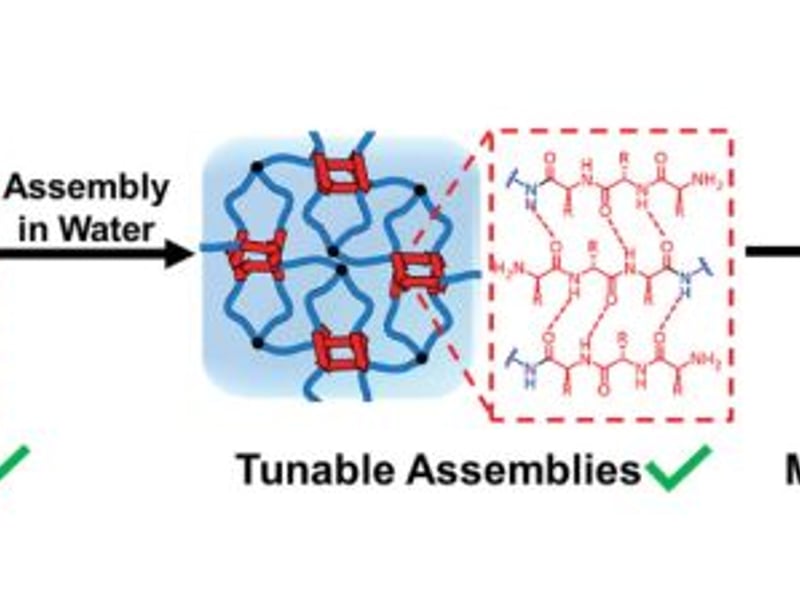
Tailoring Writability and Performance of Star Block Copolypeptides Hydrogels through Side-Chain Design
Juan Manuel Urueña, Matthew E. Helgeson, Christopher M. Bates, Craig J. Hawker, Javier Read de Alaniz, UC Santa Barbara
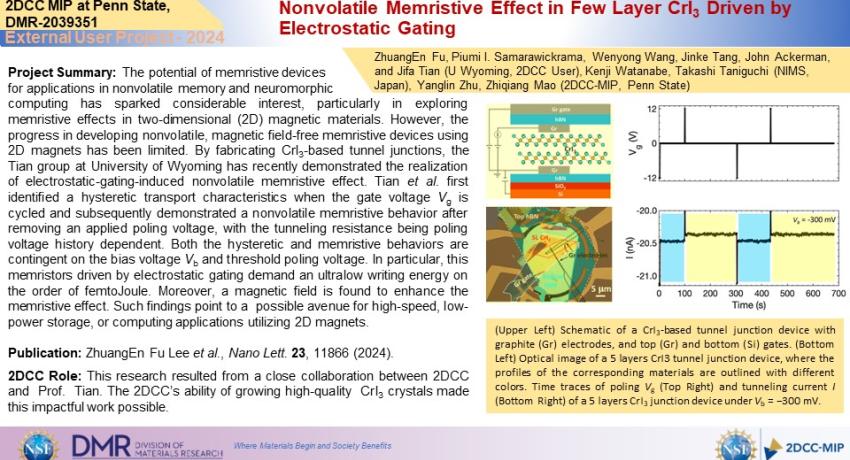
Nonvolatile Memristive Effect in Few Layer CrI3 Driven by Electrostatic Gating
ZhuangEn Fu, Piumi I. Samarawickrama, Wenyong Wang, Jinke Tang, John Ackerman, and Jifa Tian (U Wyoming, 2DCC User), Kenji Watanabe, Takashi Taniguchi (NIMS, Japan), Yanglin Zhu, Zhiqiang Mao (2DCC-MIP, Penn)
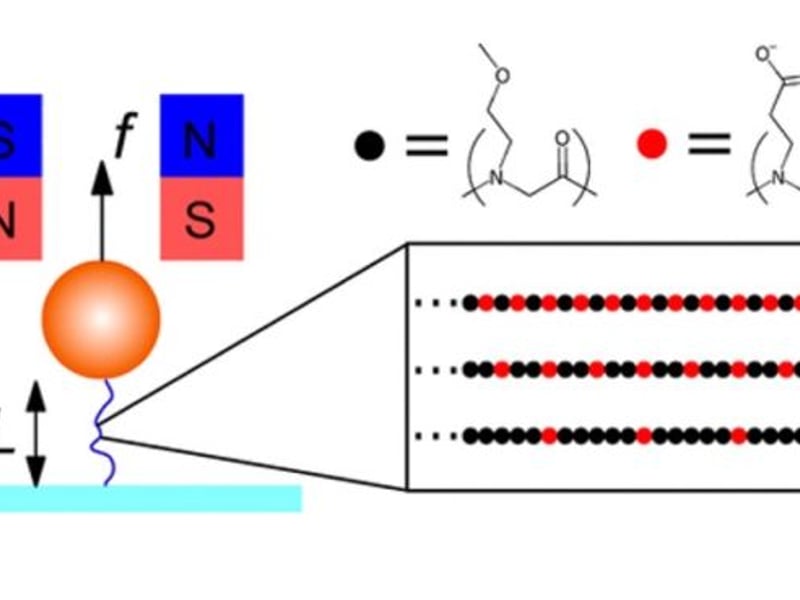
Single-Molecule Polypeptoid Stretching Reveals the Effects of Charge Sequence on Chain Conformation
Hoang P. Truong, Shawn Mengel, Rachel A. Segalman, and Omar A. Saleh, UC Santa Barbara
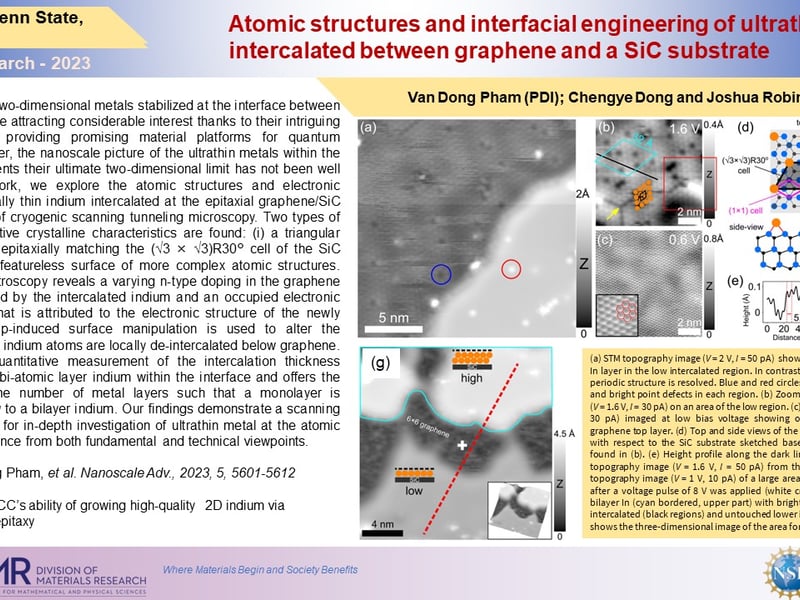
Atomic structures and interfacial engineering of ultrathin indium intercalated between graphene and a SiC substrate
Showing 41 to 50 of 237