Research Highlights

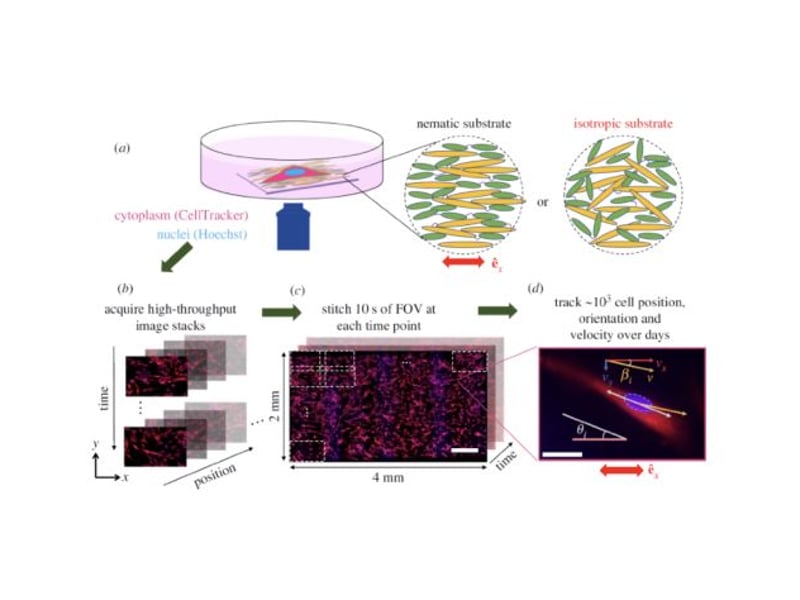
Experimental approach: a) Schematics of the cell placed on a substrate with nematic or isotropic molecular structure. (b,c) A high-throughput automated microscope stage acquires 10 s of images at every time point, which are stitched together to allow reconstruction of 103cell trajectories over the time span of days. The scale bar is 500mm. (d) A close-up image of a single cell. The scale bar is 100mm.
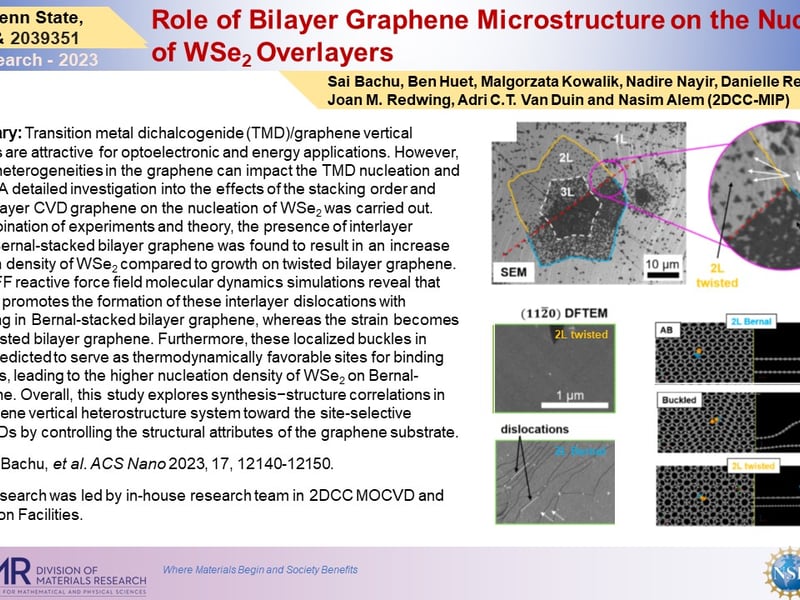
Role of Bilayer Graphene Microstructure on the Nucleation of WSe2 Overlayers
Jun 27, 2023
Pennsylvania State University

Role of Bilayer Graphene Microstructure on the Nucleation of WSe2 Overlayers

Sai Bachu, Ben Huet, Malgorzata Kowalik, Nadire Nayir, Danielle Reifsnyder-Hickey, Joan M. Redwing, Adri C.T. Van Duin and Nasim Alem (2DCC-MIP)
Transition metal dichalcogenide (TMD)/graphene vertical heterostructures are attractive for optoelectronic and energy applications. However, microstructural heterogeneities in the graphene can impact the TMD nucleation and domain growth.
Possible evidence of Weyl fermion enhanced thermal conductivity under magnetic fields in the antiferromagnetic topological insulator Mn(Bi1−xSbx)2Te4
Jun 22, 2023
Pennsylvania State University

Possible evidence of Weyl fermion enhanced thermal conductivity under magnetic fields in the antiferromagnetic topological insulator Mn(Bi1−xSbx)2Te4

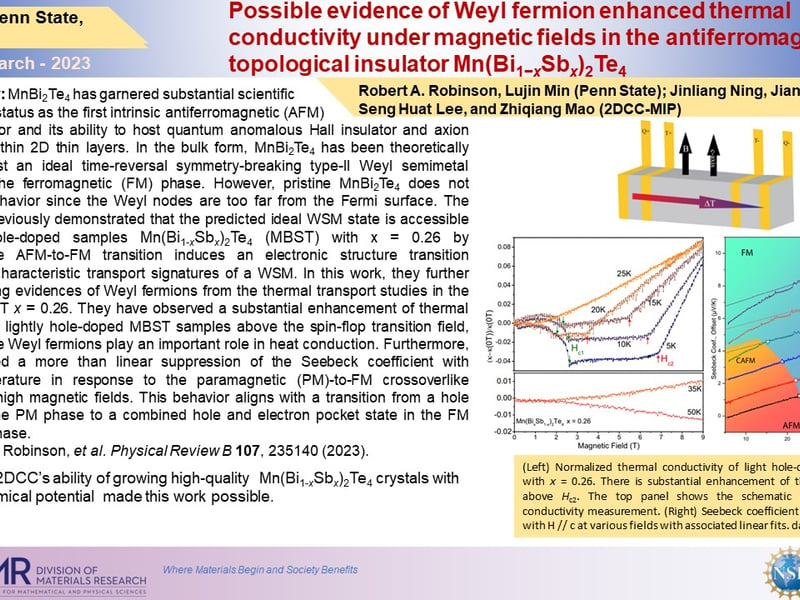
MnBi2Te4 has garnered substantial scientific interest due to its status as the first intrinsic antiferromagnetic (AFM) topological insulator and its ability to host quantum anomalous Hall insulator and axion insulator states within 2D thin layers.
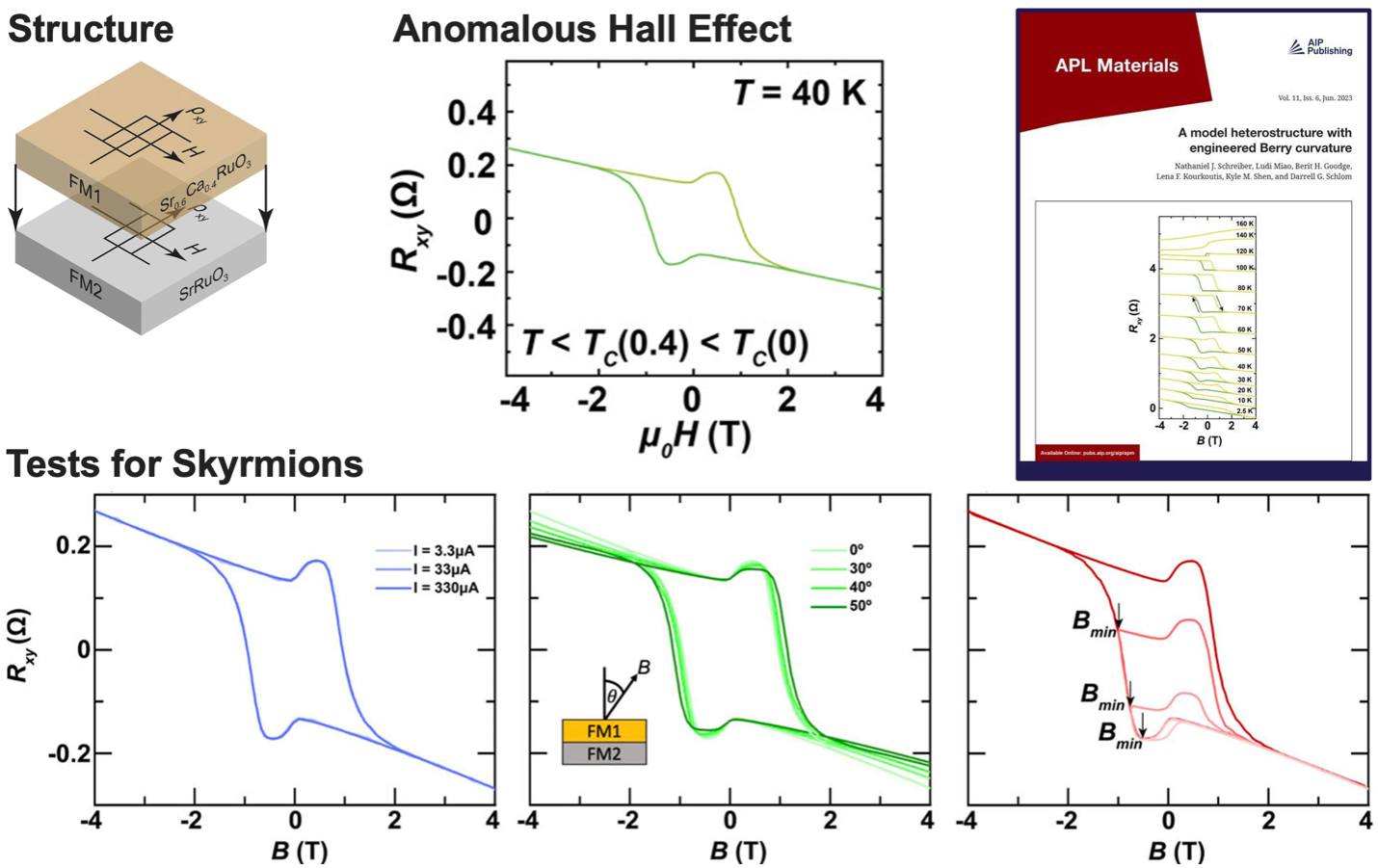
Figure 1: (Top left) structure of the thin film layers of the device. (Top center) Measurement of the Anomalous Hall Effect at 40K showing a hump feature. (Top right) Cover of the journal APL Materials June 2023 issue. (Bottom) Various tests for skyrmions that should be affected by: (1) the current density, but is not seen in transverse resistance, Rxy, at various currents, where all measurements almost perfectly overlap (left); (2) the canting angle, expecting a significant drop off in Rxy , but is not seen for angles up to 50° (center); and (3) minor loops of Rxy, measured with various Bmin, but hysteretic behavior like this is not consistent with the presence of skyrmions (right).
Jun 15, 2023
Cornell University

Hump in Hall Measurements Insufficient as Evidence for Skyrmions

D.G. Schlom, L.F. Kourkoutis, and K.M. Shen (Cornell University)
Here, the PARADIM In-House Team synthesized a simple bilayer combining a positive anomalous Hall effect (AHE) layer (Sr0.6Ca0.4RuO3) with a negative AHE layer (SrRuO3). The bilayer shows a hump-like feature in the Hall resistivity that closely resembles the one often attributed to skyrmions. Multiple tests for skyrmions were performed, but no evidence of their existence was found.
Nanomolding of metastable Mo4P3
Jun 7, 2023
Cornell University

Nanomolding of metastable Mo4P3

Judy J. Cha (Cornell University)
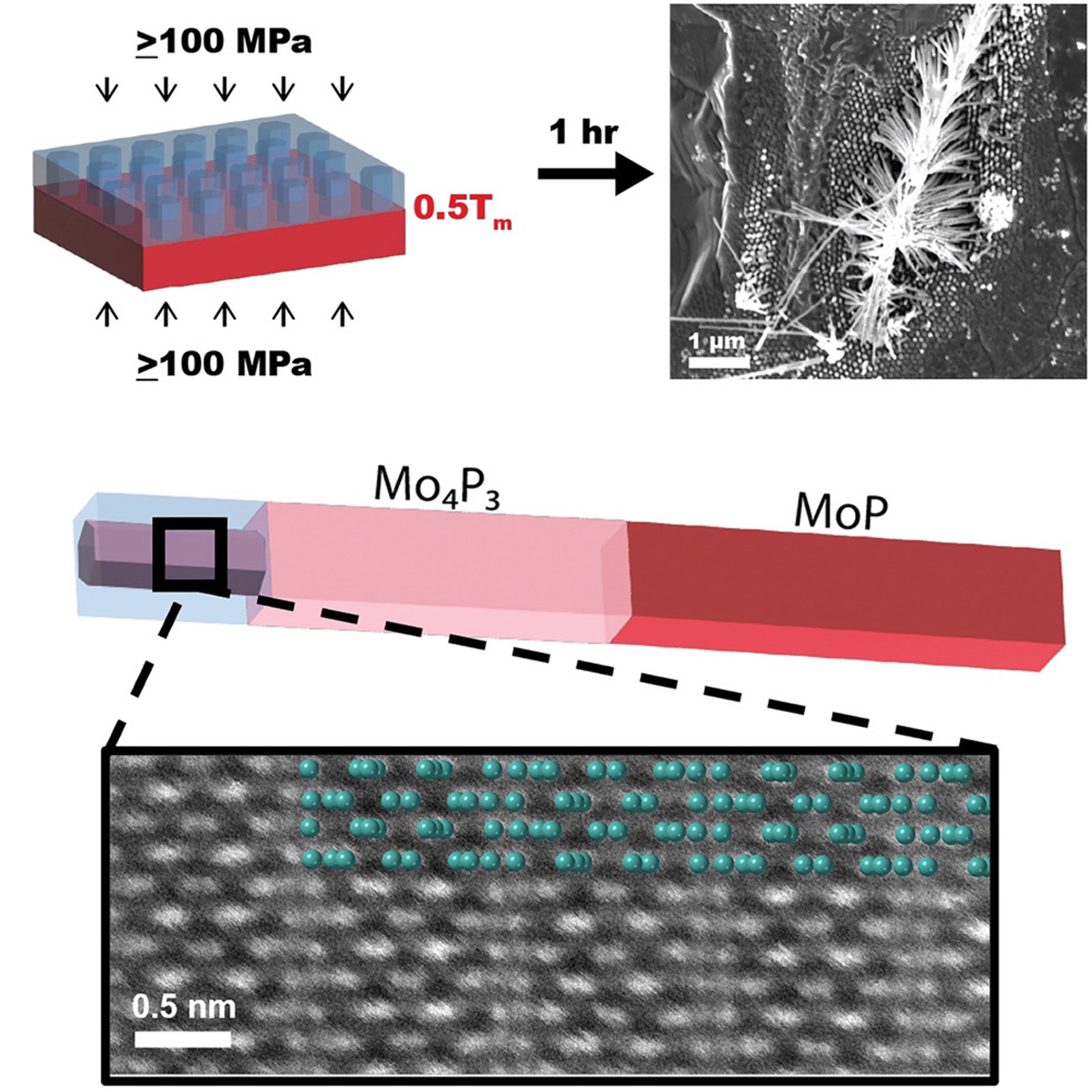
Here, an external (now local) group of researchers came to PARADIM’s Electron Microscopy as well as Theory Facilities to characterize nanomolded molybdenum-phosphide nanowires. Using a poly-crystalline feedstock of MoP, the achieved nanowires are of the composition Mo4P3, a phase metastable at room temperature and ambient pressures, demonstrating a new pathway to the nanofabrication of metastable phases. Density functional theory band structure calculations and resistivity measurements indicate that Mo4P3 is a non-topological metal with resistivity values comparable to other molybdenum phosphide compounds.
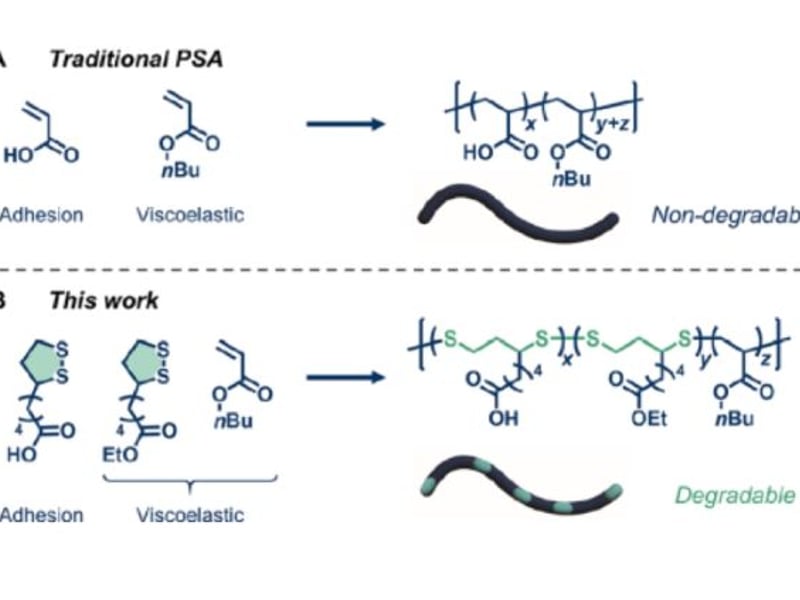
A) A conventional statistical acrylic PSA comprises n-butyl acrylate (∼97 mol %) and acrylic acid (∼3 mol %). (B) An analogous statistical degradable PSA with α-lipoic acid and ethyl lipoate as drop-in degradable monomers.
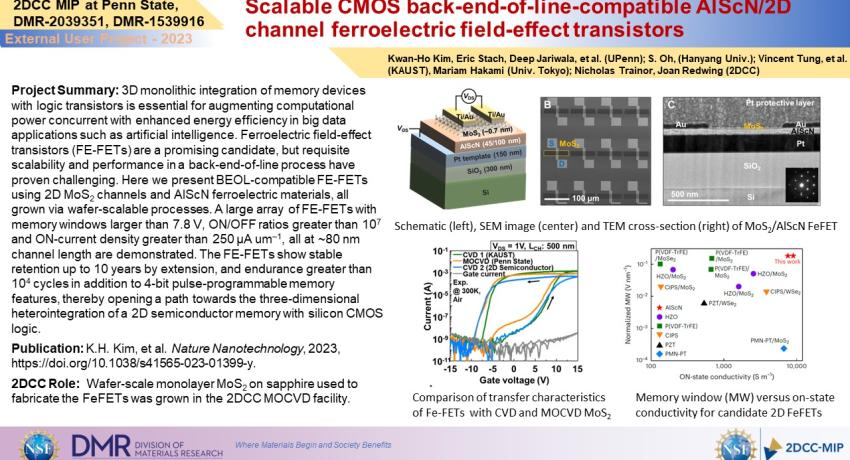
Scalable CMOS back-end-of-line-compatible AlScN/2D channel ferroelectric field-effect transistors
May 22, 2023
Pennsylvania State University

Scalable CMOS back-end-of-line-compatible AlScN/2D channel ferroelectric field-effect transistors

Kwan-Ho Kim, Eric Stach, Deep Jariwala, et al. (UPenn); S. Oh, (Hanyang Univ.); Vincent Tung, et al. (KAUST), Mariam Hakami (Univ. Tokyo); Nicholas Trainor, Joan Redwing (2DCC)

3D monolithic integration of memory devices with logic transistors is essential for augmenting computational power concurrent with enhanced energy efficiency in big data applications such as artificial intelligence
Figure 1: (top) Calculated thermopowers at E − Ef = 0 as a function of temperature. (right) Thermopowers of single crystals 1 and 2 of WSi2 as a function of temperature, measured along both the [001] (black, blue) and [100] (red, green) directions.
May 17, 2023
Cornell University

A thermally robust transverse thermoelectric

Josh E. Goldberger, J.P. Heremans, and W. Windl (Ohio State University)
Users from The Ohio State University theoretically predicted axis-dependent conduction polarity in tetragonal α-WSi2—a durable, thermally robust, and oxidation-resistant metal synthesized from earth-abundant elements. Two single crystals of α-WSi2 were prepared at PARADIM’s Bulk Crystal Growth Facility using floating zone techniques, and their anisotropic conduction properties were evaluated. Simultaneous positive and negative thermopowers measured along the [100] and [001] directions, respectively, indicate that this material exhibits axisdependent conduction polarity, which closely matches theoretical predictions.
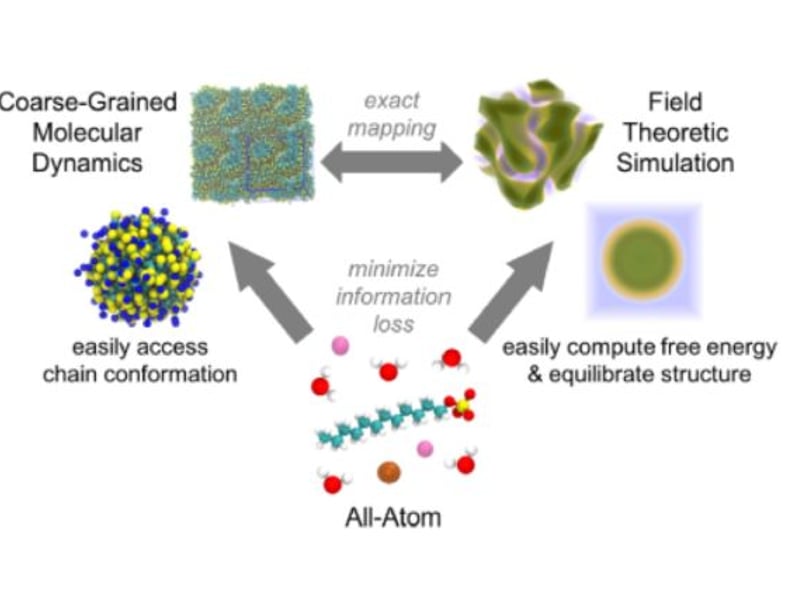
This study employs all-atom simulations to coarse-grained models using relative entropy minimization. These coarse-grained models, simulated with field-theoretic methods, enable rigorous equilibration and the study of properties difficult to access in particle-based simulations.
Evidence of magnetic fluctuation induced Weyl semimetal state in the antiferromagnetic topological insulator Mn(Bi1-xSbx)2Te4
May 2, 2023
Pennsylvania State University

Evidence of magnetic fluctuation induced Weyl semimetal state in the antiferromagnetic topological insulator Mn(Bi1-xSbx)2Te4

The recent study of intrinsic antiferromagnetic topological insulator Mn(Bi,Sb)2Te4 has attracted a great deal of interest, since it provides assess to a variety of topological quantum states such as quantum anomalous Hall insulator and axion insulator. In this work, we report systematic c-axis transport studies under high magnetic fields (up to 35T) on Mn(Bi1-xSbx)2Te4.