Research Highlights
Cornell University
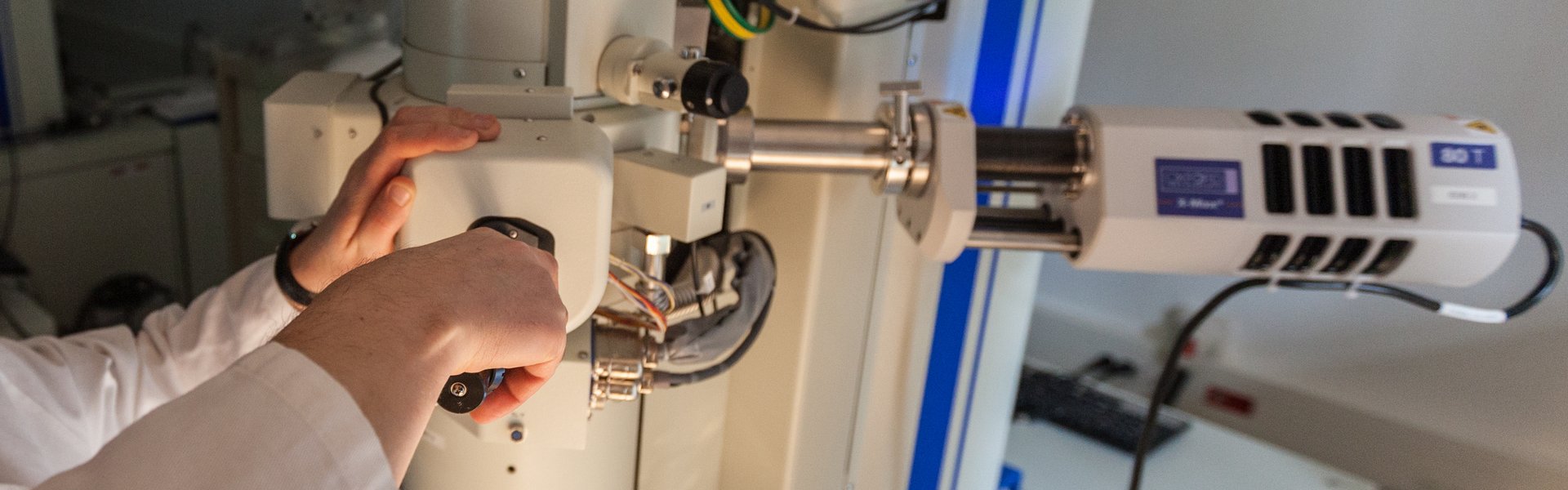
A Guinness World Record: The Highest Resolution Microscope, enabled by a new detector technology
Y. Jiang, Z. Chen, Y. Han, P. Deb, H. Gao, S. Xie, P. Purohit, M. W. Tate, J. Park, S. M. Gruner, V. Elser, D. A. Muller
The work was recognized as the highest resolution microscope (of any type) by Guinness World Records in July 2018.
University of California, Santa Barbara
First BioPACIFIC MIP Summer School
First BioPACIFIC MIP Summer School took place virtually, August 2-5, 2021
Pennsylvania State University
Atomically Thin Stripes in Monolayer Sheets
The chemical similarity of molybdenum & tungsten suggests they should randomly distribute in WxMo1-xS2, a material of great interest for next-generation elec-tronics. The 2DCC discovered that these atoms actually form thin chains, whose very different masses make properties like heat conduction anisotropic. Stripes form due to fluctuations in the availability of sulfur, the third element in WxMo1-xS2.
Cornell University
World-Record High Pressure Floating Zone Crystal Growth
Tyrel M. McQueen, W. Adam Phelan
A new world record for highest pressure of a floating zone crystal growth, at 300 atmospheres, twice the previous record, was achieved by PARADIM staff in the United States in collaboration with our industry partner SciDre. This work was done at Johns Hopkins University by Tyrel M. McQueen and W. Adam Phelan.
Pennsylvania State University
Orientation control of epitaxial transition metal dichalcogenides on hexagonal boron nitride via defects
In two recent 2DCC publications, joint experimental and theory efforts identified a general method to achieve orientational selectivity, originating from a localized defect pair that amplifies the energetic distinction between the two orientations.
Cornell University
Stretching Valleytronic Materials far beyond Conventional Limits to Tune their Properties
S. Xie, L. Tu, Y. Han, L. Huang, K. Kang, K. U. Lao, P. Poddar, C. Park, D. A. Muller, R. A. DiStasio Jr, J. Park
PARADIM researchers have created superlattice valleytronic materials—still just a single monolayer thick—by modulating the sequence in which the gas precursors are supplied during growth.
Cornell University
Freeing wafer-scale stacking of single crystals from the shackles of epitaxial constraints
H.S. Kum, H. Lee, S. Kim, S. Lindemann, W. Kong, K. Qiao, P. Chen, J. Irwin, J.H. Lee, S. Xie, S. Subramanian, J. Shim, S.-H. Bae, C. Choi, L. Ranno, S. Seo, S. Lee, J. Bauer, H. Li, K. Lee, J.A. Robinson, C.A. Ross, D.G. Schlom, M.S. Rzchowski, C.-B. Eom, J. Kim
Through the use of “remote epitaxy”—where graphene separates a growing oxide thin film from its substrate—superb crystallinity is achieved together with the ability to peel off oxide layers and create stacks of multiple high-quality layers assembled in a user-defined sequence. The approach heralds a new platform for the limitless stacking of any material into any heterostructure.
Cornell University
PARADIM machine learning model for assisted optical floating zone synthesis
D. Elbert, B. Schuster, N. Carey, C. Krill, A. Rachidi, W. Phelan, T. McQueen
PARADIM has deployed the first deep learning model of crystal synthesis to assist facility users as they optimize synthesis conditions and accelerate the realization of their materials design plans.
Pennsylvania State University
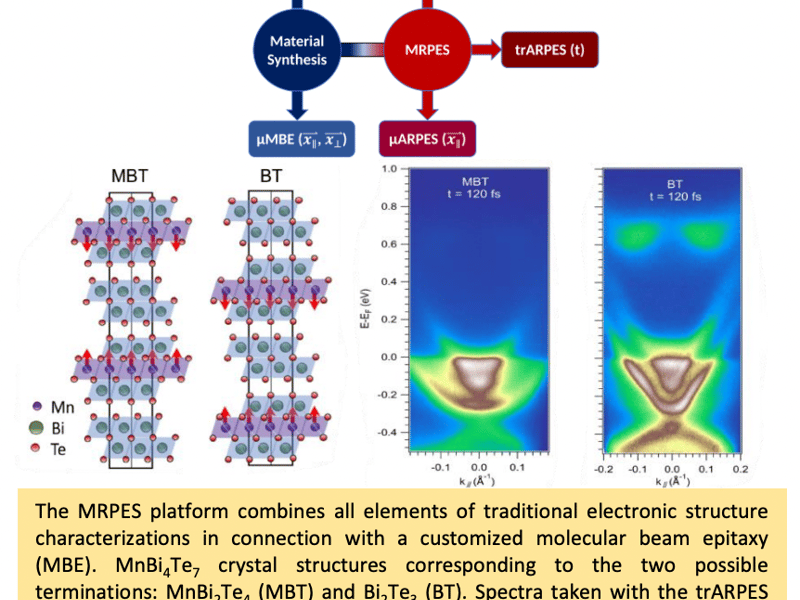
An integrated quantum material testbed with multi-resolution photoemission spectroscopy
Professor Shuolong Yang group at the University of Chicago has set up a new integrated platform for multiresolution photoemission spectroscopy (MRPES) that integrates a helium discharge lamp, a narrow bandwidth 6 eV laser, and a tunable ultrafast laser, which effectively combines static ARPES, time-resolved ARPES (trARPES), and micro-ARPES (μARPES).
Pennsylvania State University
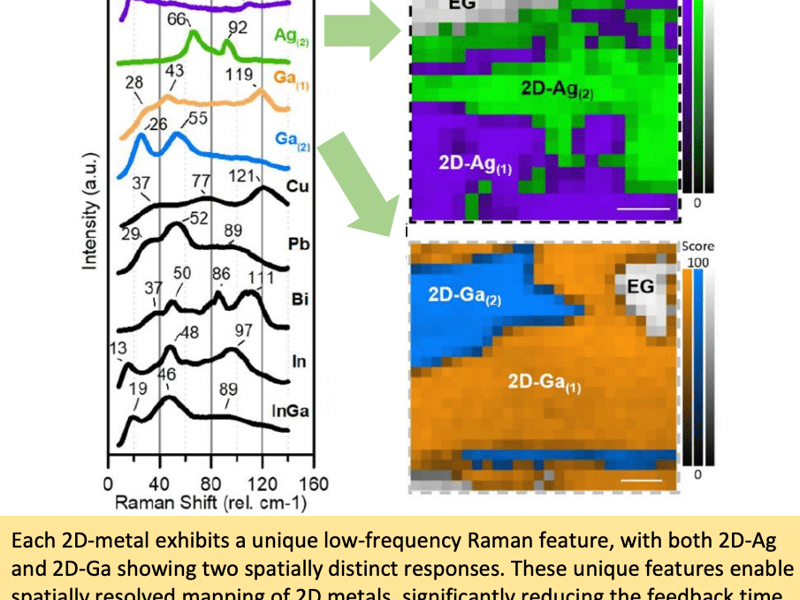
Fingerprinting 2-Dimensional Polar Metals
In this highlight, we identified newly discovered low-frequency (LF) (<100 cm−1 ) Raman features due to the formation of unique 2D polar metals (Ag, Cu, Pb, Bi, Ga, In) or metal alloys (InxGa1−x) intercalated at an epitaxial graphene (EG)/silicon carbide (SiC) interface and demonstrate that 2D-Ag and 2DGa can have spatially distinct phases with their own unique Raman responses. Additionally, we establish that the 2D-Ga exhibits a structural evolution as a function of temperature, independent of the SiC and EG, that can lead to nucleation of secondary phases.
Showing 191 to 200 of 237