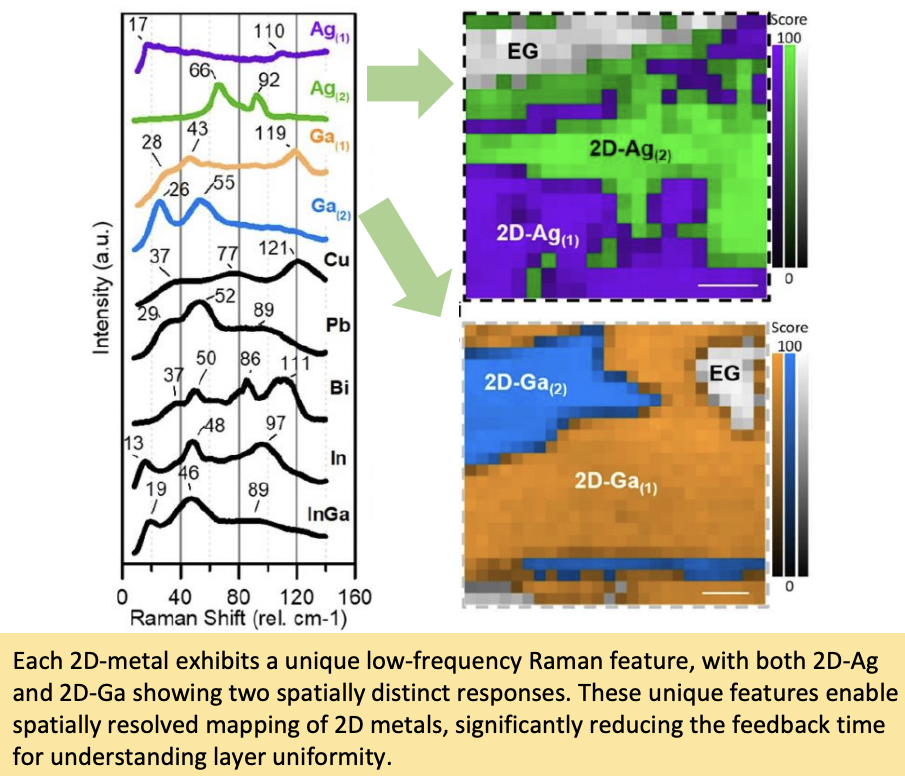
The intercalation of a molecule or ion in a layered structure is key to enhancing energy storage, material conductivity, intercalant structural ordering, and the formation of two-dimensional (2D) superconducting states. The process of intercalation modifies the vibrational energy of the host, which can be monitored non-invasively by Raman spectroscopy. However, the detected Raman spectral shifts may originate from a variety of phenomena, generally making the technique an indirect means of identifying intercalation success. In this highlight, we identified newly discovered low-frequency (LF) (<100 cm−1 ) Raman features due to the formation of unique 2D polar metals (Ag, Cu, Pb, Bi, Ga, In) or metal alloys (InxGa1−x) intercalated at an epitaxial graphene (EG)/silicon carbide (SiC) interface and demonstrate that 2D-Ag and 2DGa can have spatially distinct phases with their own unique Raman responses. Additionally, we establish that the 2D-Ga exhibits a structural evolution as a function of temperature, independent of the SiC and EG, that can lead to nucleation of secondary phases. The newly identified LF Raman responses discussed here lay the foundation for rapid, direct, and spatially resolved evaluation of 2D polar metals in ambient. Results are published in 2D Materials, 8 041003 (2021)
 Download

2D Crystal Consortium - Materials Innovation Platform (2DCC-MIP)
The 2DCC-MIP combines a vibrant in-house research effort focused on transformative advances in the synthesis and characterization of 2D chalcogenide layered materials with a robust external user program that provides access to expertise and state-of-the-art facilities. The 2DCC-MIP platform enables cutting edge research and discovery, across in-house research and the user program, on the synthesis and characterization of 2D chalcogenide materials by a national user community guided by four science drivers: Physics of 2D Systems, Epitaxy of 2D Chalcogenides, Next-generation 2D Electronics, and Advanced Characterization and Modeling.