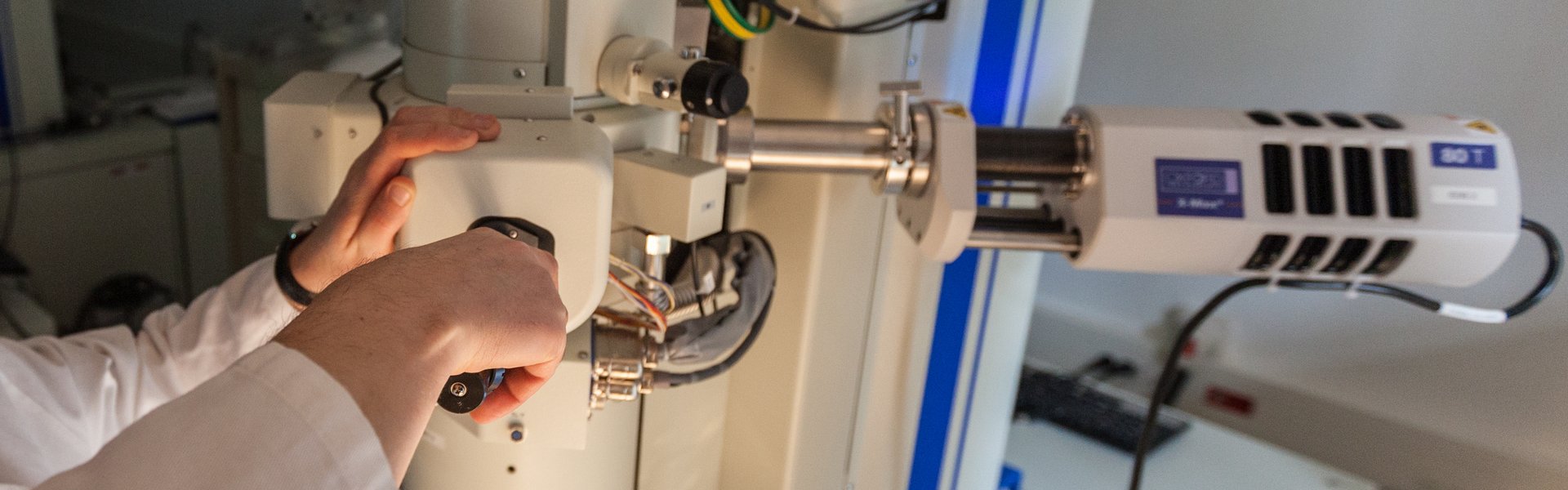
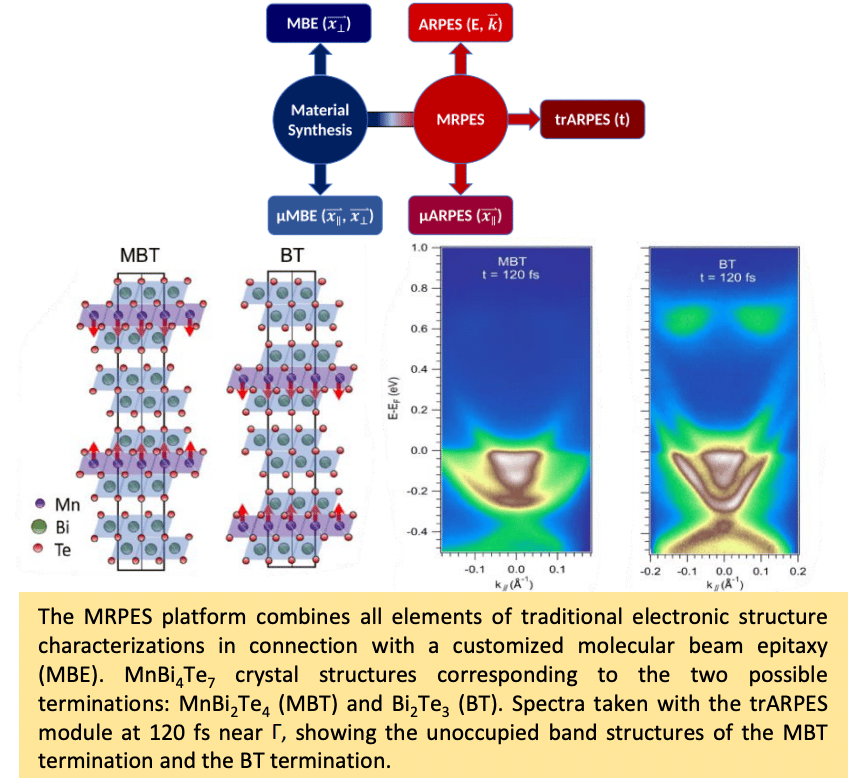
Angle-resolved photoemission spectroscopy (ARPES) has been established as a powerful tool to directly reveal electronic band structures of materials and played a critical role in discovering various topological materials such as topological insulators, Dirac semimetals, and Weyl semimetals. Investigations on quantum materials often require the combination of different modalities in photoemission spectroscopy. However, multi-modal ARPES measurements are remarkably challenging due to the limited access to multiple facilities and the potential sample degradations during transportation. Recently, Prof. Yang’s group at University of Chicago set up a new integrated platform for multiresolution photoemission spectroscopy (MRPES) that integrates a helium discharge lamp, a narrow bandwidth 6 eV laser, and a tunable ultrafast laser, which effectively combines static ARPES, time-resolved ARPES (trARPES), and micro-ARPES (μARPES). This setup provides a first-time all-in-one solution for multi-modal photoemission spectroscopy. By using single crystals of Bi2Se3 , MnBi2Te4, MnBi4Te7, and FeSe/SrTiO3 thin films, his group demonstrated an energy resolution of <4 meV in static laser-based ARPES, a time resolution of 35 fs in trARPES, and a spatial resolution of ∼10 μm in μARPES. Remarkably, their time resolution sets a new record for trARPES setups with probe pulses generated by solid-state nonlinear crystals. The detailed findings are published in Review of Scientific Instruments 92, 113907 (2021).
 Download

2D Crystal Consortium - Materials Innovation Platform (2DCC-MIP)
The 2DCC-MIP combines a vibrant in-house research effort focused on transformative advances in the synthesis and characterization of 2D chalcogenide layered materials with a robust external user program that provides access to expertise and state-of-the-art facilities. The 2DCC-MIP platform enables cutting edge research and discovery, across in-house research and the user program, on the synthesis and characterization of 2D chalcogenide materials by a national user community guided by four science drivers: Physics of 2D Systems, Epitaxy of 2D Chalcogenides, Next-generation 2D Electronics, and Advanced Characterization and Modeling.