News
News
Professor Heather Maynard has been elected to the American Academy of Arts and Sciences
Apr 21, 2023
Professor Heather Maynard has been elected to the American Academy of Arts and Sciences, recognizing her contributions in protein-polymer conjugates and smart materials for precision medicine. A longstanding UCLA faculty member, Maynard has received numerous awards and holds significant roles in various research programs and publications in chemistry and biochemistry.

News
BioPACIFIC MIP Research Featured in Soft Matter Editorial Board Highlights of 2022
Mar 26, 2023
A study by Yimin Luo et al. on high-throughput microscopy for analyzing coacervates was highlighted in the Soft Matter journal. It demonstrated a new platform for simultaneous measurement of morphology and microrheology in phase-separating fluids, improving efficiency in tracking material properties during compositional changes.

News
Advait Holkar receives the APS Emerging Soft Matter Excellence (ESME) award
Mar 21, 2023
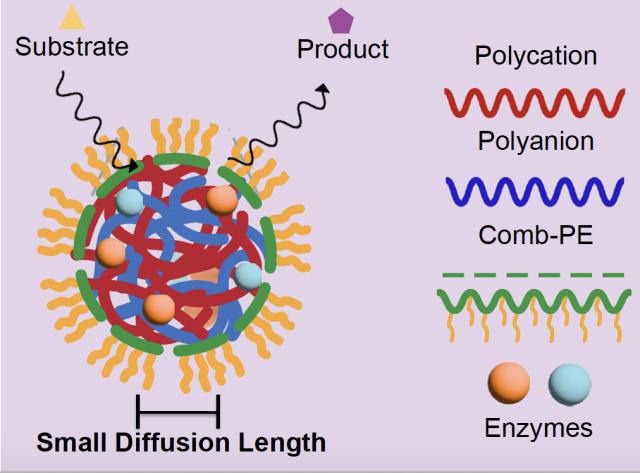
Advait Holkar, a UCLA PhD student, received the ESME award for his research on protocells that enhance enzymatic catalysis. His work shows that these protocells achieve significantly faster reaction rates and improved efficiency in enzyme cascade reactions, conducted at the Living BioFoundry and supported by BioPACIFIC MIP.
News
New material may offer key to solving quantum computing issue
Feb 23, 2023
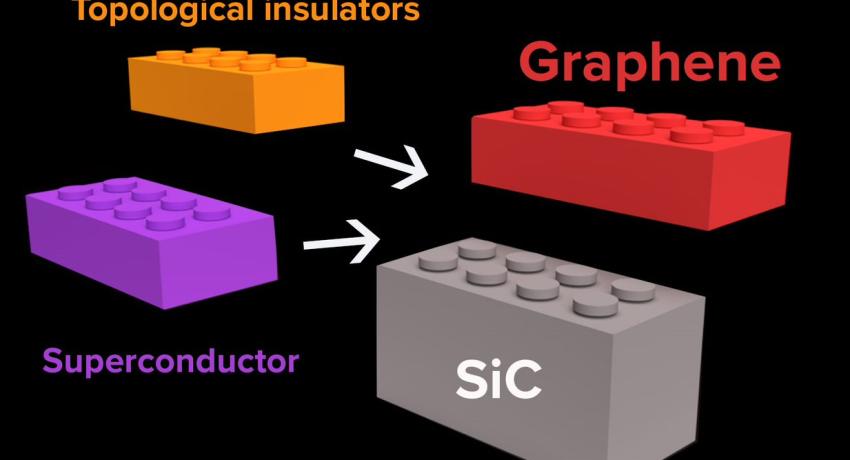
Researchers at Penn State have developed a new heterostructure of two-dimensional materials that could advance quantum computing by overcoming significant barriers. This involves using topological superconductors to enhance qubit stability. Their innovative synthesis technique may facilitate scalable production for future quantum applications, marking a step toward practical topological quantum computers.
News
2D material may enable ultra-sharp cellphone photos in low light
Dec 9, 2022
Researchers at Penn State developed a novel active pixel sensor using molybdenum disulfide, enabling sharper, energy-efficient cellphone photography and IoT sensors. This technology reduces energy costs and enhances image processing, allowing for clearer photos in low-light and adverse conditions, contributing to sustainability in photography and smart manufacturing.
News
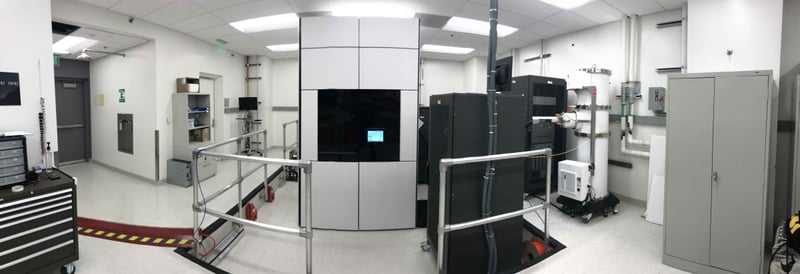
BioPACIFIC MIP has signed off on the state of the art microED
Nov 18, 2022
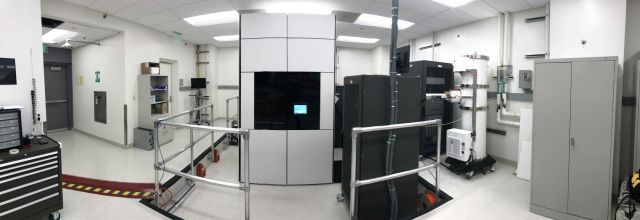
UCLA has introduced a shared-use electron microscope, the ThermoFisher Scientific Spectra 300C, for studying atomic structures of bio-sourced compounds. This tool enables rapid structure determination through micro-electron diffraction, significantly reducing analysis time. It supports the BioPACIFIC MIP collaboration aimed at developing sustainable bio-based materials, benefiting researchers at UCLA, UCSB, and beyond.
Press Release
BioPACIFIC MIP has signed off on the state of the art microED
Nov 18, 2022
There’s a new shared-use electron microscope at UCLA for investigators seeking to elucidate the atomic structures of bio-sourced monomers and small molecules. The NSF’s BioPACIFIC MIP now offers access to its ThermoFisher Scientific Spectra 300C transmission electron microscope (TEM) housed at the California NanoSystems Institute at UCLA.
News
PARADIM Researcher Berit Goodge Awarded Third Prize in APL Materials Excellence in Research Award
Nov 1, 2022
Berit Goodge received third prize in the APL Materials Excellence in Research Award for her study on lattice disorder's impact on superconductivity in Sr₂RuO₄.

News
Lena Kourkoutis Named 2022 APS Fellow for Advances in Electron Microscopy
Oct 1, 2022
Lena Kourkoutis was elected a 2022 Fellow of the American Physical Society for her groundbreaking work in cryogenic scanning transmission electron microscopy.
News
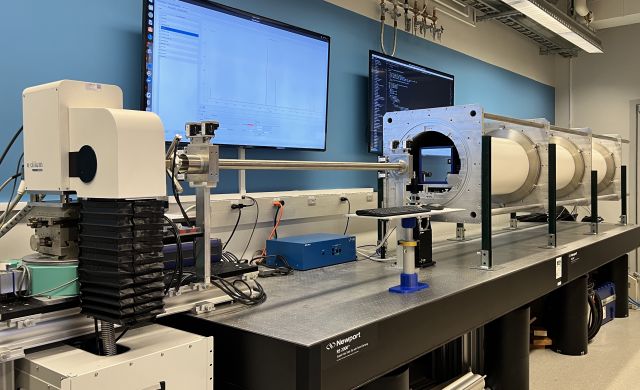
New X-ray Facility Brings Synchrotron-level Capabilities to BioPACIFIC MIP
Sep 14, 2022
The BioPACIFIC MIP X-ray Diffraction Platform offers a compact SAXS-WAXS beamline for advanced characterization of biopolymers, featuring a high brilliance liquid gallium X-ray source and a large-area pixel array detector. It allows for rapid kinetic SAXS measurements, enhancing research capabilities for U.S. scientists via a peer-review access process.
Showing 51 to 60 of 119