
Latest News

News · Oct 16, 2023
University of California, Santa Barbara
Two BioPACIFIC MIP Faculty Awarded 2023 Packard Fellowship
The Packard Foundation announced the 2023 Packard Fellows, including Yang Yang and Yuzhang Li. This class consists of 20 early-career scientists receiving $875,000 each over five years to advance their innovative research, inspiring future generations in the scientific community.
Highlight · Sep 8, 2023
Pennsylvania State University
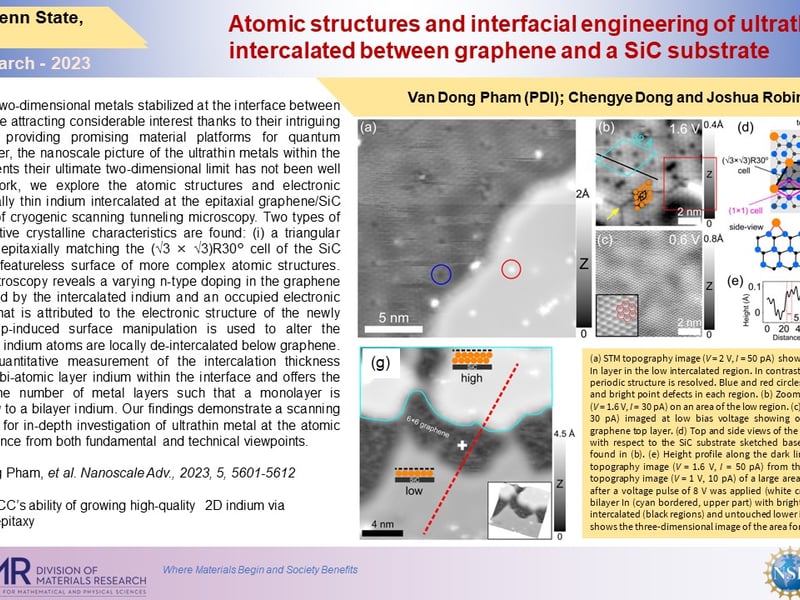
Atomic structures and interfacial engineering of ultrathin indium intercalated between graphene and a SiC substrate
Two-dimensional metals stabilized at the interface between graphene and SiC are attracting considerable interest thanks to their intriguing physical properties, providing promising material platforms for quantum technologies.

News · Sep 1, 2023
Cornell University
David Muller Awarded 2023 John Cowley Medal for Lifetime Achievement in Microscopy
By PARADIM News
PARADIM’s David Muller has received the prestigious John M. Cowley Medal, awarded once every four years to an international leader in microscopy or diffraction physics.
Highlight · Aug 29, 2023
University of California, Santa Barbara
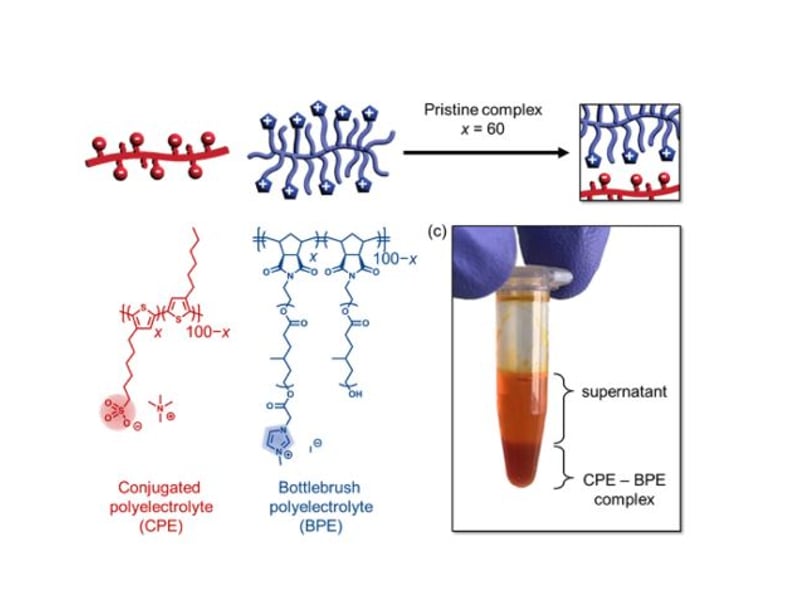
Engineering Soft, Elastic, and Conductive Polymers for Stretchable Electronics Using Ionic Compatibilization
My Linh Le, Rachel Segalman, Christopher Bates, and Michael Chabinyc, UC Santa Barbara
Demonstrated design of soft, elastic, and highly conductive polymer complexes through electrostatic interactions between an anionic conjugated polyelectrolyte (CPE) and a cationic bottlebrush polyelectrolyte (BPE) .
Highlight · Aug 9, 2023
Cornell University
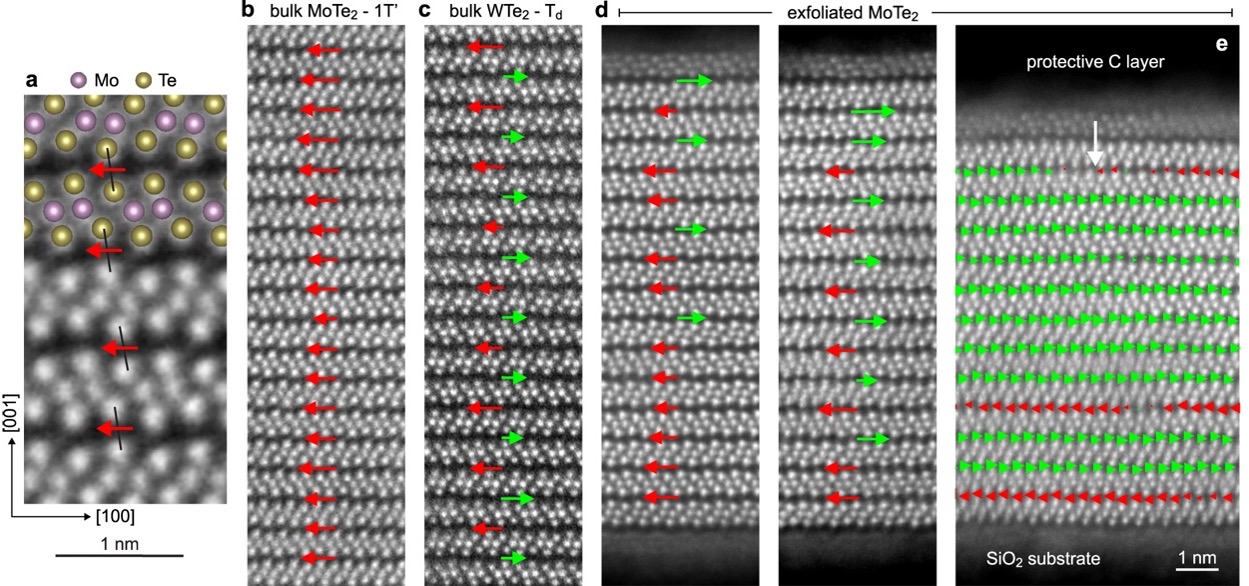
Emergent layer stacking arrangements in c-axis confined MoTe2
Judy J. Cha and Lena F. Kourkoutis (Cornell), Yimei Zhu (BNL), Peijun Gou (Yale), Yanbing Zhu, Felipe Jornada, and Evan J. Reed (Stanford)
The study of 2D transition metal dichalcogenides (TMDs) has largely assumed that the layer stacking in the nanoscale limit adopts one or more of the possible precise stacking sequences found in bulk specimens. This work demonstrates – via atomic resolution imaging – that in fact much greater stacking complexity arises in the thin limit than previously assumed. Given the importance of interlayer stacking on electronic, magnetic, and optical properties, this result suggests greater study of stacking is needed during the characterization of 2D TMDs.
Highlight · Aug 4, 2023
Pennsylvania State University
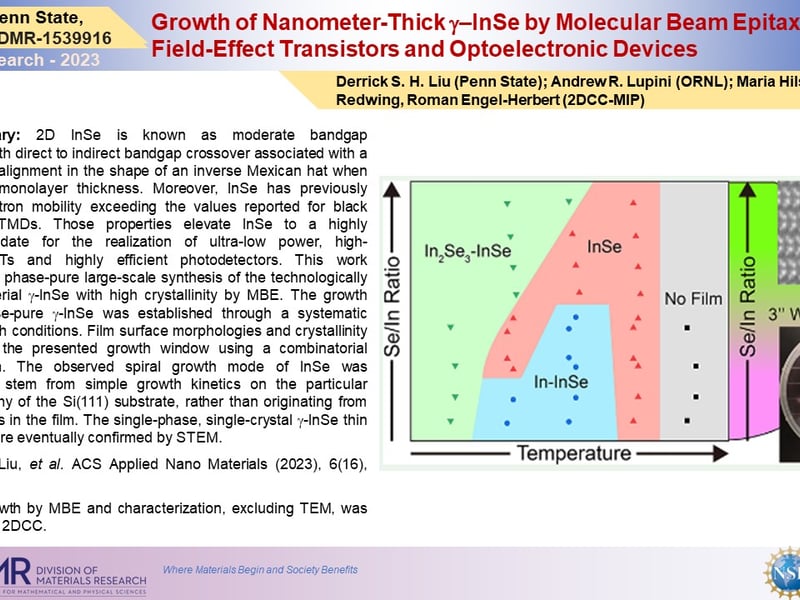
Growth of Nanometer-Thick –InSe by Molecular Beam Epitaxy for Field-Effect Transistors and Optoelectronic Devices
DerrickS. H. Liu (Penn State); AndrewR. Lupini (ORNL); Maria Hilse, Joan M. Redwing, Roman Engel-Herbert (2DCC-MIP)
2D InSe is known as moderate bandgap semiconductor with direct to indirect bandgap crossover associated with a topological band alignment in the shape of an inverse Mexican hat when reduced to the monolayer thickness.
News · Aug 4, 2023
University of California, Santa Barbara
Elizabeth Murphy Receives PMSE Graduate Student Travel Award
Elizabeth Murphy from BioPACIFIC MIP has won the ACS PMSE Graduate Student Travel Award, supporting under-represented graduate students to present research at ACS meetings. She will present her talk, "Accelerated Discovery of Block Copolymers through Automated Chromatography," at the Fall 2023 ACS Meeting in Indianapolis on August 16.
News · Aug 2, 2023
University of California, Santa Barbara
A new synergistic method can create non-canonical amino acids by merging synthetic photochemistry with biocatalysis
Researchers at UC Santa Barbara have developed a new method combining enzyme activities and small-molecule photochemistry, paving the way for innovative catalytic reactions. This approach enhances the synthesis of non-canonical amino acids, crucial for therapeutics, and offers a stereoselective process that improves product specificity.
Highlight · Jul 27, 2023
Pennsylvania State University
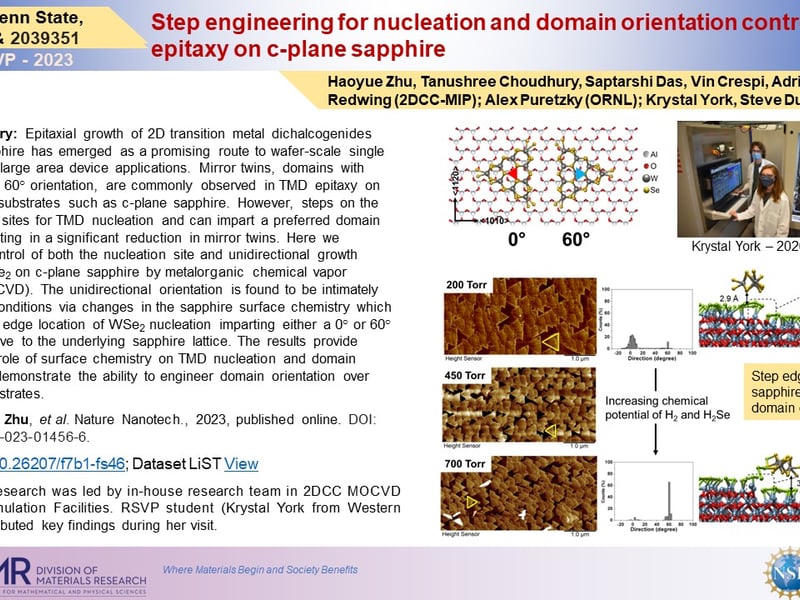
Step engineering for nucleation and domain orientation control in WSe2 epitaxy on c-plane sapphire
Epitaxial growth of 2D transition metal dichalcogenides (TMDs) on sapphire has emerged as a promising route to wafer-scale single crystal films for large area device applications. Mirror twins, domains with opposite 0° and 60° orientation, are commonly observed in TMD epitaxy on high symmetry substrates such as c-plane sapphire.
Highlight · Jul 27, 2023
Pennsylvania State University
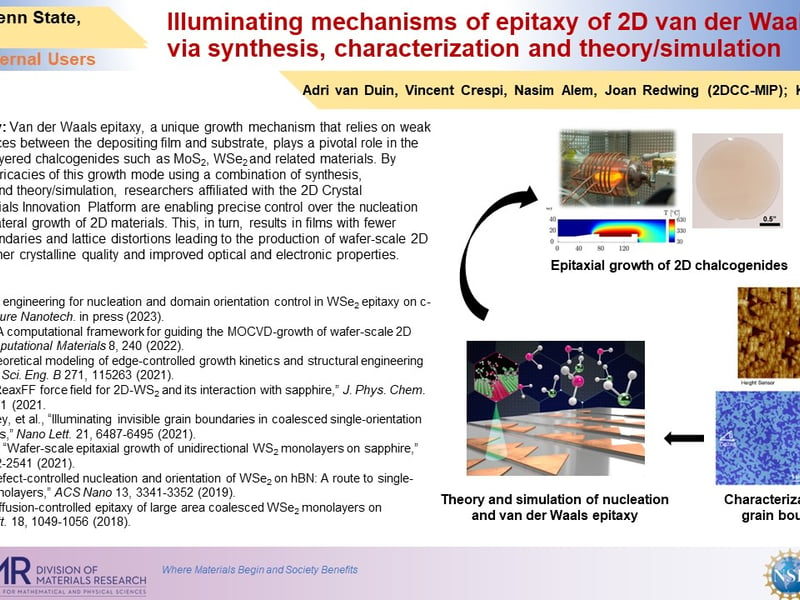
Illuminating mechanisms of epitaxy of 2D van der Waals crystals via synthesis, characterization and theory/simulation
Van der Waals epitaxy, a unique growth mechanism that relies on weak intermolecular forces between the depositing film and substrate, plays a pivotal role in the synthesis of 2D layered chalcogenides such as MoS2, WSe2 and related materials.
Showing 101 to 110 of 363