Latest News
Highlight · Apr 21, 2020
Cornell University
Materials Enabling a Magnetic “Midas Touch”
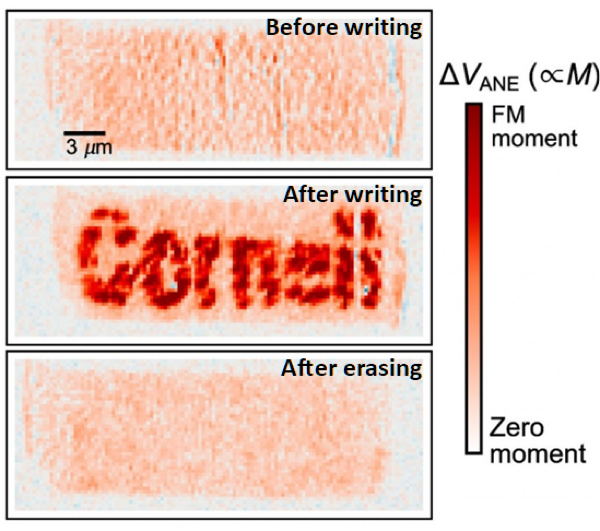
PARADIM demonstrates local photothermal control of phase transitions in Fe0.52Rh0.48 thin films, turning non-magnetic material ferromagnetic with a brief heat pulse. Patterns written with a laser persist at room temperature and erase when cooled. This enables rewritable magnetic memory/logic, artificial spin-ice lattices, and ultrafast magnonic devices at sub-micrometer scales.

News · Apr 1, 2020
Cornell University
PARADIM’s Crystal Growth Lab at JHU Featured in Johns Hopkins Magazine
By PARADIM News
A feature in Johns Hopkins Magazine spotlights PARADIM’s Bulk Crystal Growth Facility, where researchers create materials that have never existed before.

News · Apr 1, 2020
Cornell University
PARADIM User Mike Scudder Awarded OSU Presidential Fellowship
By PARADIM News
Mike Scudder, a PARADIM user and member of the Goldberger group, received Ohio State’s prestigious Presidential Fellowship in Spring 2020.
Highlight · Mar 12, 2020
Cornell University
A Strategy to Make and Manipulate Magnetic Monopoles by Exploiting Interfaces
Ludi Miao, Yonghun Lee, Antonio B. Mei, Michael J. Lawler, Kyle M. Shen
Long considered unachievable, magnetic monopoles have been realized in bulk crystals in recent years as ensembles containing equal numbers of monopoles and antimonopoles. In this form, exciting fundamental questions about the existence, properties, and dynamics of individual magnetic monopoles remain unanswered or inaccessible.
Highlight · Mar 11, 2020
Cornell University
New theoretical approach to tackle interface quantum materials
E. Gerber, Y. Yao, T.A. Arias, E.-A. Kim
The Materials-by-Design approach relies on strong theoretical capabilities to predict the properties of novel materials. Unfortunately, traditional ab initio techniques for calculating the electronic structure of materials are powerless when the lattice mismatch between two crystals leads to the absence of periodicity, as observed between many of the interface quantum materials that are the focus of PARADIM’s in-house research.

News · Mar 9, 2020
Pennsylvania State University
Two-Dimensional Metals Open Pathways To New Science
Penn State researchers, with Lawrence Berkeley and Oak Ridge National Labs, developed a platform for atomically-thin metals using epitaxial graphene. This method, called confinement heteroepitaxy (CHet), stabilizes unique metal structures for applications in biomolecular sensing, quantum phenomena, catalysis, and nonlinear optics, while preserving their properties.
Highlight · Feb 1, 2020
Cornell University
Mollifying Barriers to Enhance Self Assembly
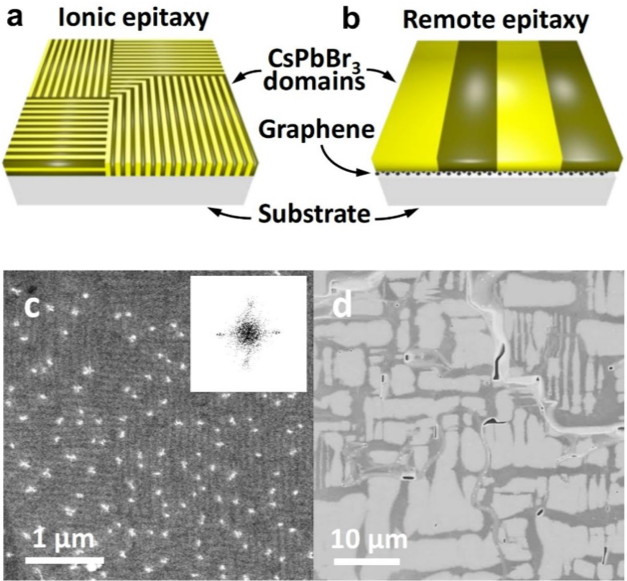
Jiang et al. show that growing CsPbBr3 thin films via remote epitaxy—using a graphene spacer between substrate and film—weakens substrate bonding, yielding larger grains, fewer defects, and improved charge transport. Reduced dislocation density increases carrier lifetime fourfold, advancing defect-tolerant halide perovskites for solar cells.

News · Jul 15, 2019
Cornell University
PARADIM Research Featured on Applied Surface Science Cover
By PARADIM News
A PARADIM user project combining theory, MBE, and ARPES was featured on the cover of Applied Surface Science’s special issue on oxide electronics.
Highlight · Jul 1, 2019
Cornell University
Theory + MBE + ARPES to navigate correlated materials
PARADIM’s in-house research team is exploiting the world-leading tools of its Platform to provide a new modality of materials discovery for artificial quantum materials. This occurs through the unique combination of thin film growth with in-situ spectroscopy enabling scientists to directly see the impact of changes in structure on how the electrons move in these materials.
Highlight · Jun 26, 2019
Cornell University
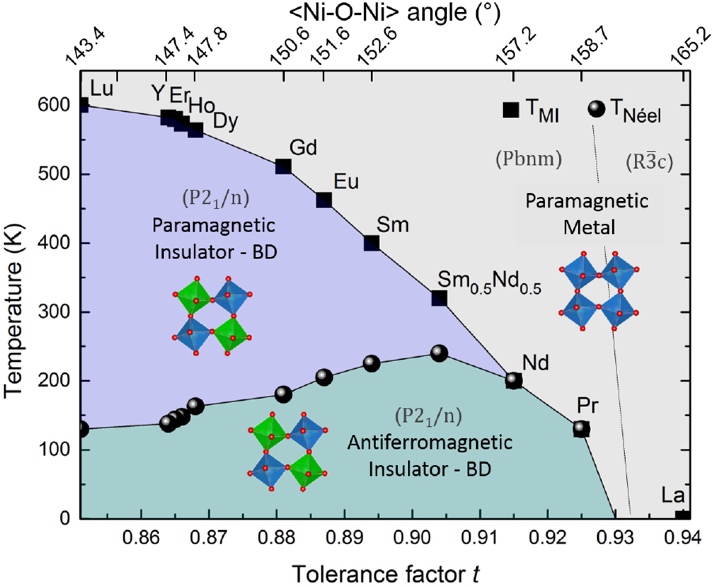
Floating Zone Crystal Growth at Record Oxygen Pressure to Create a PrNiO3 Single Crystal
PARADIM demonstrates growth of millimeter-sized PrNiO3 single crystals at 295 bar oxygen using a high-pressure floating-zone furnace, yielding the largest, highest-quality crystals to date. This enables detailed study of simultaneous metal-insulator and magnetic transitions in RNiO3, addressing prior limitations from microcrystalline samples and enabling neutron diffraction analyses.
Showing 261 to 270 of 363