
Latest News
Highlight · Apr 23, 2021
Cornell University
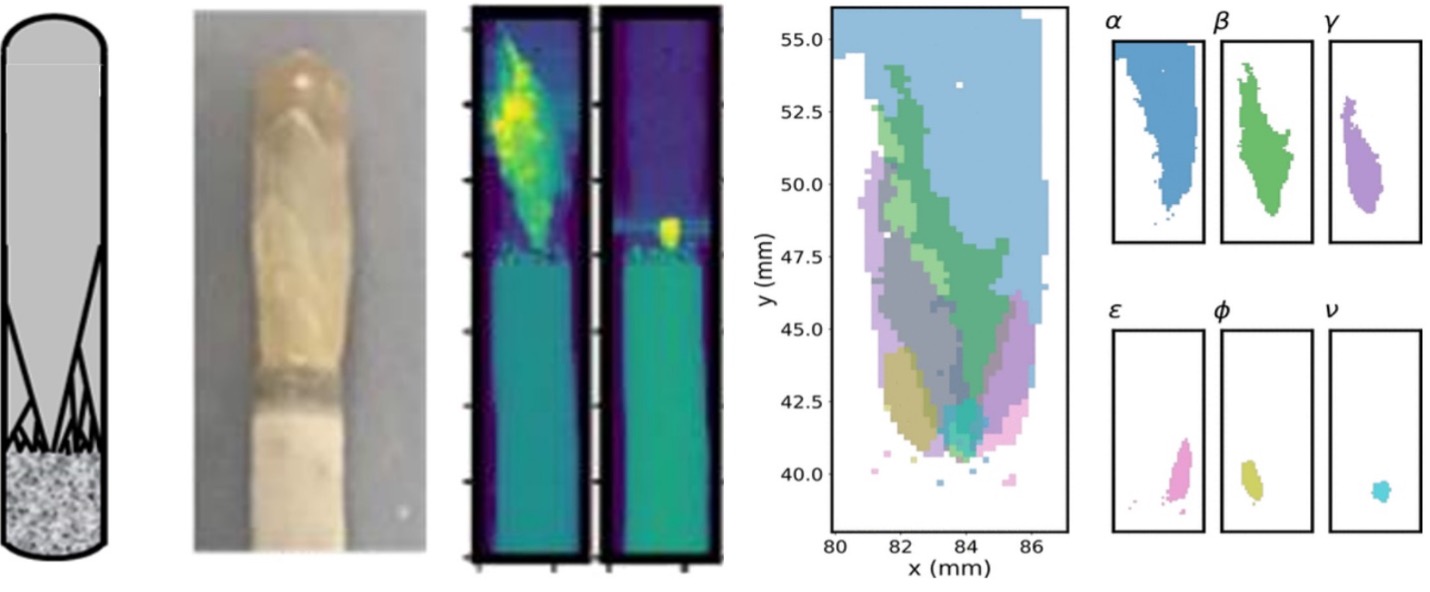
Synchrotron diagnostic imaging of crystal growth processes
PARADIM Highlight #40 reports an automated, nondestructive method using high-energy synchrotron X-rays to map grains during floating-zone growth of TiO2. The study tracks grain position, size, and shape, revealing a single grain that dominates and fills the boule. This advances growth models and accelerates materials development; data published and available.
Highlight · Apr 12, 2021
Cornell University
Unit-Cell-Thick Domains in Quasi-2D Ferroelectric Material
Many electronic devices, like non-volatile high-density memories, ultra-fast switches, and thin film capacitors, rely on ferroelectric materials—a class of materials with spontaneous electrical polarization which can be reproducibly switched. In two-dimensional (2D) and quasi-2D ferroelectric materials the size of ferroelectric domains can be small which may enable the miniaturization of devices. Understanding of ferroelectric domain structure at the atomic scale is, however, limited, hindering the development of functional device units at the microscopic level.
Highlight · Mar 22, 2021
Pennsylvania State University
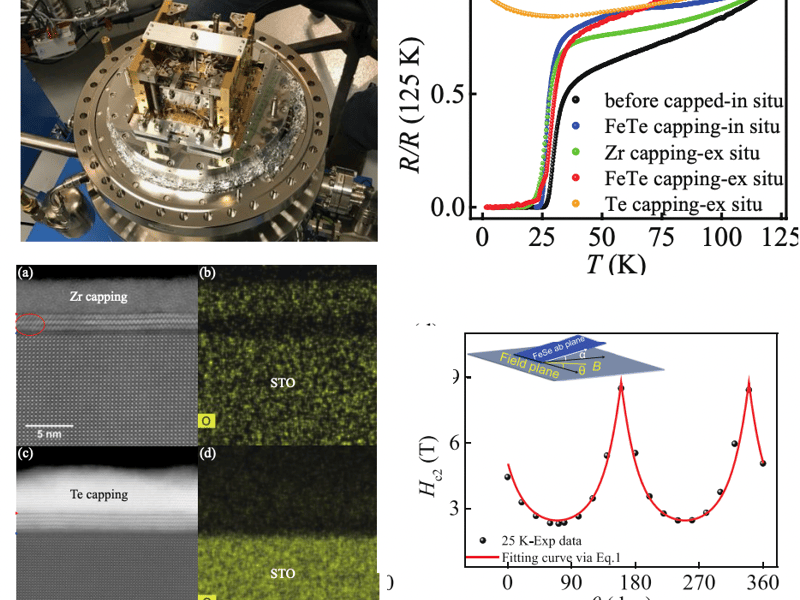
Studying the influence of a capping layer on interfacial superconductivity in FeSe/SrTiO3 heterostructures
We used the 2DCC multimodule molecular beam epitaxy (MBE) and surface characterization facility to study the influence of various capping layers on the Tc of ultrathin films of FeSe grown on SrTiO3. The multimodule facility’s in vacuo four-probe electrical resistance measurement capability provided critical information about the Tc of MBE-grown FeSe films in their pristine state, while ex situ magneto-transport measurements elucidated the key role of distinct charge transfer from different capping layers (compound FeTe, non-metallic Te, and metallic Zr). Our results show that FeTe provides an optimal cap that barely influences the inherent Tc found in pristine FeSe/SrTiO3, while the transfer of holes from a non-metallic Te cap completely suppresses superconductivity and leads to insulating behavior.

News · Feb 17, 2021
University of California, Santa Barbara
Professors Maynard and Valentine Elected to American Institute for Medical and Biological Engineering
The American Institute for Medical and Biological Engineering has elected Heather Maynard and Megan Valentine to its College of Fellows for their significant contributions in protein-polymer synthesis and biomaterials analysis, respectively. This honor recognizes elite engineers who have made impactful advancements in medical and biological engineering.

News · Feb 10, 2021
University of California, Santa Barbara
UCSB Professors Segalman and Hawker Elected to National Academy of Engineering
Two UC Santa Barbara engineers, Craig Hawker and Rachel Segalman, have been elected to the National Academy of Engineering for 2021. They were recognized for their significant contributions in materials and chemistry, with Segalman focusing on semiconducting block polymers and Hawker on polymer chemistry and molecular engineering.

News · Feb 10, 2021
University of California, Santa Barbara
BioPACIFIC MIP Co-Director Heather Maynard named Associate Editor of the Journal of the American Chemical Society
Prof. Heather Maynard, a leader in protein-polymer conjugates and co-Director of BioPACIFIC MIP, has been appointed as an Associate Editor for the Journal of the American Chemical Society. Her contributions to synthetic methods and material properties, coupled with her commitment to collaboration, exemplify her dedication to advancing chemical sciences.

News · Feb 10, 2021
University of California, Santa Barbara
Delivering Community Education at Home
The California NanoSystems Institute at UCLA successfully adapted its nanoscience education programs to an online format during the COVID-19 pandemic, enabling continued community engagement. Under Dr. Rita Blaik's leadership, hands-on experiments were restructured for home use, enhancing outreach opportunities and supporting the BioPACIFIC MIP's educational mission.

News · Feb 3, 2021
Pennsylvania State University
Transistors Built From Ultra-Thin 2D Materials Take A Step Forward
Researchers at Penn State have demonstrated that two-dimensional materials, like molybdenum disulfide and tungsten disulfide, can be used to create smaller, more efficient transistors compared to traditional silicon. These advancements could lead to faster and more energy-efficient computers, addressing the growing demand for data processing and storage.
News · Feb 2, 2021
University of California, Santa Barbara
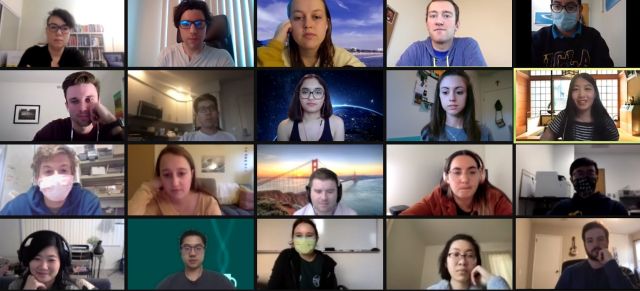
Announcing the 2021 BioPACIFIC MIP Fellows and Associates!
BioPACIFIC MIP has introduced its inaugural cohort of 25 Fellows and Associates, comprising graduate students and postdoctoral researchers from UCSB, UCLA, and UNC Chapel Hill. They will engage in research training, professional development, and networking. More information is available on the Education page.
Highlight · Jan 1, 2021
Cornell University
Transverse Thermoelectrics—A Route to more Efficient Energy Conversion
The principal challenges in current thermoelectric power generation modules are the availability of stable, diffusion-resistant, lossless electrical and thermal metal–semiconductor contacts that do not degrade at the hot end nor cause reductions in device efficiency. Transverse thermoelectric devices, in which a thermal gradient in a single material induces a perpendicular voltage, promise to overcome these problems.
Showing 231 to 240 of 363