
Latest News
News · May 28, 2021
Crystal Growth Lab Renews Funding from NSF
Rachel Wallach, The Hub
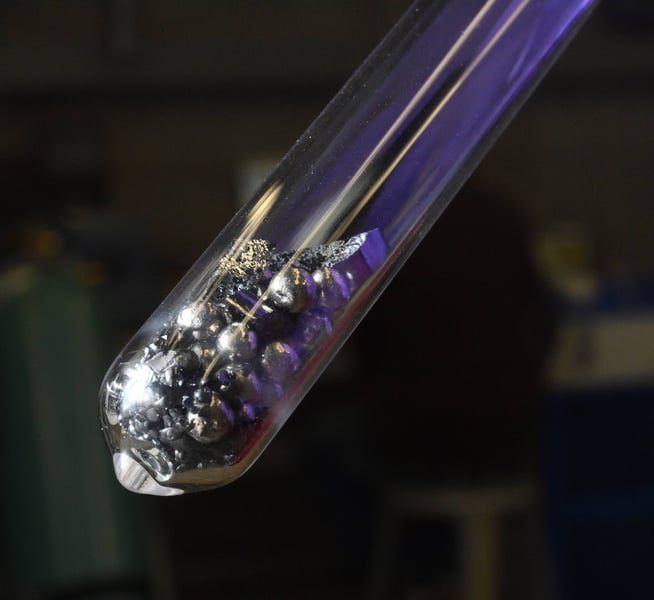
Johns Hopkins' groundbreaking bulk crystal growth facility, part of one of four materials innovation platforms supported by the National Science Foundation, has received a $5 million renewal grant that will allow scientists to continue designing and creating new materials there for the next generation of electronic devices.
News · May 25, 2021
University of California, Santa Barbara
UCSB Professor Christopher Bates Receives Camille Dreyfus Teacher-Scholar Award
Christopher Bates, an assistant professor at UC Santa Barbara, received the 2021 Camille Dreyfus Teacher-Scholar Award, providing him with $100,000 for research on bottlebrush copolymers. His work will leverage UCSB’s advanced facilities to optimize molecular designs for enhanced performance in various applications.
News · May 25, 2021
University of California, Santa Barbara
UCLA Professor Ellen Sletten chosen for the prestigious 2020-2021 McCoy Award
Professor Ellen Sletten has won the 2020-2021 McCoy Award for her significant contributions to chemistry and biochemistry. She developed bright fluorophores for shortwave infrared emission, enabling non-invasive imaging through skin and tissue, with potential applications in safe, low-cost optical diagnostics in clinical settings.
News · May 25, 2021
Pennsylvania State University
NSF Renews Funding for Two-Dimensional Crystal Consortium
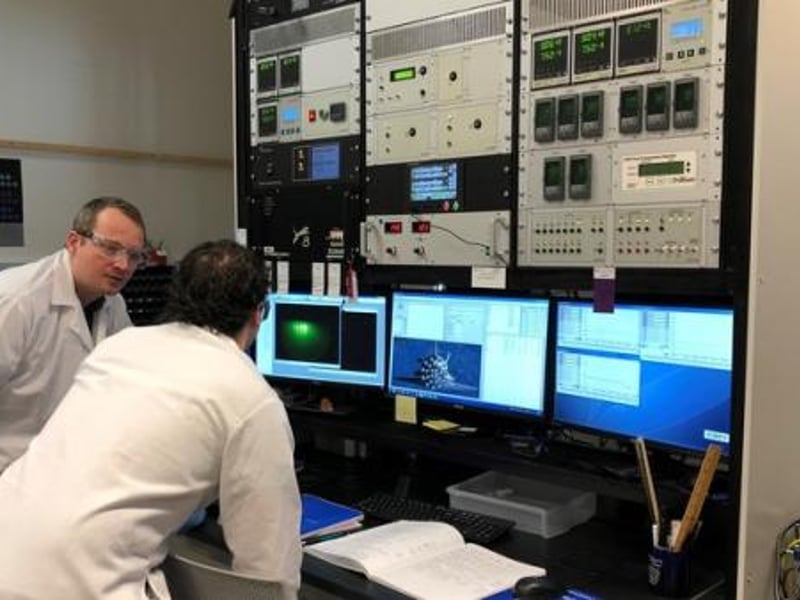
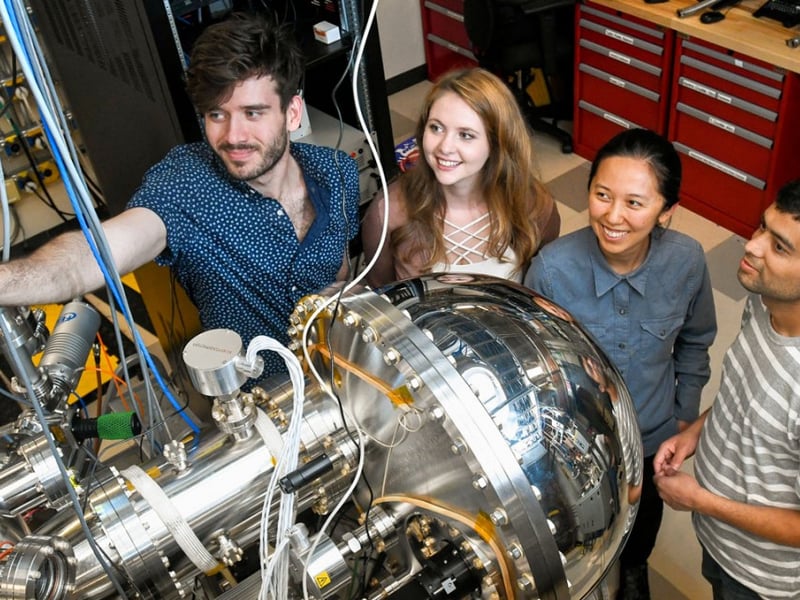
The National Science Foundation (NSF) announced a renewal of funding for the Materials Innovation Platform (MIP) national user facility at Penn State’s Materials Research Institute (MRI), the Two-Dimensional Crystal Consortium (2DCC). The 2DCC, which has many users from the Eberly College of Science, is one of four MIPs in the United States and was awarded $20.1 million over five years, an increase of 13% above the initial award in 2016.
News · May 25, 2021
Cornell University
$22.5M NSF Grant Accelerates Materials Discovery
Cornell’s Platform for the Accelerated Realization, Analysis, and Discovery of Interface Materials (PARADIM) has received a second award of $22.5 million from the National Science Foundation (NSF) to fund another five years, enabling scientists, engineers and entrepreneurs nationwide to design and create new inorganic materials for use in electronics.
Highlight · May 21, 2021
Cornell University
The Highest Resolution Microscope, enabled by a new detector technology, reaches an ultimate resolution limit – the vibrations of atoms themselves
Electron microscopy is a widespread and often essential tool for structural and chemical analysis at the atomic level. Image resolution is dominated by the energy (or wavelength) of the electron beam and the quality of the lens. By combining our new design of electron microscope pixel array detector (EMPAD), which has the dynamic range to record the complete distribution of transmitted electrons at every beam position and a phase retrieval algorithm to process the data, PARADIM’s in-house research team has increased the spatial resolution well beyond the traditional lens limitations, setting a world record in 2018 for the highest resolution microscope (0.39 Å Abbe resolution [1]) at the same dose and imaging conditions where conventional imaging modes reach only 0.98 Å. The EMPAD is the culmination of over a decade of detector development at Cornell, supported by NSF (through CHESS, CCMR), DOE, the WM Keck Foundation, and the Kavli Institute, and has been commercially licensed by ThermoFisher Scientific and is now manufactured and sold at scale.
Highlight · May 21, 2021
Cornell University
The Highest Resolution Microscope, enabled by a new detector technology, reaches an ultimate resolution limit – the vibrations of atoms themselves
Z. Chen, Y. Jiang, Y. Shao, M.E. Holtz, M. Odstrčil, M. Guizar-Sicairos, D.G. Schlom, D.A. Muller
By combining PARADIM’s new design of electron microscope pixel array detector (EMPAD), which has the dynamic range to record the complete distribution of transmitted electrons at every beam position and a phase retrieval algorithm to process the data, the research team has increased the spatial resolution well beyond the traditional lens limitations, setting a world record in 2018 for the highest resolution microscope.
Highlight · May 12, 2021
Cornell University
Beyond Terfenol-D
For nearly 50 years, Terfenol-D (Tb:x:Dy:1-:x:Fe:2:) has reigned as the material for which an applied magnetic field results in the greatest change in shape, a property known as magnetostriction. A distant second to Terfenol-D is Galfenol (Fe:1–:x:Ga:x:), the best magnetostrictor free of rare-earth elements.
News · May 1, 2021
Cornell University
PARADIM Researchers Capture Highest-Resolution Atomic Image
By PARADIM News
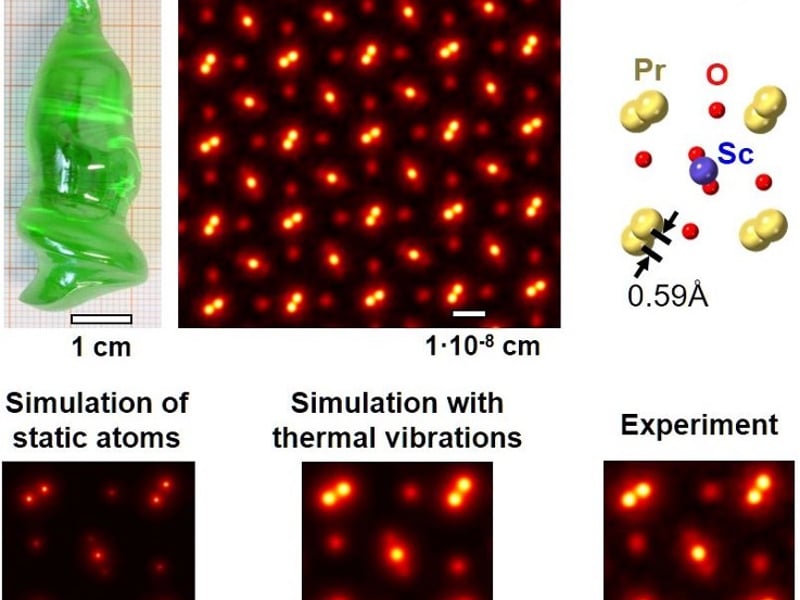
Using a new detector technology, PARADIM researchers have reached the ultimate resolution limit in electron microscopy—resolving the thermal vibrations of atoms themselves.

News · Apr 28, 2021
University of California, Santa Barbara
UCSB Professor Fredrickson Elected to National Academy of Sciences
UC Santa Barbara's Glenn Fredrickson was elected to the National Academy of Sciences in 2021. He holds a joint appointment in Materials and Chemical Engineering, directs MC-CAM, and has received numerous awards. Fredrickson is also involved in multiscale modeling and computation at the BioPACIFIC MIP.
Showing 221 to 230 of 363