Latest News

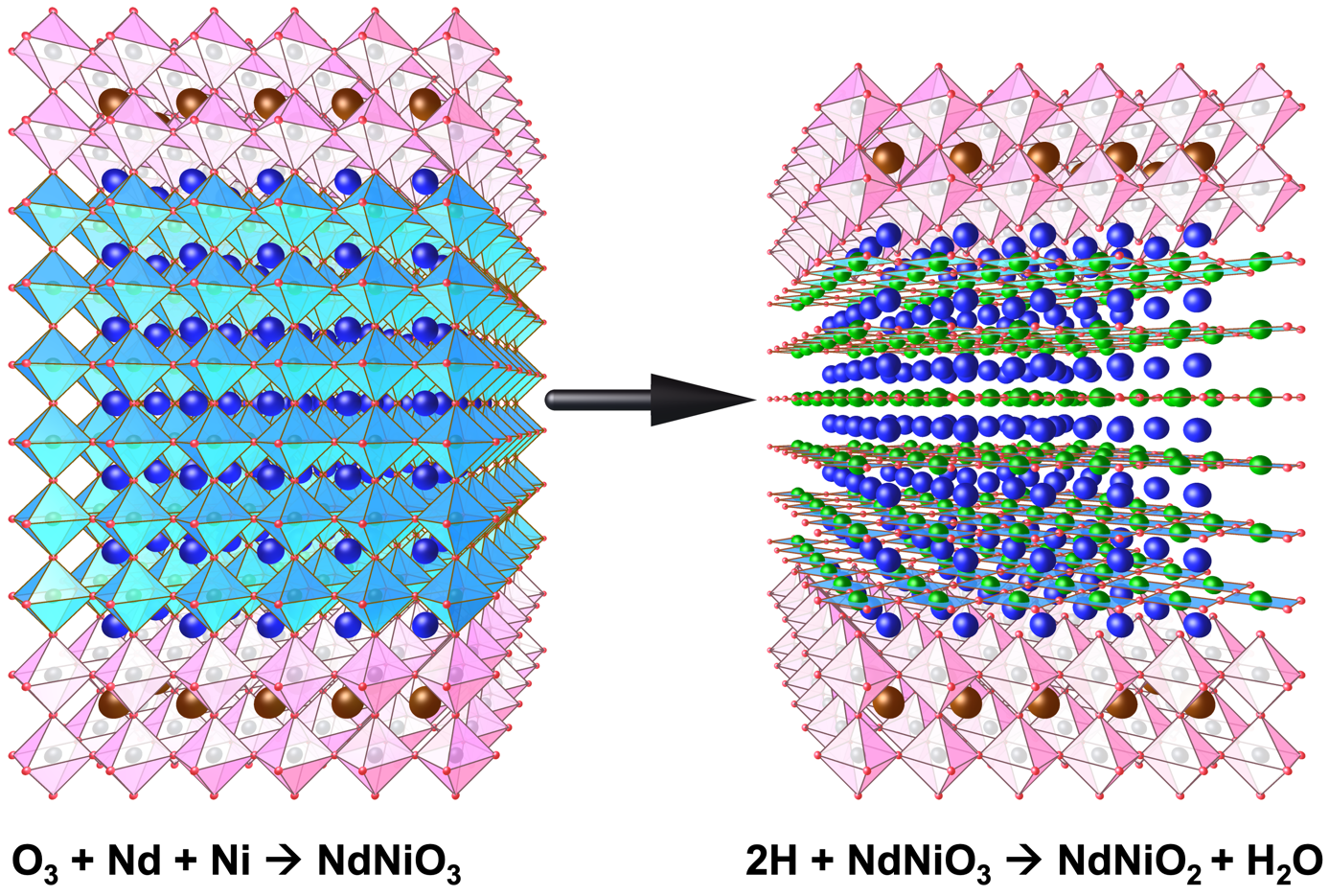
Figure 1: Schematic of the two-step in situ synthesis of NdNiO2. (left) First the NdNiO3 film (shown in blue) is grown by MBE. (right) Second, the temperature is lowered, and atomic hydrogen is used to scavenge oxygen from the film and reduce it to NdNiO2. A capping layer of SrTiO3 (shown in pink) helps to avoid damage to the surface of the NdNiO2 layer and promotes uniform oxygen removal.
Highlight · Mar 25, 2024
Cornell University

Simplified (and superior!) Synthesis of Nickelate Superconductors

L.F. Kourkoutis, D.G. Schlom, and K.M. Shen (Cornell University)

Here, PARADIM presents X-ray scattering and spectroscopy measurements on a series of NdNiO2+x samples, which reveal that the signatures of charge density wave order are absent in fully reduced, single-phase NdNiO2. The 3a0 superlattice peak instead originates from a partially reduced impurity phase where excess apical oxygens form ordered rows with three-unit-cell periodicity.
Parker Morris awarded at the ACS Spring National Meeting in New Orleans Courtesy of BioPacific News
News · Mar 20, 2024
University of California, Santa Barbara

Parker Morris Honored with Award for Outstanding Research Presentation

Parker Morris, a BioPACIFIC MIP fellow, received the "General Papers Presentation Award" from the ACS PMSE division for his talk on innovative pressure-sensitive adhesives at the ACS Spring Meeting 2024. This recognition highlights his research's potential impact and BioPACIFIC MIP's dedication to advancing materials science. Congratulations to Morris!
 Darrell Schlom. Image courtesy of PARADIM.
News · Mar 1, 2024
Cornell University

PARADIM Co-director Darrell Schlom Received the 2024 FMD John Bardeen Award

By PARADIM News

PARADIM Co-director Darrell Schlom received the 2024 FMD John Bardeen Award. This award given by the Minerals, Metals and Materials Society recognizes an individual who has made outstanding contributions and is a leader in the field of electronic materials.

Figure 1: a) Magneto-resistance showing quantum oscillations in the insulating state and metallic state, respectively. Inset shows derivative. b) Insulating state quantum oscillations have a field-independent frequency of 740 ± 60 T and metallic state quantum oscillations have a field-dependent frequency (H ∥ [100]). Lines are guides for the eye. All measurements at ≈ 650 mK. c) Schematic of the formation of Landau levels and approaching the normal and reverse quantum limit. d) Categorization of possible high magnetic field behaviors as a function of gap and normalized g-factor.
Highlight · Feb 21, 2024
Cornell University

Resolving Quantum Oscillations in Insulating YbB12

C.A. Mizzi, M.K. Chan, Neil Harrison, P.F. S. Rosa, and W.A. Phelan (Los Alamos National Laboratory), and S. Kushwaha, L. Pressley, and T.M. McQueen (Johns Hopkins University)
Here, users from Los Alamos National Lab together with PARADIM propose that the strongly correlated quantum limit can be approached in reverse, starting from an insulating state at zero magnetic field. The identified candidate material, ytterbium boride (YbB12), was grown in single crystal form at PARADIM and studied in high magnetic fields at the NHMFL@LANL. The results not only provide access to a novel quantum phase of matter, but also provide a model that naturally explains how quantum oscillations arise in insulators.
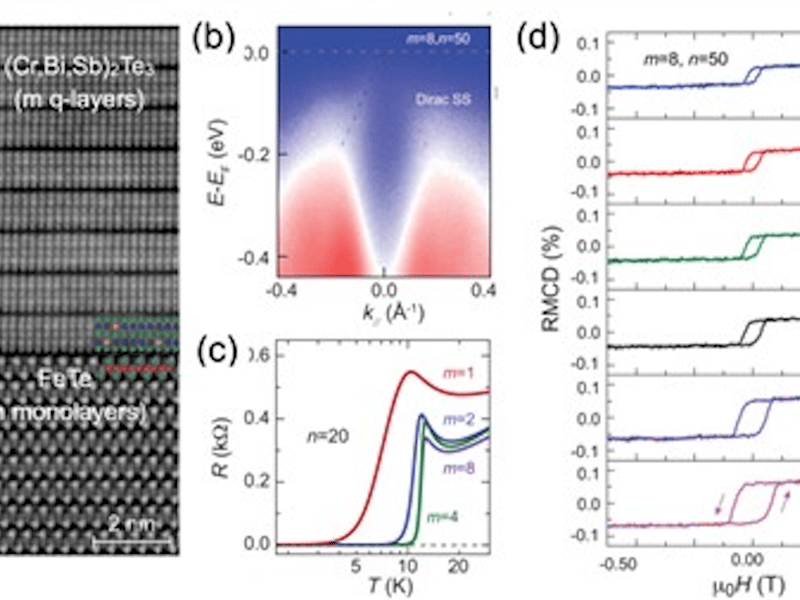
Above (a): HRTEM image of a FeTe/(Cr.Bi.Sb)2Teg heterostructure. (b)
ARPES spectrum of the sample shown in (a). (c) Resistance versus temperature in 3 samples, showing a superconducting transition. (d)
RMCD
measurements showing the presence of ferromagnetism in a
heterostructure even in the superconducting phase.
Highlight · Feb 8, 2024
Pennsylvania State University

Emergent interfacial superconductivity at the interface of topology and magnetism

Hemian Yi, Yi-Fan Zhao, Ruobing Mei, Zi-Jie Yan, Ling-Jie Zhou, Ruoxi Zhang, Zihao Wang, Stephen Paolini,, Ke Wang, Moses H. W. Chan (Penn State); Run Xiao, Anthony R. Richardella, Nitin Samarth, Chaoxing Liu, Cuizu Chang (2DCC-MIP Penn State)

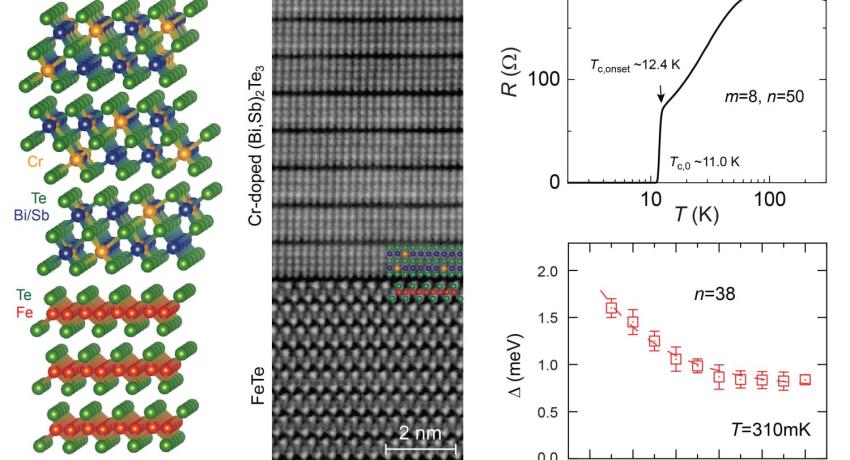
Heterogeneous interfaces that juxtapose different materials have been known to create emergent quantum phenomena. We used molecular beam epitaxy to synthesize heterostructures formed by stacking together two magnetic materials, a ferromagnetic topological insulator (Cr,Bi,Sb)2Te3) and an antiferromagnetic metal, iron chalcogenide (FeTe).
Combining materials may support unique superconductivity for quantum computing
News · Feb 8, 2024

Combining materials may support unique superconductivity for quantum computing

By Gail McCormick, Penn State
A new fusion of materials, each with special electrical properties, has all the components required for a unique type of superconductivity that could provide the basis for more robust quantum computing. The new combination of materials, created by a team led by researchers at Penn State, could also provide a platform to explore physical behaviors similar to those of mysterious, theoretical particles known as chiral Majoranas, which could be another promising component for quantum computing.
Courtesy of 2DCC News
News · Feb 8, 2024
Pennsylvania State University

Combining materials may support unique superconductivity for quantum computing

Researchers at Penn State have developed a new material fusion that demonstrates robust superconductivity, which may enhance quantum computing capabilities. This combination of magnetic materials could also aid in exploring theoretical Majorana particles, essential for topological quantum computers. Their findings were published in the journal Science.
SM3 and BioPACIFIC MIP Researchers Courtesy of BioPacific News
News · Feb 8, 2024
University of California, Santa Barbara

BioPACIFIC MIP proud to host ASU's SM3 Center for a 2-day collaboration workshop

A recent workshop between Arizona State University’s Biodesign Center and BioPACIFIC MIP focused on advancing innovation and collaboration in sustainable materials. The partnership aims to develop sustainable polymers, improve research practices, and enhance workforce development through shared interests in technology and environmental solutions, benefitting the biomaterials community.
News · Jan 19, 2024
University of California, Santa Barbara

BioPACIFIC MIP unites two UC campuses to advance a new model for materials research
Researchers at UC are repurposing alpha-lipoic acid as a monomer to create environmentally friendly polymers to replace petroleum-derived plastics. The initiative, BioPACIFIC MIP, aims to develop bioplastics that decompose quickly and with safe byproducts, while fostering collaboration and cutting-edge research in materials science and engineering.
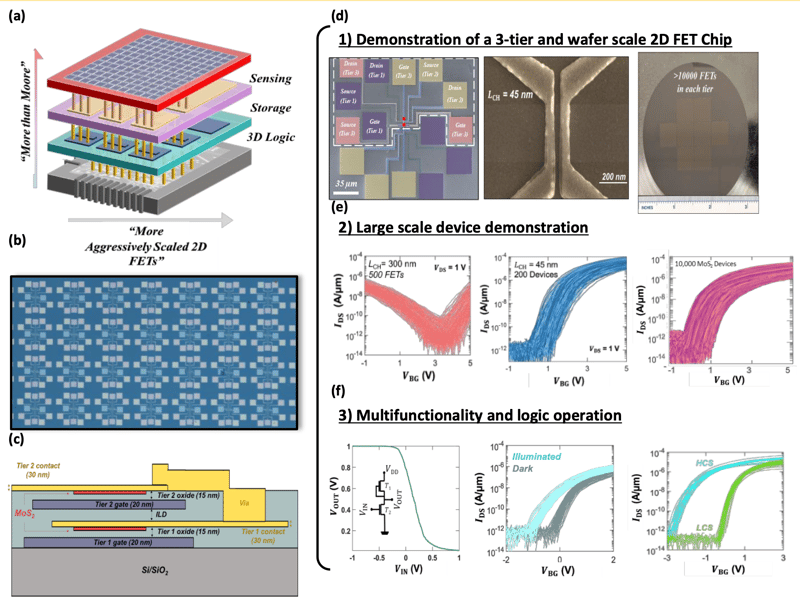
Three-dimensional integration of two-dimensional field-effect transistors