Latest News

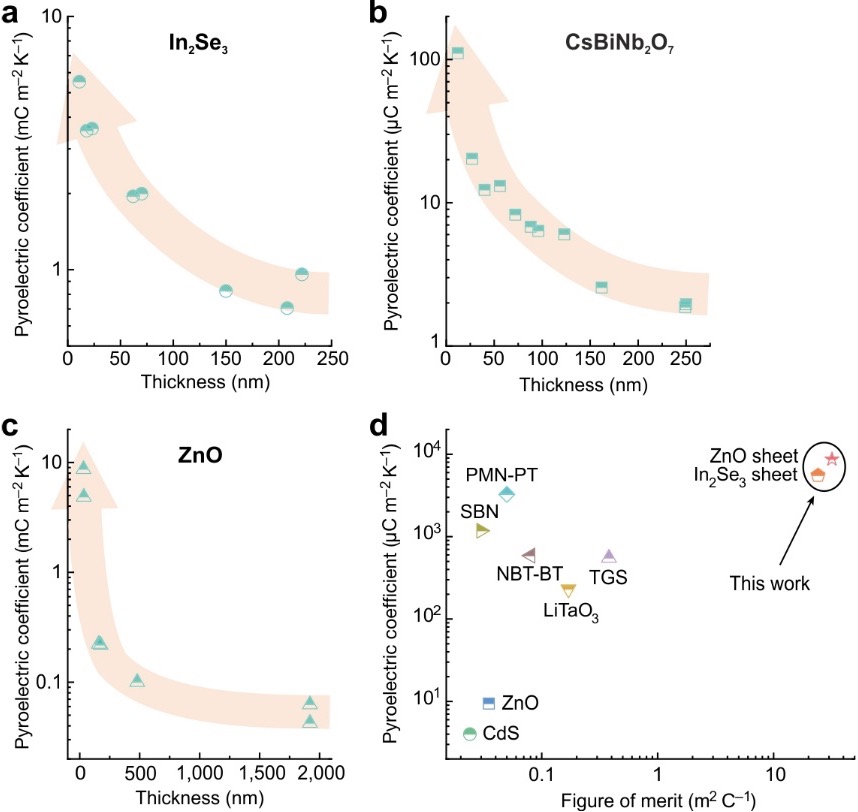
Figure: (a-c) Effective pyroelectric coefficients as a function of material thickness for In2Se3, CsBiNb2O7, and ZnO. Light orange arrows are guides for the eyes. d) Comparison of the pyroelectric coefficients and the figures of merit of In2Se3 (11 nm) and ZnO (32 nm) with those of conventional single-crystalline and epitaxial pyroelectric materials.
Highlight · Jul 20, 2022
Cornell University

Giant Pyroelectric Effect

Jian Shi (Rensselaer Polytechnic Institute)

Here, researchers from RPI came to PARADIM to characterize three model pyroelectric materials whose bonding character varies from a van der Waals material (In2Se3), to a quasi-van der Waals material (CsBiNb2O7), to an ionic/covalent material (ZnO).
Courtesy of 2DCC News
News · Jul 14, 2022
Pennsylvania State University

New type of semiconductor may advance low-energy electronics

A partnership between Penn State and MIT is developing a new semiconductor, tin selenide (SnSe), which interacts uniquely with light, promising advancements in low-energy computing and photonics. The collaboration has led to a precise fabrication process that could enhance the quality and application of 2D materials, benefiting various industries.
Nine layers of SnSe that were epitaxially grown on an a-plane sapphire substrate. Credit: Wouter Mortelmans/MIT. All Rights Reserved.
News · Jul 14, 2022

New type of semiconductor may advance low-energy electronics

A research partnership between Penn State and the Massachusetts Institute of Technology (MIT) could enable an improved method to make a new type of semiconductor that is a few atoms thin and interacts with light in an unusual way. This new semiconductor could lead to new computing and communications technologies that use lower amounts of energy than current electronics.
Prof. Craig Hawker Courtesy of BioPacific News
News · May 5, 2022
University of California, Santa Barbara

CNSI Co-director Hawker Elected to the NAS

UC Santa Barbara professors Craig Hawker, Alison Butler, and Richard Church have been elected to the National Academy of Sciences, recognizing their distinguished research contributions. Chancellor Henry T. Yang expressed pride in their achievements, highlighting the honor's significance in the scientific community.
Crystal structure of SrRuO₃ showing how orientation affects magnetic behavior. Image courtesy of PARADIM/Cornell University.
News · May 1, 2022
Cornell University

PARADIM Study Reveals New Mechanism for Switching Magnetization

By PARADIM News

Holding the right material at the right angle, Cornell researchers have discovered a strategy to switch the magnetization in thin layers of a ferromagnet—a technique that could eventually lead to the development of more energy-efficient magnetic memory devices.

News · Apr 18, 2022
University of California, Santa Barbara

Funding Opportunity: NSF Convergence Accelerator

The NSF Convergence Accelerator is offering funding for new research tracks aimed at addressing societal challenges through interdisciplinary collaboration. Proposals can be submitted via two pathways, with selected teams eligible for significant funding. Informational webinars are available to educate potential participants about the program and submission details.
PARADIM REU students capture their reflection in a polished crystal growth chamber during their summer research experience at Cornell. Image courtesy of PARADIM.
News · Apr 1, 2022
Cornell University

NSF Renews PARADIM REU Program with $621K Grant

By PARADIM News

A program designed to give undergraduate students an introductory summer research experience in materials discovery has been funded through a three-year, $621,000 grant from the National Science Foundation. The grant renews the Research Experiences for Undergraduates (REU) program and leverages the Platform for the Accelerated Realization, Analysis, and Discovery of Interface Materials (PARADIM) - a national user facility dedicated to accelerating the discovery of next-generation materials for electronics.

Zubia Hasan. Image courtesy of PARADIM.
News · Apr 1, 2022

PARADIM REU Alumna Zubia Hasan Awarded P.D. Soros Fellowship

By PARADIM News

PARADIM REU alumna and current PARADIM user Zubia Hasan has been awarded a prestigious P.D. Soros Fellowship for New Americans. This fellowship is a merit-based fellowship exclusively for immigrants and children of immigrants who are pursuing graduate school in the United States.
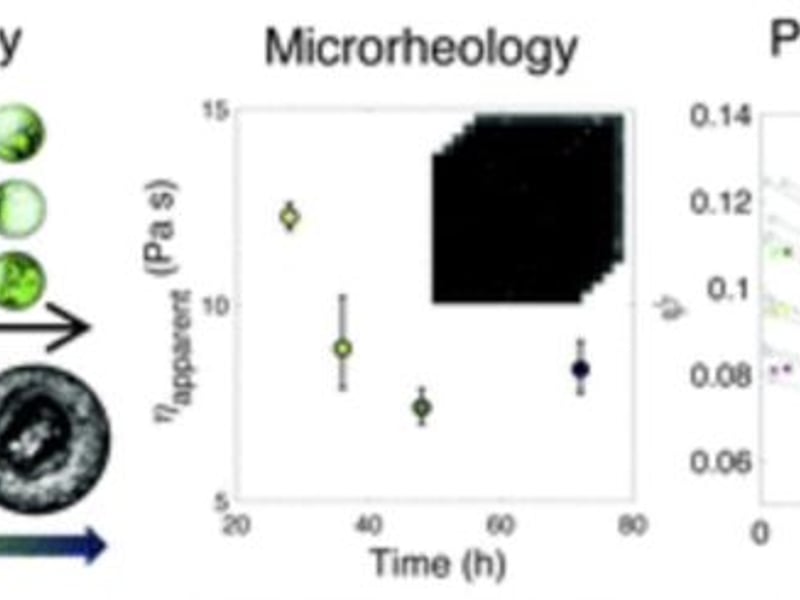
By tracking the progression of phase separation, relationships between composition and viscosity are extracted to construct a coacervate phase diagram, accelerating the multi-phase material space discovery.
Highlight · Mar 30, 2022
University of California, Santa Barbara

High-throughput microscopy to determine morphology, microrheology, and phase boundaries applied to phase separating coacervates

Yimin Luo, Mengyang Gu, Chelsea E. R. Edwards, Megan T. Valentine and Matthew E. Helgeson (UCSB)
A high-throughput characterization platform to achieve simultaneous, in situ mapping of time-evolving morphology and micro-rheology in phase separating complex fluids over a large compositional space.
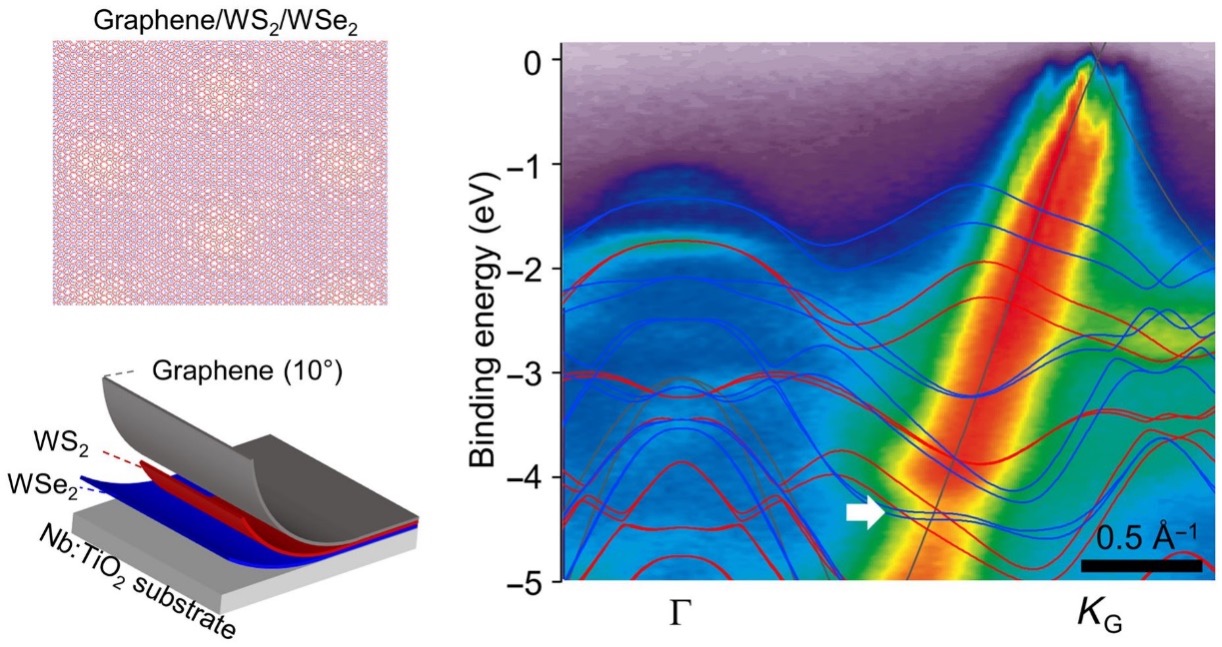
Figure: (left) Depiction of the atomic arrangement of an aligned WS2/WSe2 moiré superlattice with a graphene layer. Schematics of the assembly of a moiré superlattice sample on a Nb:TiO2 substrate, where WS2, WSe2, and graphene are represented by red, blue, and gray colors, respectively. (right) ARPES spectra with overlaid density functional theory (DFT) calculations of the band structures for individual monolayer graphene (gray), WS2 (red), and WSe2 (blue). The white arrow indicates hybridization between the graphene and transition metal dichalcogenide bands.
Highlight · Mar 25, 2022
Cornell University

Engineering Quantum Fabrics with Arbitrary Periodicities

Kyle M. Shen,Eun-Ah Kim & Jie Shan (PARADIM), Kin Fai Mak (Cornell), Eli Rotenberg & Aaron Bostwick (Advanced Light Source)

This advance points to a new approach in engineering designer quantum fabrics with arbitrary periodicities, through the coupling of a third layer to an existing moiré heterostructure.