
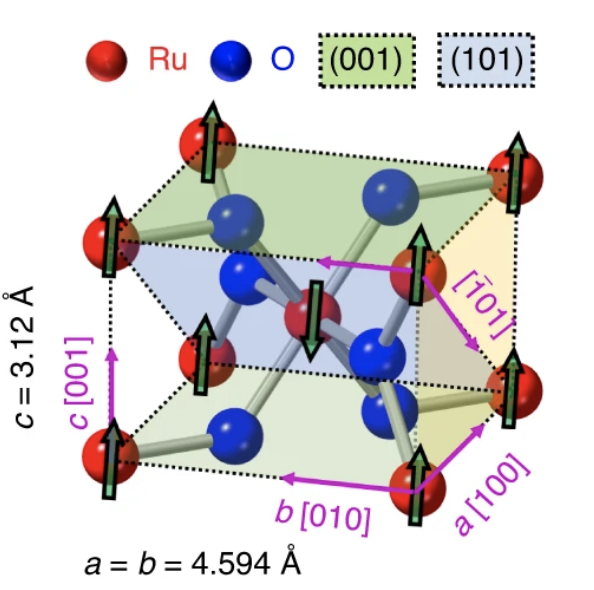
Researchers at Cornell, supported by PARADIM, have discovered that switching the orientation of a thin film of the ferromagnet SrRuO₃ can control its magnetization through a symmetry-dependent effect called spin-orbit torque. This finding, published in Nature Materials, demonstrates how the crystal orientation of a material can influence the direction and efficiency of spin current flow.
The work opens new possibilities for developing low-power magnetic memory devices by eliminating the need for external magnetic fields. “It’s the same material, but when you grow it in a different orientation, the symmetry changes how the spins behave,” said lead author John Wright.
Platform for the Accelerated Realization, Analysis, and Discovery of Interface Materials (PARADIM)
PARADIM helps users design and create new interface materials — materials that do not exist in nature — with unprecedented properties for the next generation of electronic devices. Creating new interface materials with unprecedented properties, by design rather than by serendipity, is accomplished in PARADIM through a synergistic set of user facilities dedicated to theory (figuring out where to put the atoms for useful behavior), synthesis (putting the atoms in the targeted positions), and characterization (seeing that the atoms are indeed in the desired positions).