Investigators using transmission electron microscopes (TEM) to delve into nanoscale phenomena can run up against a number of obstacles. It can be difficult to capture data on ultrafast processes. Weak signals can be difficult to detect. And some samples are susceptible to electron-beam damage.
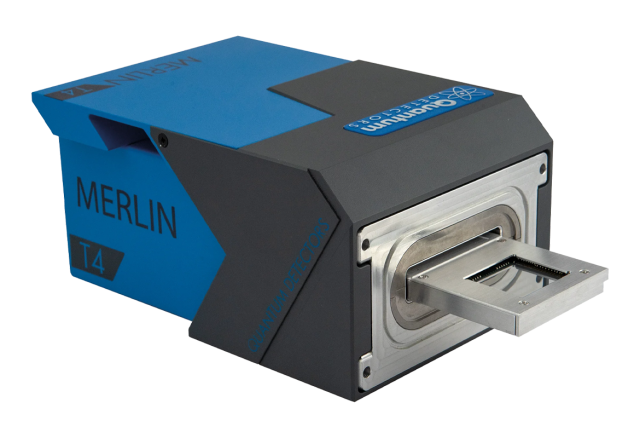
To overcome these challenges, the California NanoSystems Institute (CNSI) at UCLA has brought online the Quantum Detectors Merlin T4 hybrid pixel detector. The device offers advantages across numerous scientific applications — whether it’s mapping structures in new materials, characterizing features and defects of semiconductors or nanoparticles, or exploring beam-sensitive biomaterials, polymers, batteries or catalysts.
The Merlin T4 works in conjunction with the Thermo Fisher Scientific Spectra 300C at the National Science Foundation–funded BioPACIFIC Materials Innovation Platform. This addition extends the microscope’s capabilities for advanced diffraction, four-dimensional scanning TEM (4D-STEM), time-resolved measurements and low-dose characterization. Thanks to an event-based mode that records information about where and when each electron arrives with 200-picosecond precision, researchers gain finer control of how TEM data are reconstructed and analyzed over different time windows.