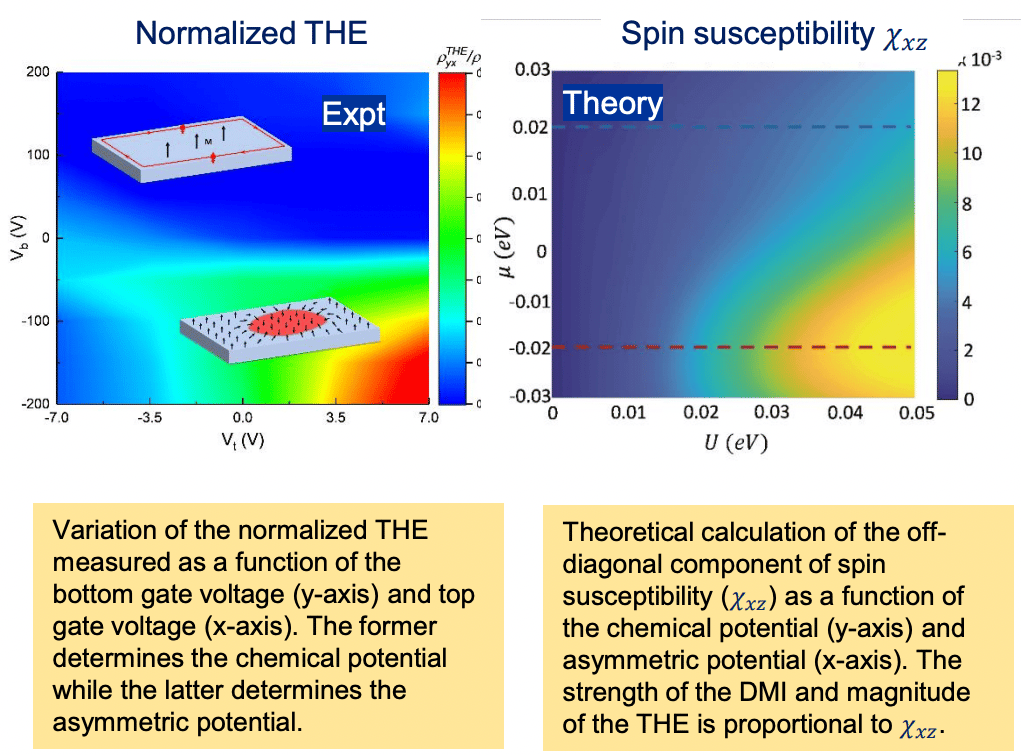
The interplay between topology in momentum space and topology in real space creates a vibrant playground for studying emergent phenomena in condensed matter physics. Topology in momentum space manifests in nontrivial band structures and is directly revealed by the quantum anomalous Hall effect (QAHE) observed in magnetically-doped topological insulators (TIs). Topology in real space is often associated with chiral magnetic spin textures in certain magnetic materials and manifests as the topological Hall effect (THE). These effects are typically only seen in separate samples engineered to have distinct characteristics. 2DCC experimentalists used molecular beam epitaxy to grow magnetic TI heterostructures (Cr-doped (Bi,Sb)2Te3 multilayers) wherein the interplay between the QAH effect and the THE could be studied in a single sample geometry. The development of a robust protocol for fabricating dual-gated devices enabled the systematic variation of the chemical potential and the asymmetric potential in these devices. This yielded a phase diagram of the interplay between the QAHE and THE. 2DCC theorists developed an analytical model for this phase diagram by evaluating the dual gate dependence of the Dzyaloshinskii-Moriya interaction (DMI) and carrier density. The excellent qualitative agreement between experiment and theory provides strong evidence for the existence of a THE in the system studied, opening a route for understanding and manipulating chiral magnetic spin textures in real space. Editor’s Suggestion in Physical Review Research (Letters) 3, L032004, 2021
 Download
Publication
Mapping the phase diagram of the quantum anomalous Hall and topological Hall effects in a dual-gated magnetic topological insulator heterostructure
Physical Review Research
View Publication

2D Crystal Consortium - Materials Innovation Platform (2DCC-MIP)
The 2DCC-MIP combines a vibrant in-house research effort focused on transformative advances in the synthesis and characterization of 2D chalcogenide layered materials with a robust external user program that provides access to expertise and state-of-the-art facilities. The 2DCC-MIP platform enables cutting edge research and discovery, across in-house research and the user program, on the synthesis and characterization of 2D chalcogenide materials by a national user community guided by four science drivers: Physics of 2D Systems, Epitaxy of 2D Chalcogenides, Next-generation 2D Electronics, and Advanced Characterization and Modeling.