
A six-year, $24.9 million grant from the U.S. National Science Foundation (NSF) will establish the Autonomous Robotic Metallurgist Materials Innovation Platform (ARM-MIP) at Texas A&M University — a national user facility where robots and artificial intelligence take on the repetitive labor of alloy discovery, freeing scientists to focus on discovery itself.
ARM-MIP will be sited at The Texas A&M University System RELLIS Campus in Bryan, a dedicated research campus that also hosts the Texas A&M Engineering Experiment Station and the U.S. Army Transformation and Training Command’s central testing hub at the George H.W. Bush Combat Development Complex. The platform is designed to reach more than 200 users a year and 50 alloys per month in its first year, scaling to more than 200 alloys per month by year six.
“The establishment of ARM-MIP at Texas A&M reinforces our role as a national leader in the research addressing critical needs for the nation,” said Texas A&M President Dr. Susan Ballabina. “By opening this facility to researchers across the United States, we are expanding access to cutting-edge capabilities while accelerating discoveries that can strengthen industries, enhance national security and improve lives.”
“Housing the ARM-MIP facility at Texas A&M positions our students and faculty to collaborate with leading metal alloy researchers from across the nation,” said Dr. Robert H. Bishop, vice chancellor and dean of Texas A&M Engineering. “Minimizing repetitive labor and maximizing time spent creating new alloys and interpreting results allows us to have an impact at scale.”
The grant will be awarded through NSF’s Materials Innovation Platforms program, the agency’s national user-facility initiative for materials research. Only four platforms exist today — for two-dimensional crystals, interface materials, bio-derived polymers and glycomaterials. ARM-MIP will be the fifth, and the first devoted to metals.
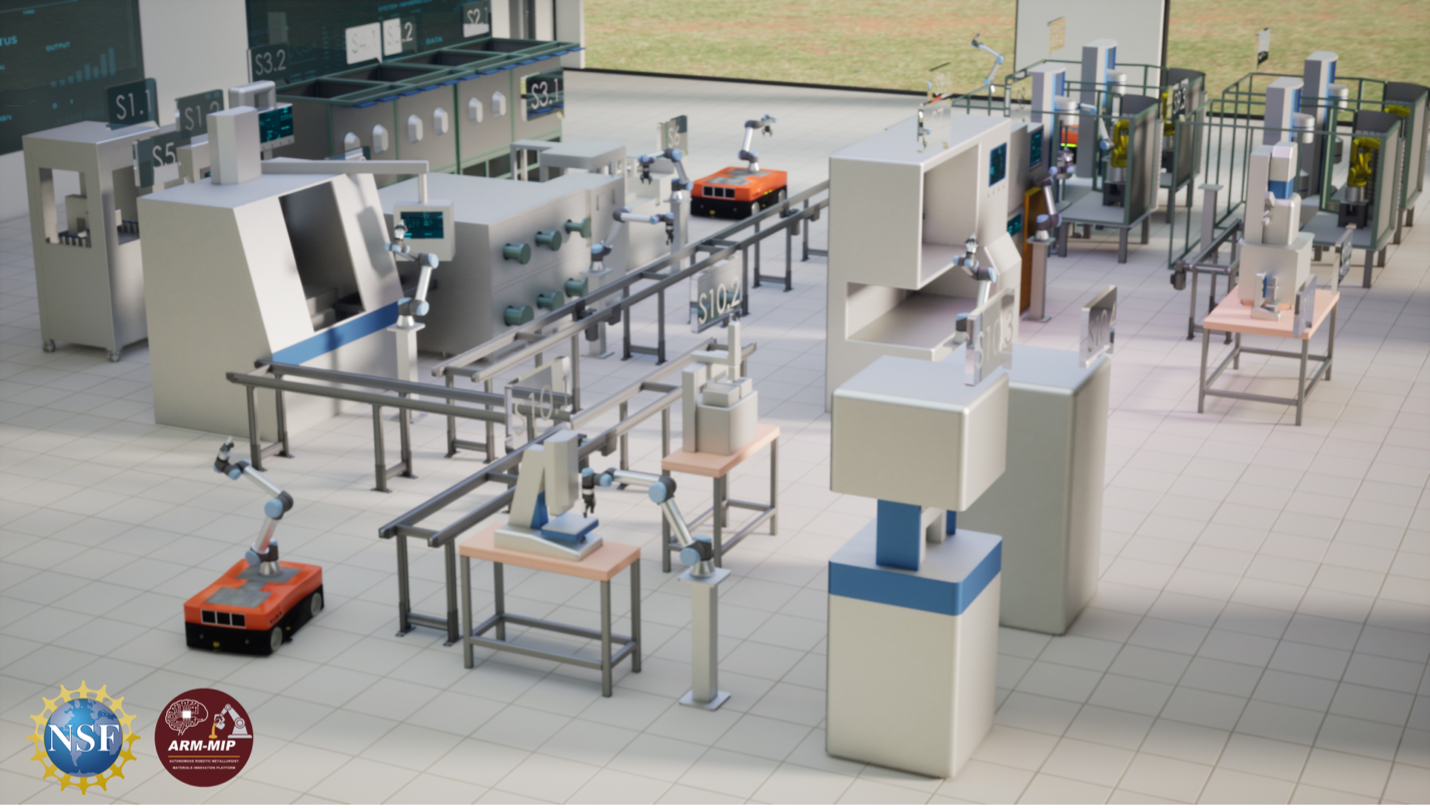

Autonomous Robotic Metallurgist Materials Innovation Platform (ARM-MIP)
ARM-MIP is an NSF-funded, open-access national user facility at Texas A&M University that designs, makes, tests, and learns from new alloys in a single autonomous laboratory, integrating robotics, artificial intelligence, physics-based simulation, and automated experimentation. Housed on the Texas A&M University System RELLIS Campus, ARM-MIP is the first MIP devoted to metals, giving researchers from universities, national laboratories, and industry hands-on and remote access to autonomous alloy discovery.