A First-of-Its-Kind Crystal Growth Method Advances Stoichiometry Control at Penn State
Jan 18, 2026
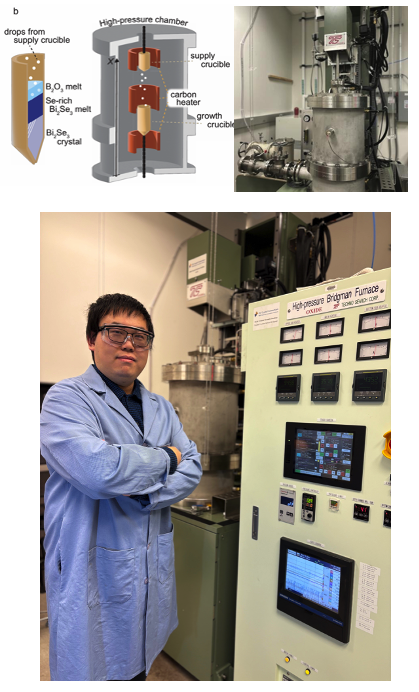
Large single crystals with precise stoichiometry control are the cornerstones of modern-day microelectronics, global positioning systems, optical communications, energy harvesting, etc. In addition, fundamental research also relies heavily on ideal single crystals to access intrinsic properties. One central challenge in crystal growth by conventional techniques such as Czochralski and Bridgman is that large, high-quality crystals can be grown only for congruent melting compositions where the solid and liquid compositions are the same. This crystallization pathway is unfortunately not common, and complex solidification by incongruent melting or solid-solution methods leads to composition gradients, precipitates, or unwanted orientations. Conventional methods such as Czochralski, Bridgman, top seeding solution growth, and traveling heater all encounter problems of non-stoichiometry and compositional gradients along the growth axis.
The 2DCC-MIP established a novel Bridgman-type growth technique, the double-crucible vertical Bridgman (DCVB) method, which can control crystal stoichiometry. Unlike conventional Bridgman growth, where crystals are grown from the melt in a single crucible moving from the hot to cold zone, the DCVB furnace employs a two-crucible geometry. This design allows for the continuous feeding of source material from an upper crucible to the growth crucible, facilitating traveling solvent growth within the Bridgman furnace. Combined with liquid encapsulation and high pressure, both of which effectively suppress the vaporization of volatile elements, this approach allows for better control of melt composition throughout the growth process. As a result, it can enable crystal growth for incongruent melting compositions and yield crystals with improved homogeneity and stoichiometry. The DCVB crystal growth technique does not exist in academia. The DCVB at Penn State is the first of its kind worldwide.
This work is supported by DOI: 10.1021/acs.cgd.5c01138