2DCC-MIP Collaboration Expands Undergraduate Research at Kenyon College
Jan 18, 2026
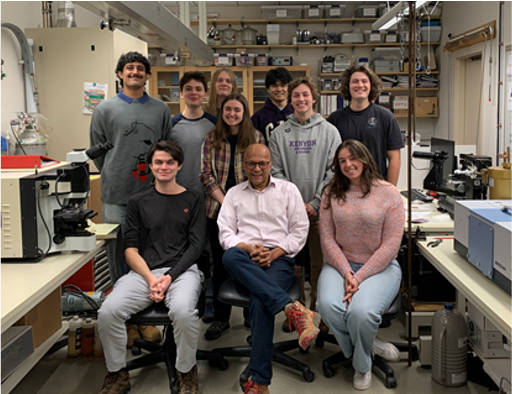
Frank Peiris, professor of physics at Kenyon College, is leveraging the capabilities of the 2D Crystal Consortium–Materials Innovation Platform (2DCC-MIP) at Penn State to engage undergraduates in cutting-edge studies of thin-film growth and electronic structure. Since 2018, Peiris and his undergraduate researchers—many of whom present at national conferences and pursue graduate study—have collaborated closely with 2DCC-MIP scientists. Approximately 90% of his group’s projects are conducted in partnership with the 2DCC-MIP, reflecting the facility’s strong support for Primarily Undergraduate Institution (PUI) researchers.
Recent collaborative work has used in-situ spectroscopic ellipsometry, integrated directly into the 2DCC-MIP’s molecular beam epitaxy system, to extract thickness-dependent dielectric functions of platinum selenide and reveal a semiconducting-to-metallic transition with increasing film thickness. In parallel, Peiris’s group has used ellipsometry-derived dielectric functions to monitor and control the growth of ternary bismuth indium selenide, enabling real-time determination of alloy composition and precise optimization of MBE growth conditions. These projects have led to multiple publications, student presentations, and new collaborations catalyzed by the 2DCC-MIP, underscoring the facility’s impact on both undergraduate research and materials discovery.
This work is supported by DOI:
10.1016/j.jcrysgro.2022.126714, 10.1116/6.0004406, 10.1016/j.jcrysgro.2024.127741, and 10.1016/j.jcrysgro.2021.126177