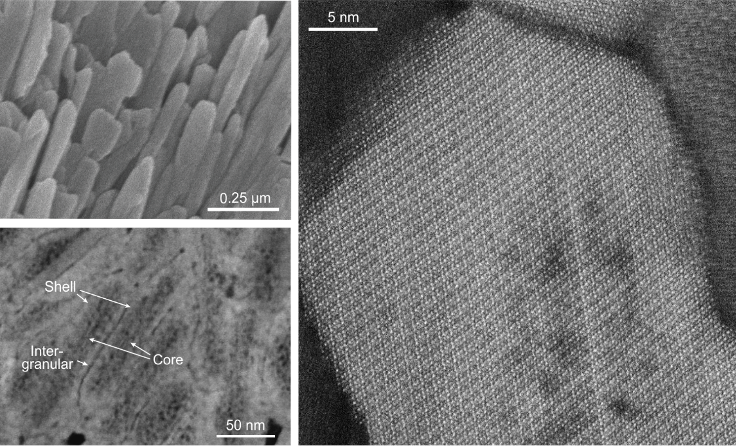
In a collaboration between Northwestern University, PARADIM’s in-house research team, and the University of Virginia, researchers have used atomic-resolution imaging to better understand the structural origins of tooth decay. The study, published in Nature, reveals nanoscale changes in the crystallinity and composition of enamel that contribute to caries formation.
The work was featured in the Cornell Chronicle article, “Smile: Atomic imaging finds root of tooth decay.” Read the full study in Nature.
Platform for the Accelerated Realization, Analysis, and Discovery of Interface Materials (PARADIM)
PARADIM helps users design and create new interface materials — materials that do not exist in nature — with unprecedented properties for the next generation of electronic devices. Creating new interface materials with unprecedented properties, by design rather than by serendipity, is accomplished in PARADIM through a synergistic set of user facilities dedicated to theory (figuring out where to put the atoms for useful behavior), synthesis (putting the atoms in the targeted positions), and characterization (seeing that the atoms are indeed in the desired positions).