
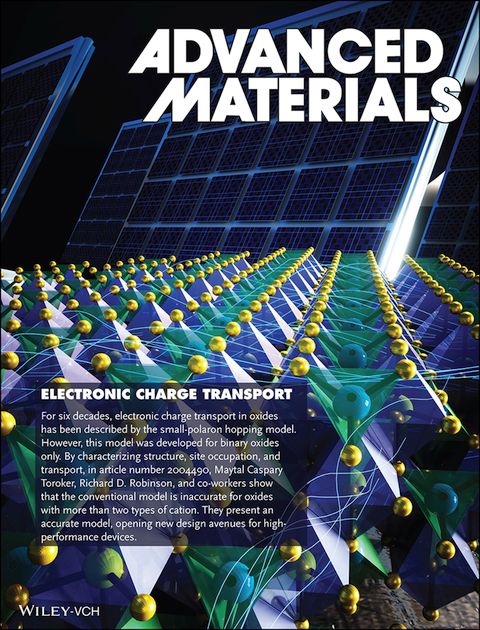
Research from a PARADIM user project has been featured on the cover of Advanced Materials (December 2020 issue). The study challenges the long-standing small-polaron hopping model by demonstrating its limitations in describing electronic transport in complex oxides with multiple cation types.
The paper, titled “Breakdown of the Small-Polaron Hopping Model in Higher-Order Spinels,” is co-authored by A. Bhargava, R. Eppstein, J. Sun, M.A. Smeaton, H. Paik, Lena Kourkoutis, Darrell Schlom, Maytal Caspary Toroker, and Richard D. Robinson.
Platform for the Accelerated Realization, Analysis, and Discovery of Interface Materials (PARADIM)
PARADIM helps users design and create new interface materials — materials that do not exist in nature — with unprecedented properties for the next generation of electronic devices. Creating new interface materials with unprecedented properties, by design rather than by serendipity, is accomplished in PARADIM through a synergistic set of user facilities dedicated to theory (figuring out where to put the atoms for useful behavior), synthesis (putting the atoms in the targeted positions), and characterization (seeing that the atoms are indeed in the desired positions).