PARADIM Users Create High-Efficiency Single-Crystal Photocathode
cornell.edu
Mar 1, 2022
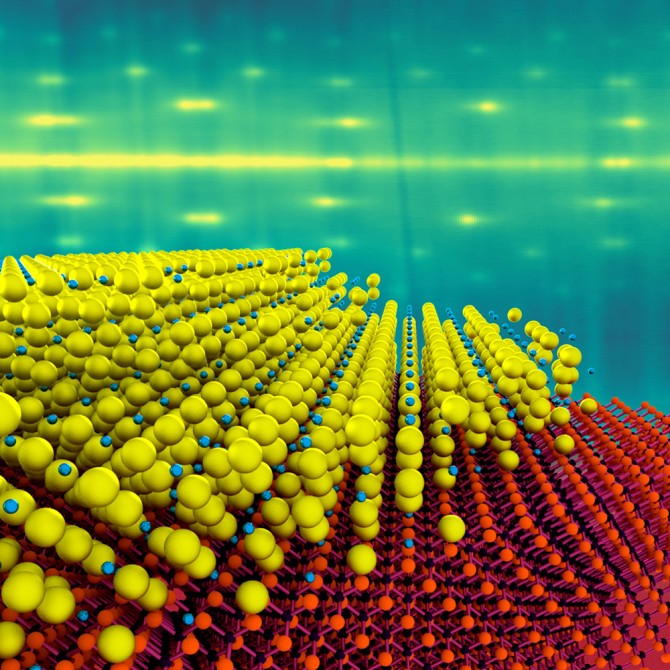
An artist’s conception of the single-crystal alkali antimonides photocathode, which is 10 times more efficient than existing photocathodes. Image credit: Christopher Parzyck; image courtesy of PARADIM.
By PARADIM News
PARADIM users affiliated with Cornell’s Center for Bright Beams, an NSF Science and Technology Center, have developed a novel method to grow single-crystal alkali antimonide photocathodes. The new technique yields materials with electron emission efficiencies up to 10 times greater than previous designs, a breakthrough for electron beam applications including ultrafast electron microscopy and advanced accelerators.
The work highlights the power of PARADIM’s synthesis platforms in enabling next-generation materials for quantum and beam science.