Novel precision glycopolymers enable fine control over interactions with carbohydrate-binding proteins

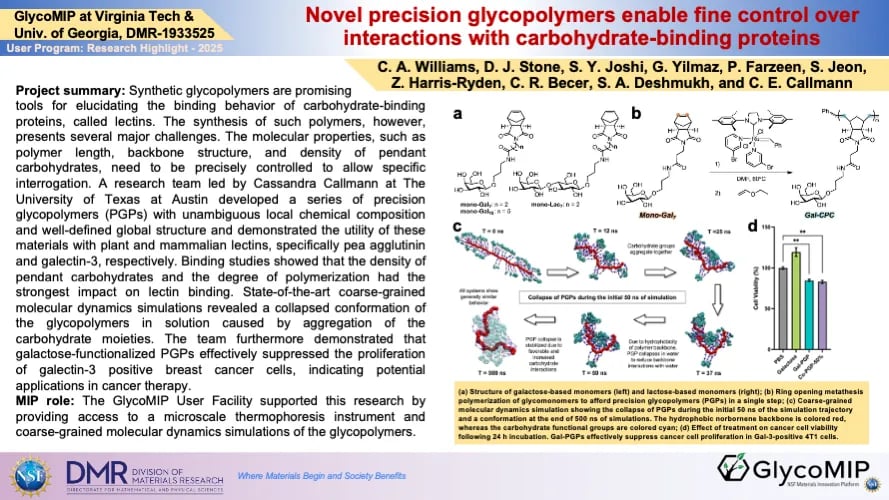
What Has Been Achieved:
A team of researchers, led by Cassandra Callmann at The University of Texas at Austin, developed a synthesis method for glycopolymers that affords precise control over polymer length, backbone structure, and density of pendant carbohydrates. The team identified the latter to be a critical factor for lectin binding with grafting densities below 50% resulting in weaker interactions.
Importance of the Achievement:
The novel synthesis method and structure-activity relationship, established in this study, enables new design strategies for lectin-binding glycopolymers for a large range of applications.
Unique Feature(s) of the MIP that Enabled this Achievement:
The research was enabled by GlycoMIP’s unique expertise and capabilities to characterize protein–carbohydrate interactions and carry out coarse grained molecular dynamics simulations of glycopolymers.
Publication:
Williams, C. A.; Stone, D. J.; Joshi, S. Y.; Yilmaz, G.; Farzeen, P.; Jeon, S.; Harris-Ryden, Z.; Becer, C. R.; Deshmukh, S. A.; Callmann, C. E. Systematic Evaluation of Macromolecular Carbohydrate-Lectin Recognition Using Precision Glycopolymers. Biomacromolecules 2024, 25(12), 7985-7994. DOI: 10.1021/acs.biomac.4c01245
External User Projects:
230103-RP Binding affinity of galactose-containing polymers to galectin-3
220909-RP Binding Affinity of Galactose-Containing Polymers to Galactose-Binding Lectins
Entire acknowledgement statement:
The authors acknowledge funding and support from GlycoMIP, a National Science Foundation Materials Innovation Platform (DMR-1933525). C.E.C. acknowledges funding support from the Cancer Prevention and Research Institute of Texas (RR210050), the Welch Foundation (F-2093- 20220331), and the American Cancer Society (IRG-21-135- 01-IRG). S.A.D., S.Y.J., and P.F. acknowledge the Advanced Research Computing Facility at Virginia Tech. The authors also thank NIH grant 1 S10 OD021508-1 for use of the Bruker AVANCE III 500 NMR at UT-Austin.